All species › Waders, gulls and terns › Jaegers and skuas › South Polar Skua
South Polar Skua | Stercorarius maccormicki
Zuidpooljager | Págalo Polar | Mandrião-do-sul
The South Polar Skua breeds farther south than almost any other bird, along the coasts of Antarctica, often near penguin colonies. After the breeding season it migrates across the oceans to the northern hemisphere, in the Pacific as far as the coasts of North America and Japan. In the guide area it is a scarce passage migrant far out at sea.
Voice
Usually silent away from the breeding grounds. At colonies hoarse, laughing and barking calls.
Recording: steve — CC BY-SA 4.0 · xeno-canto
Identification
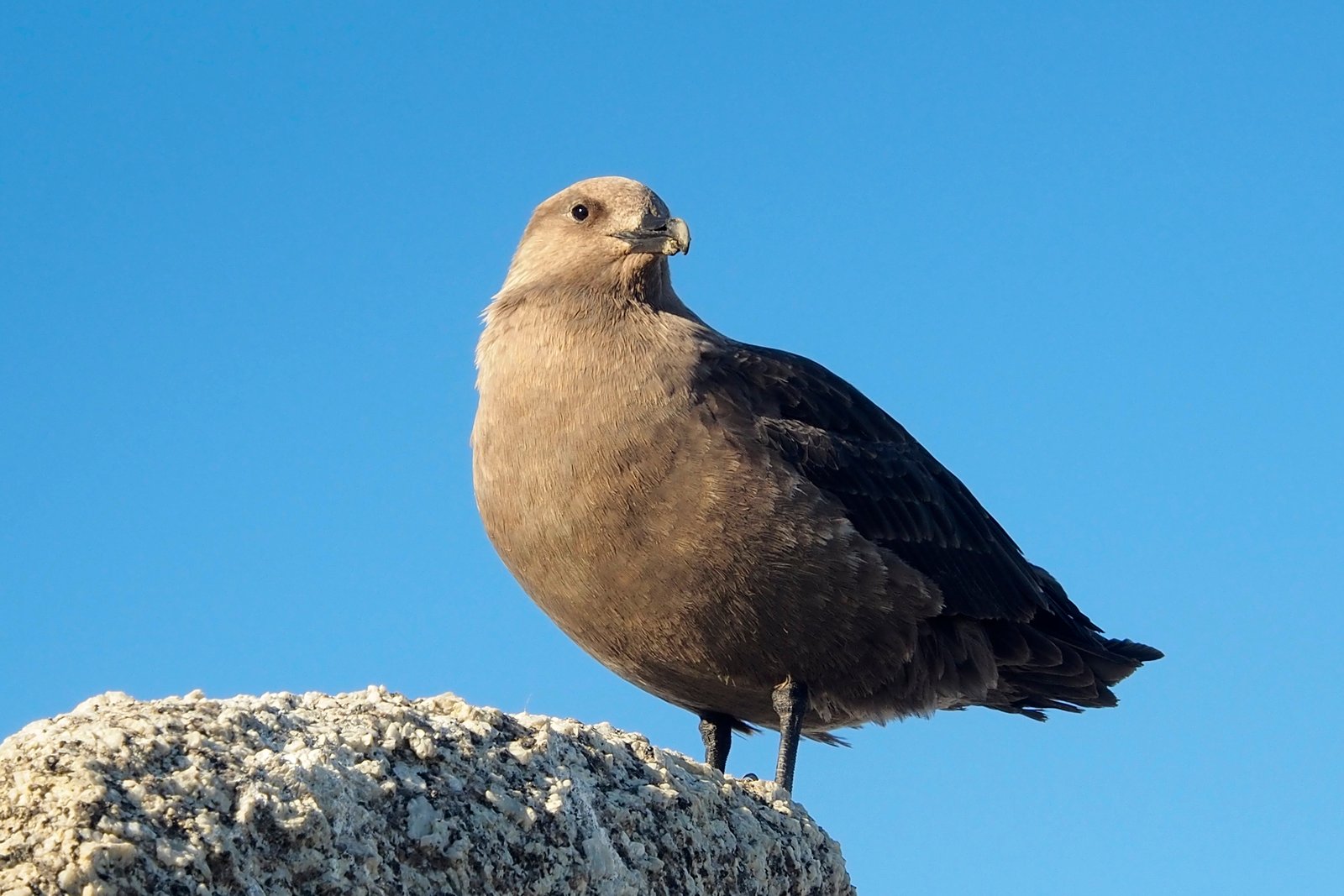
50–55 cm, a bulky, compact skua with broad wings, a short, broad tail and a heavy, blackish bill that is smaller than in other skuas. There are pale, intermediate and dark birds. Pale birds have a plain pale, greyish-buff to yellowish-brown head and underparts that contrast sharply with the blackish-brown back and wings; dark birds are plain dark greyish brown, often with fine pale streaks on the nape and a paler area around the base of the bill. All have a large white patch at the base of the primaries, above and below, and plain dark underwing coverts without cinnamon. Juveniles are plainer greyish brown, with a blue-grey base to the bill. The sexes are alike.
Confusion species
Chilean Skua Stercorarius chilensis has cinnamon underparts and underwing coverts, a dark cap and a two-toned bill with a pale base. Brown Skua Stercorarius antarcticus is larger and heavier, warmer brown with pale spots and streaks on the back and wings; in the guide area at most exceptional. Dark Pomarine Jaegers Stercorarius pomarinus are slimmer, with narrower wings, a longer tail and a smaller white wing patch.
Habitat
Open ocean, usually far offshore over deep water; occasionally in inshore waters or at fishing boats. Outside the breeding season it eats mainly fish, caught itself or stolen from other seabirds, and offal. It breeds on ice-free rocks and gravel along the coast of Antarctica, where it also takes eggs and chicks of penguins and petrels.
Where the bird is most at home, classified by the vegetation units of the Andes and the west coast.


Range and movements
Scarce passage migrant at sea off the coasts of Peru and Ecuador, on the way to and from the Antarctic breeding grounds. There are few confirmed records, partly because skuas at sea are not always identified to species. Not known from Colombia, Bolivia or the Galápagos. Breeds along the coast of Antarctica and in the austral winter migrates north across the oceans, as far as the northern Pacific and Atlantic.
How and when to look
The best chance is on pelagic trips far off the coast of Peru or Ecuador, especially around April–May and September–October. Look for large, plain greyish-brown skuas with white wing flashes among the shearwaters; photograph the underwing.
Conservation status
Least Concern. The world population is small but stable; possible threats are disturbance at research stations and changes in the Antarctic ecosystem.
Scientific name
Stercorarius maccormicki | Saunders, 1893
Saunders described the species in 1893 and placed it straight away in the genus where it still stands. The genus Stercorarius was introduced in 1760 by Brisson. The genus name is Latin stercorarius, 'of dung' (from stercus, 'dung'); food disgorged by birds chased by skuas was once thought to be excrement. The species name honours Robert McCormick (1800–1890), a British naval surgeon and naturalist on James Clark Ross's Antarctic expedition (1839–1843). The specimen the first description was based on came from Possession Island, Victoria Land, Antarctica.