All species › Waders, gulls and terns › Jaegers and skuas › Pomarine Jaeger
Pomarine Jaeger | Stercorarius pomarinus
Middelste jager | Págalo pomarino | Mandrião-pomarino
The Pomarine Jaeger is the largest and most heavily built of the three small jaegers. Adults have broad, twisted central tail feathers that project like spoons beyond the tail. On the Arctic tundra it feeds mainly on lemmings in the breeding season; in the guide area it is the most numerous jaeger offshore, often in small groups at fishing boats and seabird flocks.
Voice
Usually silent in the guide area. On the breeding grounds a hard, nasal week and barking calls.
Recording: Benjamin Drillat — CC BY-NC-SA 4.0 · xeno-canto
Identification
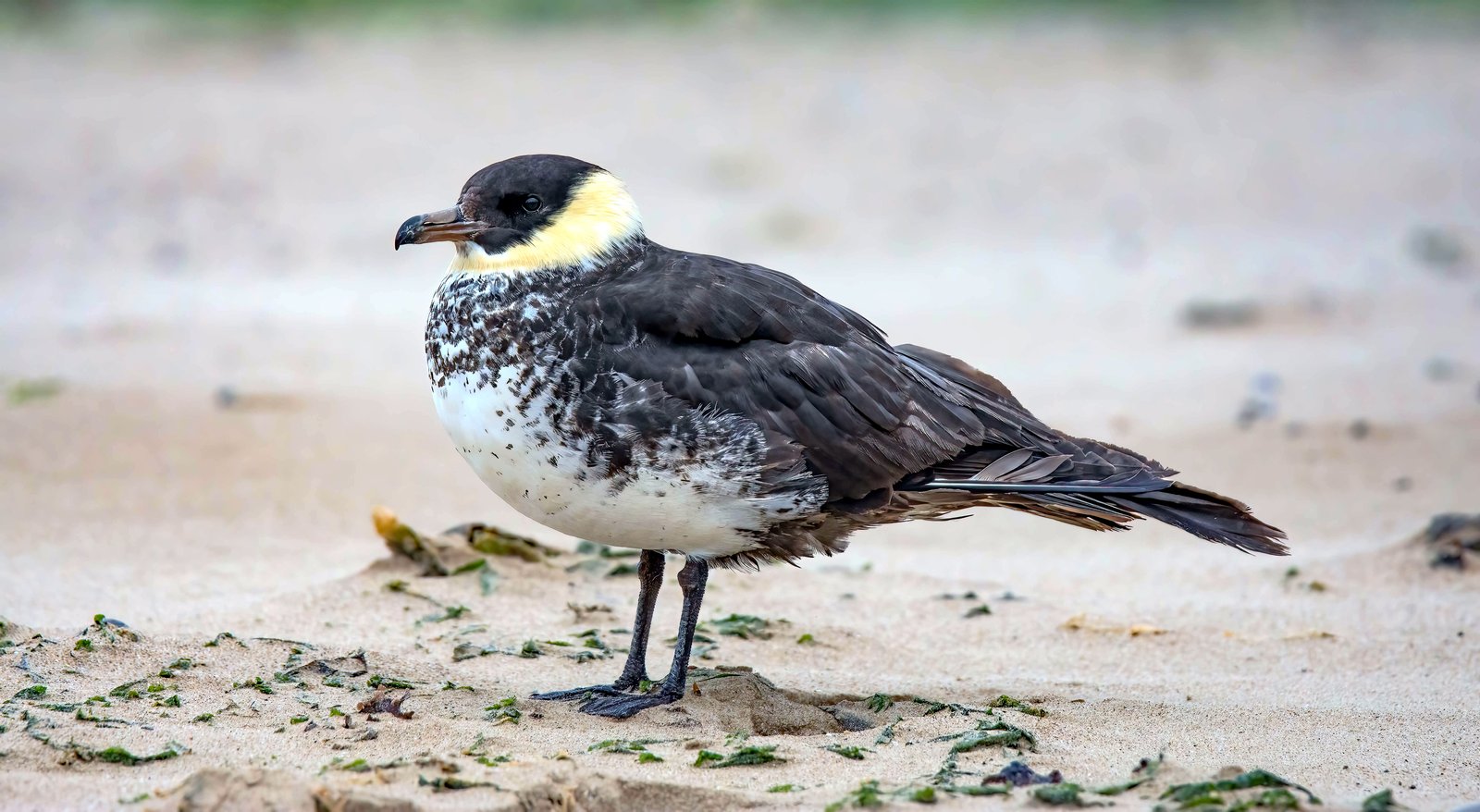
46–51 cm without the spoon-shaped central tail feathers, which project 5–11 cm beyond the tail in adults. Bulky, with a broad chest, a broad wing base and a thick, two-toned bill with a pale base and a dark tip. There are pale and less numerous dark morphs. The pale morph has a black cap extending below the bill, a yellowish neck, white underparts with a broad, mottled breast band and barred flanks; the dark morph is entirely dark blackish brown. Both have a distinct white patch at the base of the primaries. Juveniles are plain dark brown to greyish brown, without warm rufous tones, with a barred rump and underwing, a double pale patch on the underwing and short, blunt central tail feathers. The sexes are alike.
Confusion species
Parasitic Jaeger Stercorarius parasiticus is smaller and slimmer, with a thinner bill, pointed central tail feathers and a faster, more agile flight; juveniles are usually warmer rufous-brown. Long-tailed Jaeger Stercorarius longicaudus is much slimmer and lighter, with very long, thin tail streamers. Chilean Skua Stercorarius chilensis and South Polar Skua Stercorarius maccormicki are larger and broader-winged, with a short tail without elongated feathers and a large white wing patch; dark Pomarine Jaegers without tail projections can resemble them, but are slimmer and longer-tailed.
Habitat
Inshore waters and open ocean, especially over the cold, fish-rich water of the Humboldt Current and along the continental shelf; more often far offshore than Parasitic Jaeger, but also seen from land. It steals fish from gulls, terns and shearwaters, catches fish itself and eats discards from fishing boats; it sometimes kills smaller birds. It does not breed in the guide area; the nest is a scrape on the Arctic tundra.
Where the bird is most at home, classified by the vegetation units of the Andes and the west coast.


Range and movements
In Peru and Ecuador a fairly common winter visitor and passage migrant off the whole coast, at sea and sometimes visible from land; also regular in the waters around the Galápagos. In Colombia off the Pacific coast and in smaller numbers off the Caribbean coast. Some immatures stay all year. Not in Bolivia. Breeds on the Arctic tundra of North America and Asia and winters on tropical and subtropical seas.
- Summer visitor (c. Apr–Sep)
- Winter visitor (c. Oct–Mar)
- Passage (Mar–Apr, Oct–Nov)
- dark = core range, pale = thinly spread
How and when to look
On pelagic trips from Peru and Ecuador between October and April, often in small groups at fishing boats and seabird flocks. From headlands along the coast they sometimes pass low over the sea.
Conservation status
Least Concern. Breeding success depends strongly on lemming numbers; at sea the species is sensitive to oil pollution and to fluctuations in fish stocks during El Niño.
Scientific name
Stercorarius pomarinus | (Temminck, 1815)
Temminck described the species in 1815 as Lestris pomarinus; because it was later moved to another genus, the author and year stand in brackets. The genus Stercorarius was introduced in 1760 by Brisson. The genus name is Latin stercorarius, 'of dung' (from stercus, 'dung'); food disgorged by birds chased by skuas was once thought to be excrement. The species name is a corruption of pomatorhinus, from Greek pōma, 'lid', and rhis, 'nose', after the horny plate over the nostrils. The specimen the first description was based on came from Arctic Europe.