All species › Waders, gulls and terns › Jaegers and skuas › Long-tailed Jaeger
Long-tailed Jaeger | Stercorarius longicaudus
Kleinste jager | Págalo rabero | Mandrião-de-cauda-comprida
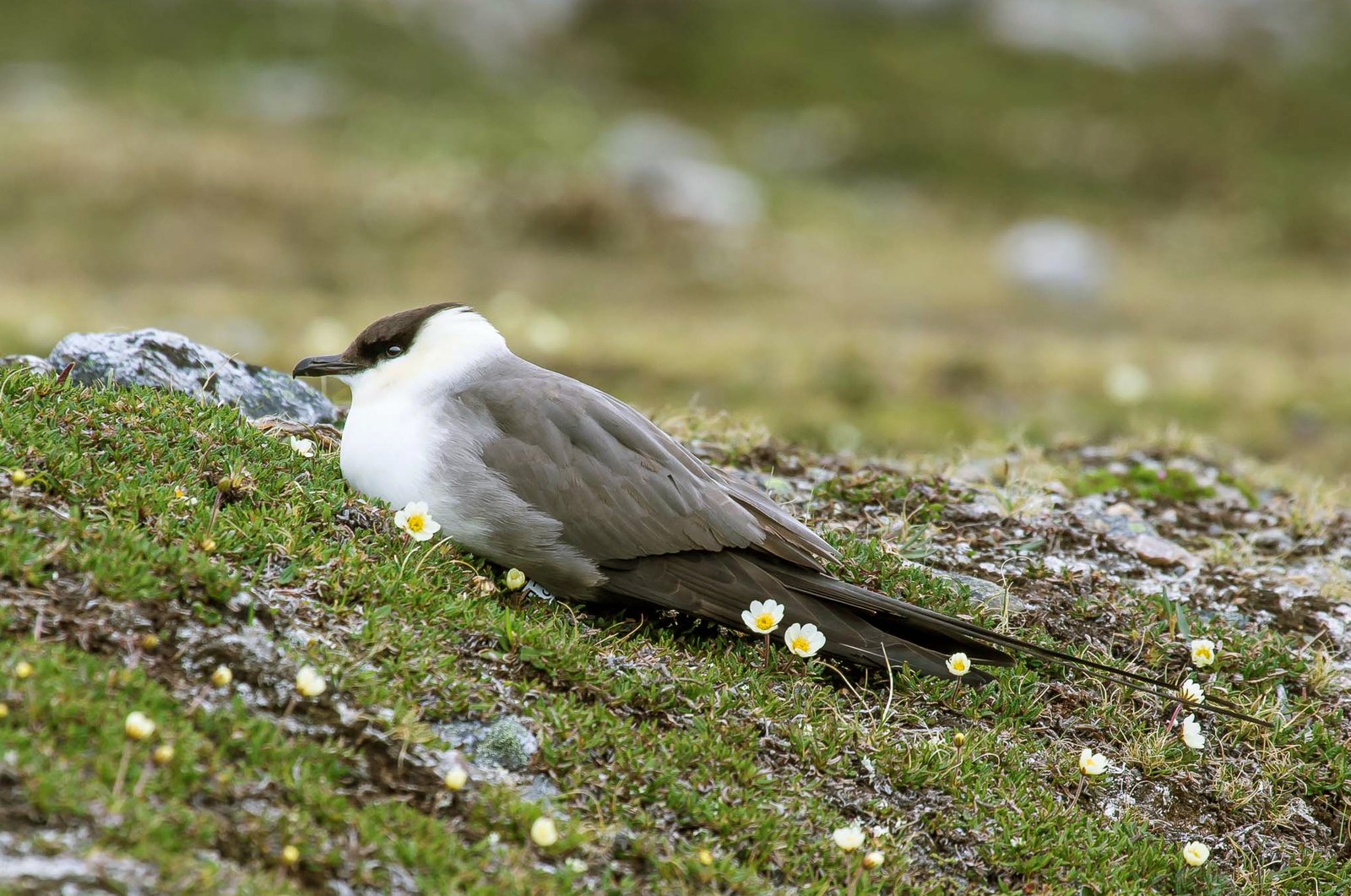
The Long-tailed Jaeger is the slimmest jaeger and the one most tied to the open sea. Adults have very long, thin central tail feathers that trail behind the bird like a streamer. On the Arctic tundra it feeds largely on lemmings in the breeding season; afterwards it migrates across the open ocean to the southern hemisphere and in the guide area usually stays far offshore.
Voice
Usually silent in the guide area. On the breeding grounds a shrill, rattling kreek-kreek and plaintive calls.
Recording: Stanislas Wroza — CC BY-NC-SA 4.0 · xeno-canto
Identification
48–53 cm, of which the central tail feathers of the adult project 14–20 cm beyond the tail; without them 35–41 cm. Lightly and slimly built, with narrow wings, a short bill and a light, tern-like flight. Adults are almost always pale: a black cap, a yellowish neck, a white breast that becomes grey towards the rear, and grey upperparts on which the pale grey wing coverts contrast with the black flight feathers. Only two white shafts on the outer primaries and no white patch on the underwing. In non-breeding plumage the cap is less sharply defined and the flanks are barred. Juveniles are cold greyish brown to almost black, often with a pale, greyish head, boldly black-and-white barred undertail coverts and underwing and short, blunt central tail feathers. The sexes are alike.
Confusion species
Parasitic Jaeger Stercorarius parasiticus is bulkier, with warmer brown tones, three to five white shafts, a white patch on the underwing and shorter, pointed central tail feathers; adult Long-tailed Jaegers without streamers in moult resemble a Parasitic Jaeger, but show the contrast between grey coverts and black flight feathers. Pomarine Jaeger Stercorarius pomarinus is much larger and heavier, with a broad chest, a thick bill and broad, spoon-shaped central tail feathers. Juveniles of the three small jaegers are very similar; note structure, the number of white shafts and the cold greyish-brown colour.
Habitat
Open ocean, usually far offshore over deep water and along the edge of the continental shelf; rarely in inshore waters. It picks fish, squid and offal from the surface and chases other seabirds less often than the other jaegers. It rests on the water. It does not breed in the guide area; the nest is on Arctic tundra and fell.
Where the bird is most at home, classified by the vegetation units of the Andes and the west coast.


Range and movements
Passage migrant and winter visitor at sea off the coast of Peru, especially in the south, and in smaller numbers off Ecuador and the Pacific coast of Colombia. Almost only recorded far offshore; not regularly reported from the Galápagos. Not in Bolivia. Breeds around the North Pole and winters mainly at sea in the cold currents off south-western South America and southern Africa.
- Winter visitor (c. Oct–Mar)
- Passage (Mar–Apr, Oct–Nov)
- dark = core range, pale = thinly spread
How and when to look
Join a pelagic trip that goes far enough offshore, for instance from Lima or Pucusana in Peru, especially in October–November and April–May, the months of passage. Look for slim, grey jaegers with a light flight low over the waves.
Conservation status
Least Concern. Breeding success varies strongly with lemming numbers; no major threats are known at sea.
Scientific name
Stercorarius longicaudus | Vieillot, 1819
Vieillot described the species in 1819 and placed it straight away in the genus where it still stands. The genus Stercorarius was introduced in 1760 by Brisson. The genus name is Latin stercorarius, 'of dung' (from stercus, 'dung'); food disgorged by birds chased by skuas was once thought to be excrement. The species name comes from Latin longus, 'long', and cauda, 'tail'. The specimen the first description was based on came from Northern Europe.