All species › Parrots › African and New World parrots › Brown-throated Parakeet
Brown-throated Parakeet | Eupsittula pertinax
Maïsparkiet | Perico carisucio | Periquito-de-bochecha-parda
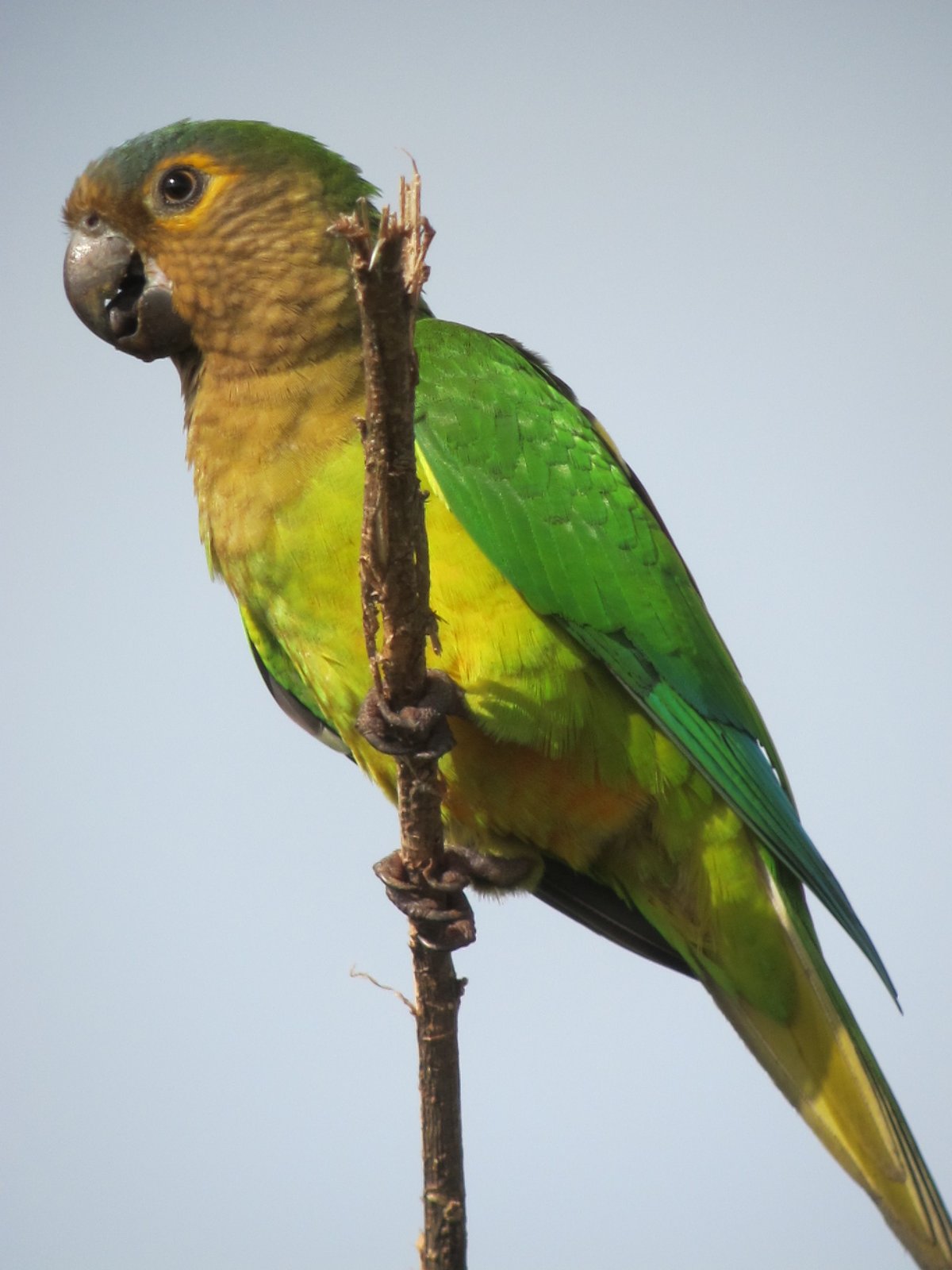
In the guide area the Brown-throated Parakeet is a parakeet of the dry, open lowlands of northern and eastern Colombia. Flocks move with loud chattering through scrub, savanna and farmland and often come into villages and gardens. The species has many subspecies, which differ mainly in the colour of the face.
Voice
Shrill, rolling calls, such as kree-kree, in flight; continuous chattering while feeding.
Recording: JAYRSON ARAUJO DE OLIVEIRA — CC BY-NC-SA 4.0 · xeno-canto
Identification
23–25 cm, with a long, pointed tail and a dark, greyish bill. The plumage is green. The face, throat and breast are olive-brown to greyish brown; around the eye is a narrow pale ring with a few orange or yellow feathers. The crown is bluish green, and the belly is yellowish green. The primaries are bluish. The sexes are alike.
Confusion species
Orange-chinned Parakeet Brotogeris jugularis is smaller, with a short, pointed tail, an orange chin spot and brown shoulders. Scarlet-fronted Parakeet Psittacara wagleri is larger, with a red forehead and a pale bill, and lives mainly on the slopes. Chestnut-fronted Macaw Ara severus is much larger, with a bare white face and reddish-brown underwings.
Habitat
Dry scrub, cactus scrub, savanna with woodlots, forest edges, mangrove and farmland with trees, also villages and gardens, mainly in the lowlands up to roughly 1200 m. It eats seeds, fruit, flowers and maize. It nests in a cavity in an arboreal termite nest.
Where the bird is most at home, classified by the vegetation units of the Andes and the west coast.


Range and movements
In Colombia in the dry Caribbean lowlands, around the Sierra Nevada de Santa Marta, on the Guajira Peninsula, in the Magdalena Valley and in the llanos east of the Andes. Absent from Ecuador, Peru, Bolivia and the Galápagos. Outside the guide area in Panama, Venezuela, the Guianas, northern Brazil and the Antilles.
- Resident
- dark = core range, pale = thinly spread
How and when to look
Along the Caribbean coast of Colombia, around Santa Marta and in La Guajira, and in the llanos of Casanare and Meta. Flocks often come to fruiting trees in villages.
Conservation status
Least Concern. The species is common and tolerates farmland; locally birds are captured for the cage-bird trade.
Scientific name
Eupsittula pertinax | (Linnaeus, 1758) (GBIF: Aratinga pertinax)
Linnaeus described the species in 1758 as Psittacus pertinax; because it was later moved to another genus, the author and year stand in brackets. The genus Eupsittula was introduced in 1853 by Bonaparte. The genus name comes from Greek eu, 'good, fine', and Latin psittula, a diminutive of psittacus, 'parrot': 'true little parrot'. The species name is Latin pertinax, 'tenacious, persistent'. The specimen the first description was based on came from Curaçao.