All species › Parrots › African and New World parrots › Blue-and-yellow Macaw
Blue-and-yellow Macaw | Ara ararauna
Blauwgele ara | Guacamayo azuliamarillo | Arara-canindé
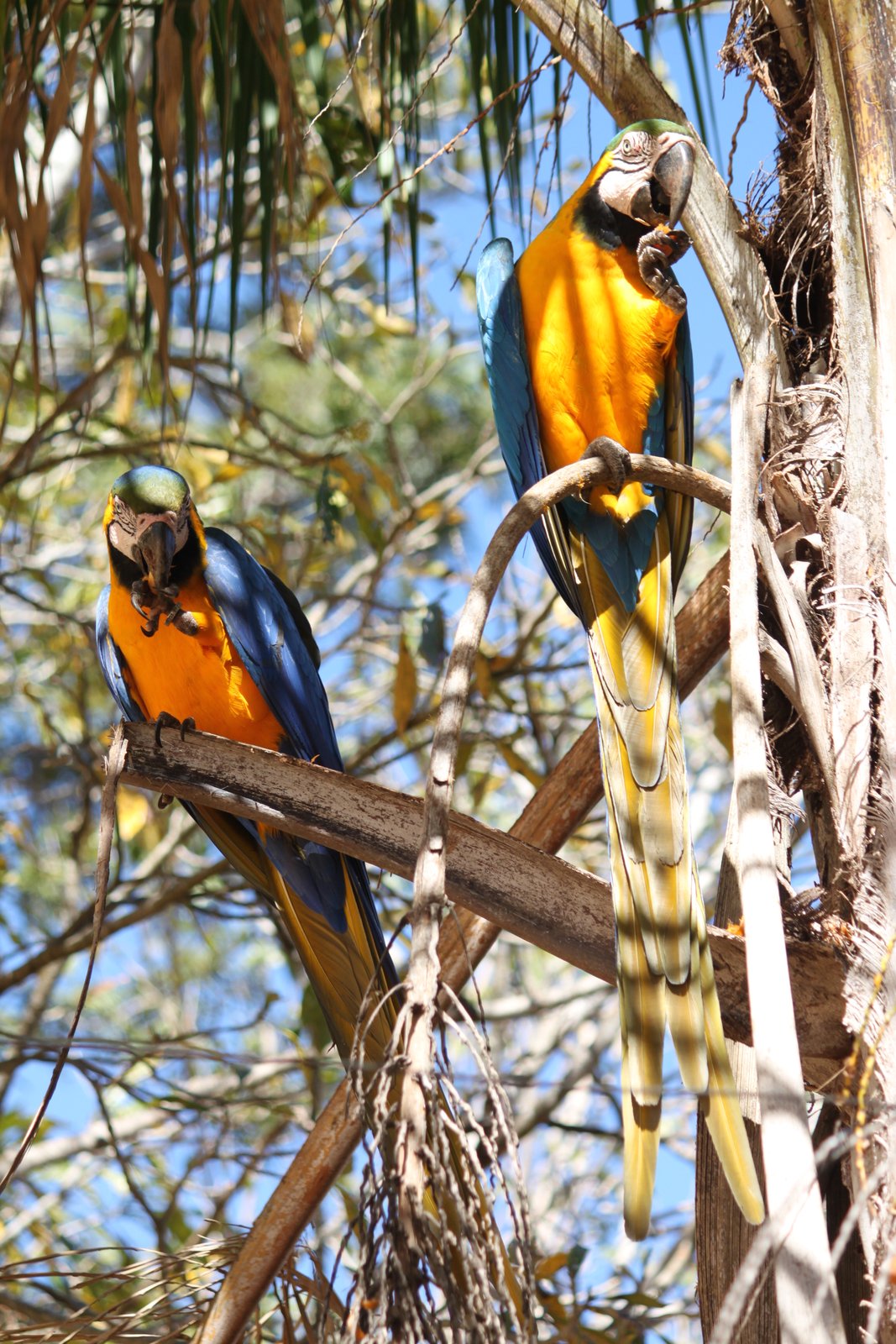
The Blue-and-yellow Macaw is a large, long-tailed parrot, bright blue above and golden yellow below. In the guide area it lives in the Amazonian lowlands east of the Andes, especially in and around swamps with moriche palms. Pairs fly close together over the forest, with slow, deep wingbeats, screeching loudly.
Voice
Loud, raucous, harsh screeches, mainly in flight; slightly lower and less shrill than those of the other large macaws.
Recording: JAYRSON ARAUJO DE OLIVEIRA — CC BY-NC-SA 4.0 · xeno-canto
Identification
81–86 cm, with a long, pointed tail and a heavy, black, hooked bill. The upperparts, wings and tail are bright blue, and the forehead is green. The underparts are golden yellow to orange-yellow. The bare white face has narrow lines of tiny black feathers, and the throat is black. The underside of the wings and tail is yellow. The sexes are alike.
Confusion species
Blue-throated Macaw Ara glaucogularis is slightly smaller, with a blue instead of black throat, a blue forehead and thicker blue feather lines on the face; it lives only in the savannas of the Beni in Bolivia, where the two species can occur together. Elsewhere in the guide area the Blue-and-yellow Macaw is unmistakable.
Habitat
Swamp forest with moriche palms, Mauritia flexuosa, flooded forest along rivers, the edges of terra firme forest and forest islands in seasonally flooded savanna, mainly below 500 m. It eats fruit, nuts and seeds, including palm fruit. It visits clay banks along rivers. It nests preferably in the hollow trunk of a dead palm.
Where the bird is most at home, classified by the vegetation units of the Andes and the west coast.


Range and movements
In the Amazonian lowlands east of the Andes. In Colombia in the east of the country. In Ecuador and Peru in the Amazonian lowlands. In Bolivia in the northern and central lowlands, including the savannas of the Beni. Absent from the Galápagos. Outside the guide area in eastern Panama, Venezuela, the Guianas, Brazil and Paraguay.
- Resident
- dark = core range, pale = thinly spread
How and when to look
At palm swamps in the Amazonian lowlands, where pairs and groups fly to their roost at dusk, and at the clay licks along the rivers of south-eastern Peru. Flying birds can be recognised from afar by the contrast of blue and yellow.
Conservation status
Least Concern. Declining locally through capture for the cage-bird trade and the felling of moriche palms, but still fairly common in large parts of Amazonia.
Scientific name
Ara ararauna | (Linnaeus, 1758)
Linnaeus described the species in 1758 as Psittacus Ararauna; because it was later moved to another genus, the author and year stand in brackets. The genus Ara was introduced in 1799 by De Lacépède. The genus name comes from Tupi ará, 'macaw', an onomatopoeia of these birds' call. The species name comes from the Tupí name arára úna, 'big dark parrot', a name for the Hyacinth Macaw. The specimen the first description was based on came from Pernambuco, Brazil.