All species › Swifts › Hummingbirds › Brown Violetear
Brown Violetear | Colibri delphinae
Bruine violetoorkolibrie | Colibrí pardo | Beija-flor-marrom
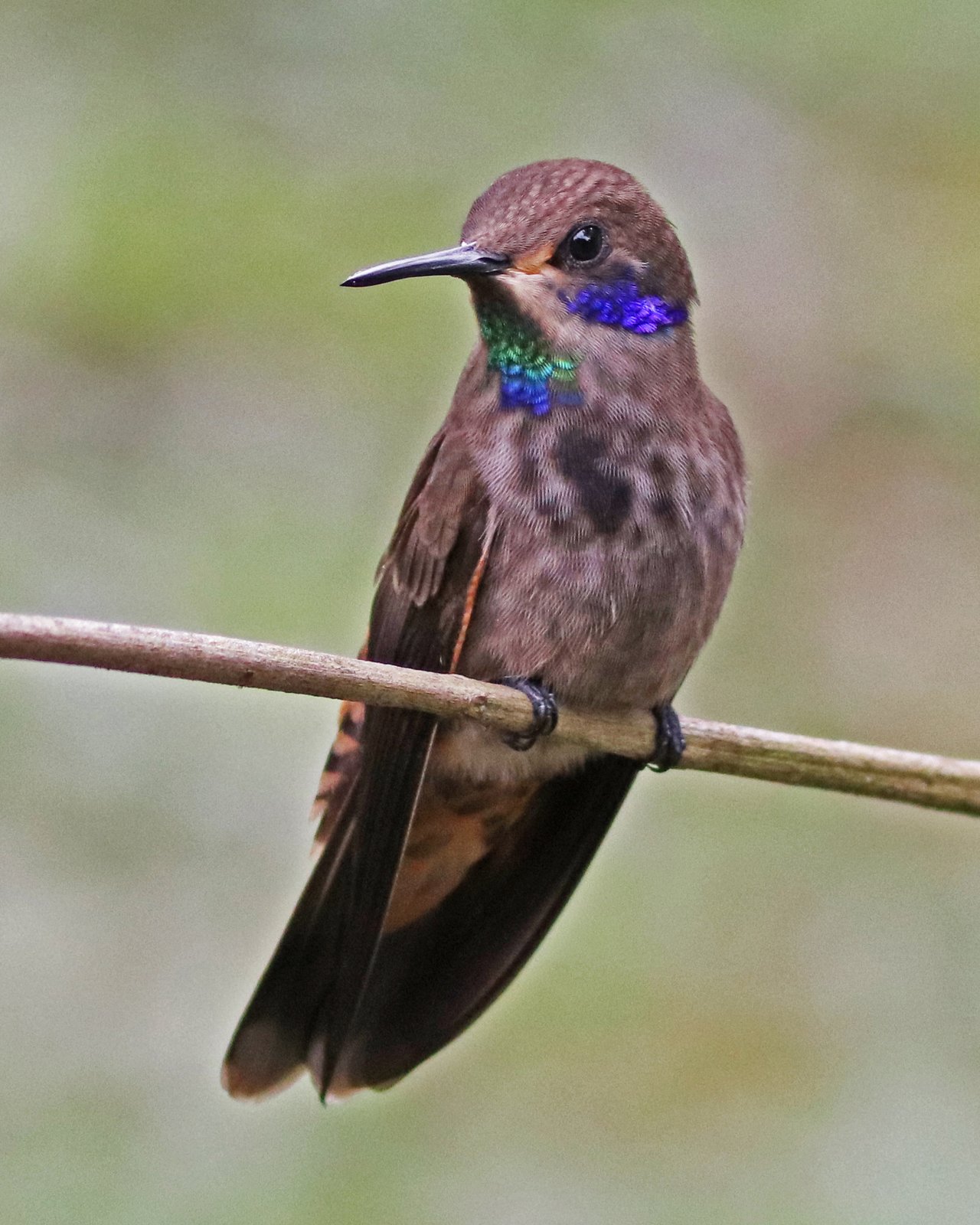
The Brown Violetear is a medium-sized, greyish brown hummingbird with a violet ear patch and a glittering throat patch, found at forest edges and in open woodland on the lower slopes. It is widespread and wanders to flowering trees, so that at one site it may be numerous at times and absent at others. The males sing in small groups at fixed sites.
Voice
The males sing in loose groups an endlessly repeated series of dry, scratchy chipping notes from a perch in the middle level of the forest. The call is a dry tchit.
Recording: Juan Freile — CC BY-NC-SA 4.0 · xeno-canto
Identification
11–12 cm, with a short, straight black bill. Dull greyish brown above and below, with a violet-blue patch behind the eye and a glittering green to blue patch in the centre of the throat. A pale buff malar stripe frames the throat. The rump has rufous edges. The tail is bronzy with a dark subterminal band. The sexes are nearly alike. Young birds have more rufous edging and a smaller throat patch.
Confusion species
Hardly confusable because of the greyish brown colour with a violet ear patch. Brown Inca Coeligena wilsoni is also brown, but has a much longer bill and white patches on the sides of the breast, without a violet ear patch. Hermits such as Green Hermit Phaethornis guy have a long, decurved bill and a striped face.
Habitat
Edges of humid forest, open and secondary woodland, plantations with shade trees such as coffee, and clearings with flowering trees, mostly between about 400 and 1800 m, locally up to 2500 m and lower. It often visits flowering trees, such as Inga and Erythrina, high in the canopy, as well as lower flowers and feeders. It also catches insects in flight.
Where the bird is most at home, classified by the vegetation units of the Andes and the west coast.


Range and movements
In Colombia on the slopes of all three cordilleras, on the Pacific side and in the Sierra Nevada de Santa Marta. In Ecuador on both slopes of the Andes. In Peru along the eastern slope of the Andes. In Bolivia on the eastern slope of the Andes. Absent from the Galápagos. Outside the guide area from Guatemala and Belize through Central America to Venezuela, Trinidad, the Guianas and locally in Brazil.
- Resident
- dark = core range, pale = thinly spread
How and when to look
At lodge feeders on the lower slopes and in shade-coffee plantations. A group of singing males can be found by listening for the repeated chipping; birds then often sit on a bare branch in the middle level.
Conservation status
Least Concern. The species has a large range and also uses forest edges, secondary woodland and plantations.
Scientific name
Colibri delphinae | (Lesson, 1839)
Lesson described the species in 1839 as Ornismya Delphinae; because it was later moved to another genus, the author and year stand in brackets. The genus Colibri was introduced in 1824 by Spix. The genus name is the French word colibri, 'hummingbird'; the further origin of that word is uncertain, possibly from a Caribbean language. The species name probably refers to Delphine d'Albémar, the tragic heroine of Madame de Staël's novel 'Delphine' (1802); Lesson himself gave no explanation. The specimen the first description was based on came from Bogotá, Colombia.