All species › Swifts › Hummingbirds › Lesser Violetear
Lesser Violetear | Colibri cyanotus
Kleine violetoorkolibrie | Colibrí oreja violeta menor | Beija-flor-de-orelha-violeta-pequeno
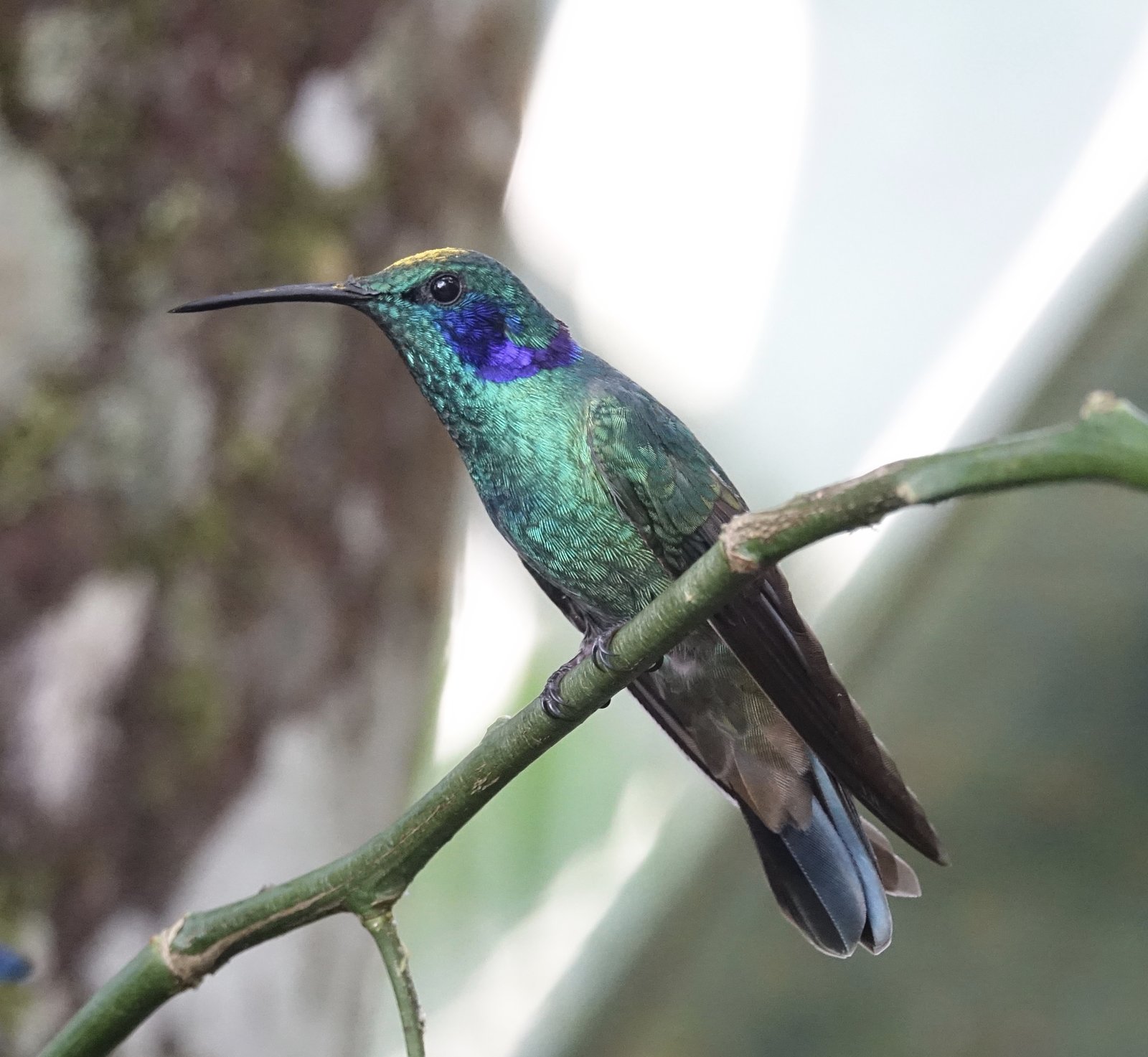
The Lesser Violetear is a green hummingbird with a violet-blue ear patch, found at forest edges, in clearings and in gardens at middle elevations in the Andes. It was formerly treated as one species together with the Mexican form. The male sings for hours from an open branch.
Voice
The song is an endlessly repeated series of dry, metallic notes, such as chip-chip, chip-chip, given from an open perch, often throughout the year. The call is a dry tchit.
Recording: Johan Chaves — CC BY-NC-SA 4.0 · xeno-canto
Identification
10–11 cm, with a straight black bill of medium length. Glittering green, with a violet-blue patch from below the eye to the ear coverts that does not meet under the chin. The throat and breast are glittering green, without violet and without a blue belly patch. The tail is bluish green with a dark subterminal band. The female is duller, with a smaller ear patch. Young birds have rufous feather edges.
Confusion species
Sparkling Violetear Colibri coruscans is clearly larger, with a larger violet patch that meets under the chin and a blue-violet belly patch; on average it lives higher and in more open country, but both occur together. White-vented Violetear Colibri serrirostris in Bolivia has white undertail coverts and violet on the chin. Brown Violetear Colibri delphinae is greyish brown.
Habitat
Edges of humid montane forest, clearings, scrub, older secondary woodland, coffee plantations, gardens and pastures with scattered trees, mostly between about 1000 and 3000 m. It visits flowers at all levels and feeders and catches small insects in flight. The nest is a small cup on a low, drooping branch.
Where the bird is most at home, classified by the vegetation units of the Andes and the west coast.


Range and movements
In Colombia in all three cordilleras, in the Serranía de Perijá and in the Sierra Nevada de Santa Marta. In Ecuador on both slopes of the Andes. In Peru along the Andes, mainly on the eastern slope. In Bolivia on the eastern slope of the Andes. Absent from the Galápagos. Outside the guide area in the mountains of Costa Rica and Panama and in the Andes and coastal mountains of Venezuela.
- Resident
- dark = core range, pale = thinly spread
How and when to look
At feeders and flowering shrubs at lodges in montane forest and at forest edges along roads at middle elevations. Listen for the repeated chip-chip of a male singing from a bare branch.
Conservation status
Not Evaluated as a separate species. The former, broader species in which it was included was assessed as Least Concern. It tolerates forest edges, plantations and gardens well.
Scientific name
Colibri cyanotus | (Bourcier, 1843)
Bourcier described the species in 1843 as Trochilus cyanotus; because it was later moved to another genus, the author and year stand in brackets. The genus Colibri was introduced in 1824 by Spix. The genus name is the French word colibri, 'hummingbird'; the further origin of that word is uncertain, possibly from a Caribbean language. The species name combines Greek kuanos, 'dark blue', with ous, ōtos, 'ear': 'blue-eared'. The specimen the first description was based on came from Caracas, Venezuela.