All species › Swifts › Hummingbirds › Horned Sungem
Horned Sungem | Heliactin bilophus
Zonnestraalkolibrie | Colibrí cornudito | Chifre-de-ouro
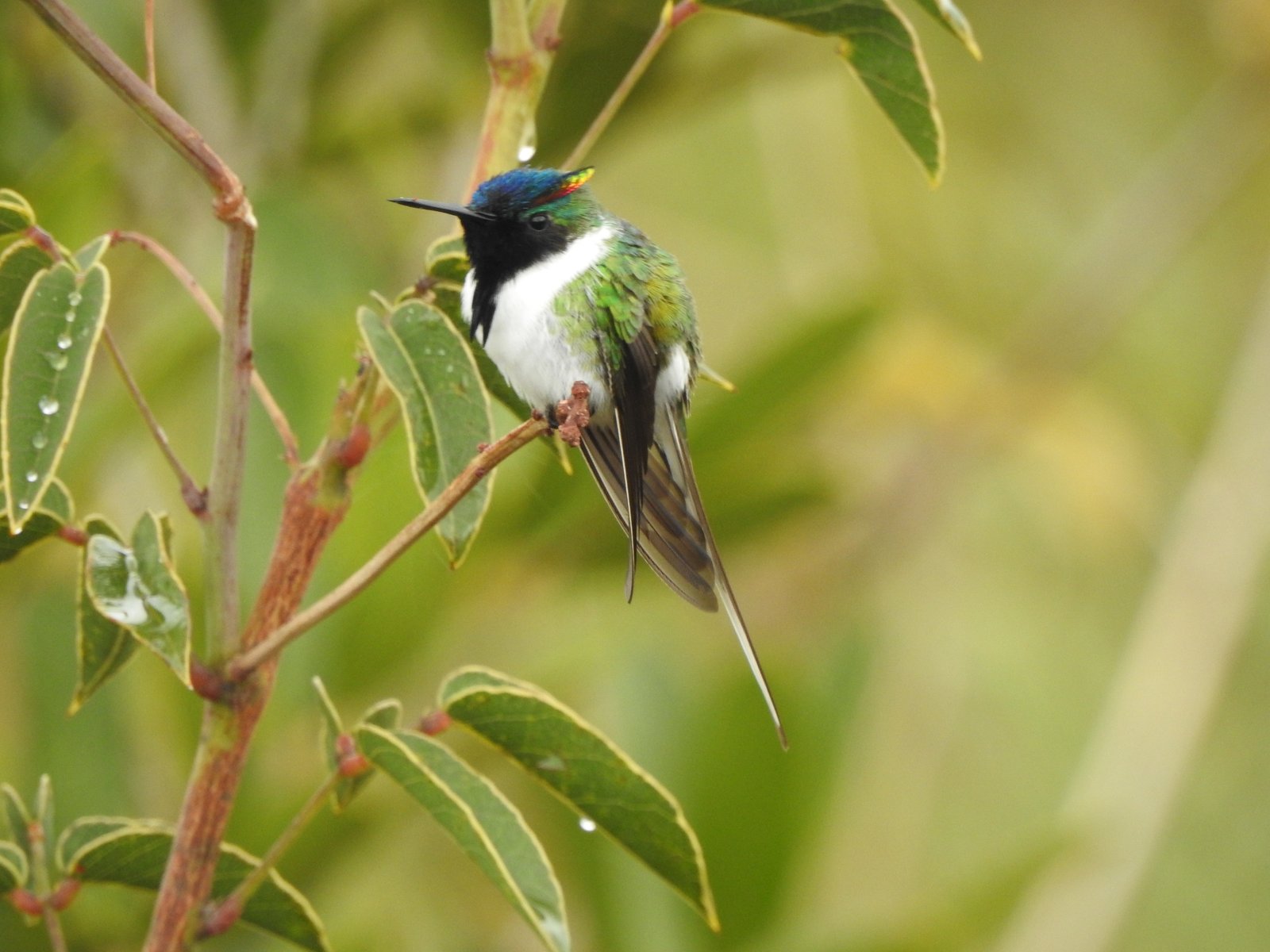
The Horned Sungem is a small hummingbird of the cerrado and open savannas of central South America. The male carries a tuft of elongated, red-gold feathers on each side of the blue crown, like two little horns, and has a black throat and a long, pointed tail. In the guide area it occurs only in the savannas of eastern Bolivia.
Voice
Usually silent. The call is a thin, high tsip, sometimes rapidly repeated.
Recording: JAYRSON ARAUJO DE OLIVEIRA — CC BY-NC-SA 4.0 · xeno-canto
Identification
9–11 cm, including the long, graduated and pointed tail; the bill is short, straight and black. The male is bronzy green above, with a glittering blue crown and, on the sides of the head, elongated orange-red to golden plumes. The chin and throat are black, the beard slightly elongated; the cheeks, sides of the neck and underparts are white. The central tail feathers are green, the outer ones white. The female lacks the plumes and the black throat; she is green above and whitish below, with a dull grey throat, and has the same graduated tail with white sides.
Confusion species
Black-eared Fairy Heliothryx auritus is also white below with white outer tail feathers, but is larger, has no plumes or black throat, shows a black ear patch, and lives in the canopy of humid forest. Amethyst Woodstar Calliphlox amethystina is smaller, with a forked tail; the male has a purplish-red throat and a white breast band, the female is rufous below.
Habitat
Cerrado, open savanna with scattered shrubs and small trees, and the edges of gallery forest, in the guide area in the lowlands below about 500 m. It takes nectar low down at flowering herbs and shrubs, often with the tail cocked, and catches small insects. The nest is a small cup of plant down on a low branch.
Where the bird is most at home, classified by the vegetation units of the Andes and the west coast.


Range and movements
In Bolivia in the savannas of Beni and eastern Santa Cruz. Absent from Colombia, Ecuador, Peru and the Galápagos. Outside the guide area mainly in central and eastern Brazil, with smaller numbers in the savannas of Suriname.
- Resident
- dark = core range, pale = thinly spread
How and when to look
In the cerrado of eastern Santa Cruz, for example around Noel Kempff Mercado, and in the savannas of Beni. Check flowering herbs and low shrubs in open country; between feeding bouts birds often perch on top of a low bush.
Conservation status
Least Concern. Conversion of cerrado and savanna to cropland and pasture affects its habitat, but the species has a large range.
Scientific name
Heliactin bilophus | (Temminck, 1820)
Temminck described the species in 1820 as Trochilus bilophus; because it was later moved to another genus, the author and year stand in brackets. The genus Heliactin was introduced in 1831 by Boie. The genus name combines Greek hēlios, 'sun', with aktis (aktinos), 'ray'. The species name combines Latin bi-, 'two', with Greek lophos, 'crest', referring to the male's two ear tufts. The specimen the first description was based on came from Brazil.