All species › Swifts › Hummingbirds › Tooth-billed Hummingbird
Tooth-billed Hummingbird | Androdon aequatorialis
Tandsnavelkolibrie | Colibrí piquidentado | Beija-flor-de-bico-denteado
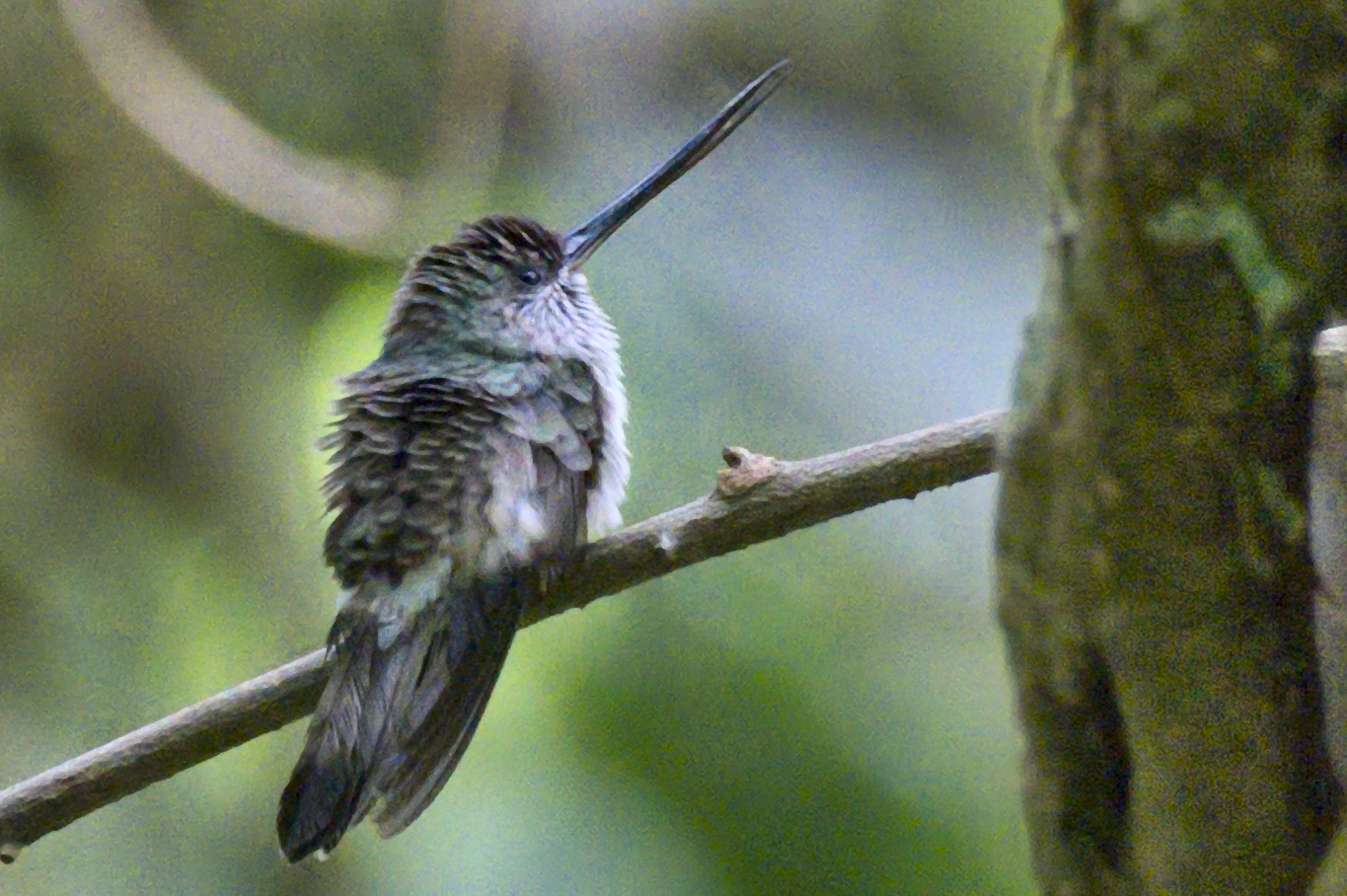
The Tooth-billed Hummingbird is a fairly large, streaked hummingbird of the Chocó rainforest, the only species in its genus. Its long, straight bill has a small hook at the tip and fine, tooth-like serrations along the edges, visible only at very close range. It forages in the lower forest strata along a fixed route from flower to flower.
Voice
A thin, high tsip or tsit, in flight and while foraging; the song is a series of high, squeaky notes.
Recording: Niels Poul Dreyer — CC BY-NC-SA 4.0 · xeno-canto
Identification
13–14 cm, with a long, straight, black bill of about 4 cm with a small hook at the tip. The upperparts are green, the crown darker and somewhat bronzy, and a narrow white band crosses the rump. The underparts are greyish white and densely streaked black on the throat and breast. The rounded tail is grey-green, with a blackish band before the white tips. The sexes are alike; the female has a slightly shorter, less hooked bill.
Confusion species
Long-billed Starthroat Heliomaster longirostris also has a long, straight bill and a white rump patch, but its underparts are plain grey, without streaks, and it has a white malar stripe. Hermits such as White-whiskered Hermit Phaethornis yaruqui have a decurved bill and a long tail with elongated, white central tail feathers, and lack streaked underparts.
Habitat
Humid lowland and foothill forest, mainly in the lower and middle strata and along forest edges and clearings, from sea level to about 1500 m. It visits flowers along a fixed route and also takes spiders and small insects. The nest is a cup of plant fibres attached to a twig or leaf, low above the ground.
Where the bird is most at home, classified by the vegetation units of the Andes and the west coast.


Range and movements
In Colombia on the Pacific slope and in the Chocó lowlands, from the north-west to Nariño, and in the north-west into the lowlands of Córdoba and Antioquia. In Ecuador in the north-west, in Esmeraldas, Imbabura and Pichincha. Absent from Peru, Bolivia and the Galápagos. Outside the guide area in eastern Panama.
- Resident
- dark = core range, pale = thinly spread
How and when to look
Along forest trails and edges in the foothill forest of north-western Ecuador and the Pacific slope of Colombia. Wait at flowering plants in the lower forest stratum; a bird often returns at intervals along the same route.
Conservation status
Least Concern. Deforestation in the Chocó affects its habitat, especially in the lowlands of north-western Ecuador.
Scientific name
Androdon aequatorialis | Gould, 1863
Gould described the species in 1863 and placed it straight away in the genus where it still stands. He introduced the genus Androdon in that same work. The genus name comes from Greek anēr, andros, 'man', and odous, odontos, 'tooth', referring to the tooth-like serrations of the bill. The species name comes from Latin aequatorialis, 'van de evenaar' and refers to Ecuador, not necessarily the type locality. The specimen the first description was based on came from Ecuador.