All species › Passerines › Tyrant flycatchers and allies › Buff-banded Tyrannulet
Buff-banded Tyrannulet | Mecocerculus hellmayri
Bruinstaarttachuri | Piojito de los pinos | Tiranete-de-faixa-ocre
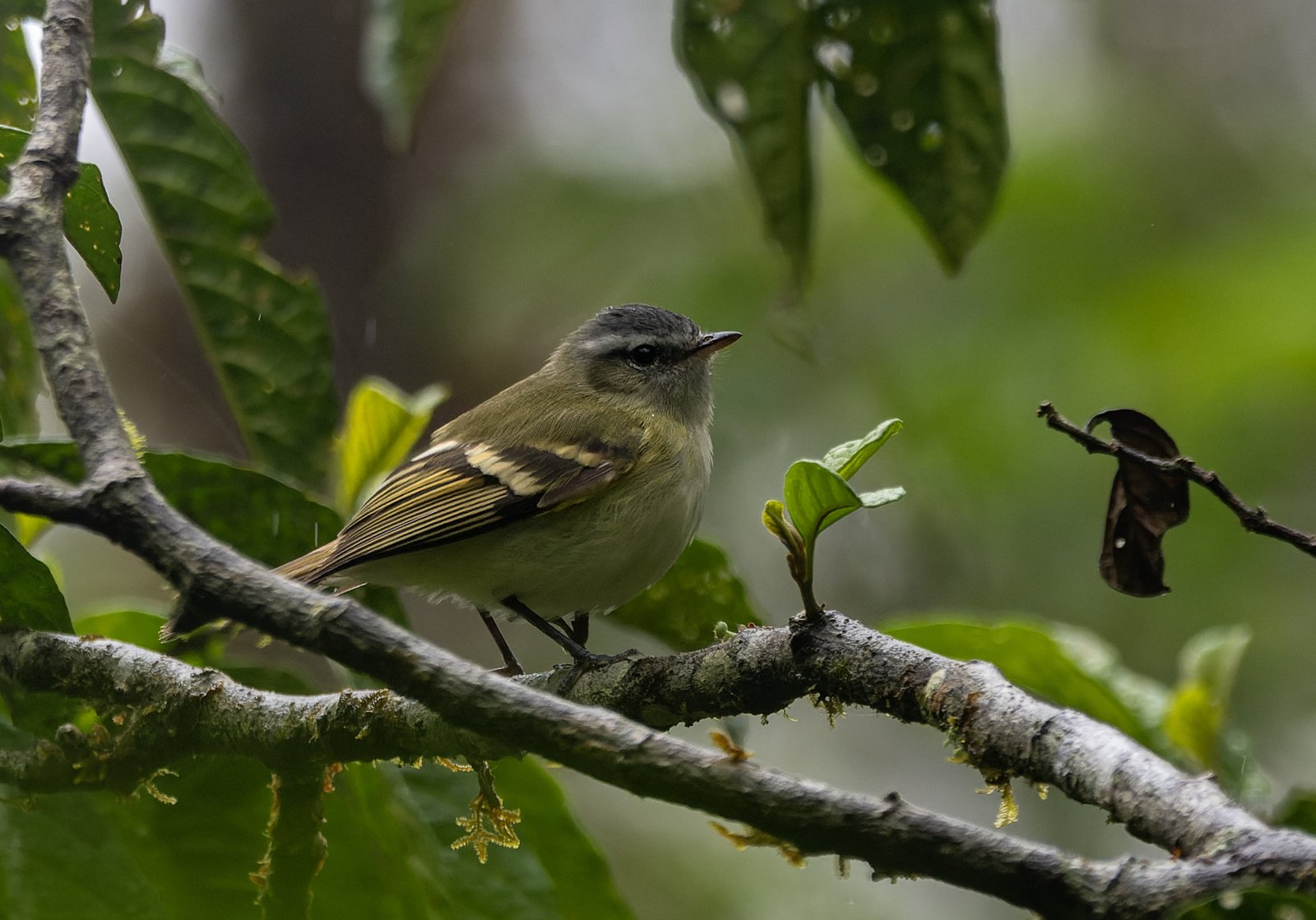
The Buff-banded Tyrannulet is a small tyrant of the Yungas montane forests of southern Peru, Bolivia and north-western Argentina. It lives in the canopy of alder woodland and forest with Podocarpus, recalled by its Spanish name (after the 'pino del cerro'). The broad buffy wing bars are its main feature.
Voice
Short, high calls, tsit, and a fast, dry chatter.
Recording: Andrew Spencer — CC BY-NC-SA 3.0 · xeno-canto
Identification
11 cm, with a small, thin bill. The crown is grey, with a whitish supercilium and a dark eye-stripe. The back is olive-grey. The wings are blackish, with two broad buffy to pale yellow wing bars. The tail is brownish, without white. The throat is whitish, the breast pale grey and the belly pale yellow. The sexes are alike.
Confusion species
White-banded Tyrannulet Mecocerculus stictopterus has pure white wing bars, a longer tail and usually lives higher. White-throated Tyrannulet Mecocerculus leucophrys is larger, with a puffed-out white throat and an upright posture. Yungas Tyrannulet Phyllomyias weedeni and other small tyrannulets have narrower wing bars and a shorter bill.
Habitat
Humid Yungas montane forest, especially alder (Alnus) and Podocarpus woodland, forest edges and riparian woodland in mountain valleys, roughly between 1500 and 3000 m. It searches for small insects among the leaves in the canopy, often in mixed flocks. Outside the breeding season some birds move somewhat lower. Little is known about the nest.
Where the bird is most at home, classified by the vegetation units of the Andes and the west coast.


Range and movements
In Peru only in the far south-east, in the Yungas of Puno. In Bolivia on the eastern slope of the Andes from La Paz south through Cochabamba and Chuquisaca to Tarija. Absent from Colombia, Ecuador and the Galápagos. Outside the guide area in north-western Argentina.
- Resident
- dark = core range, pale = thinly spread
How and when to look
Search alder woodland and forest edges in the mountain valleys of the Bolivian Yungas, for example in Tarija and Chuquisaca, and follow the mixed flocks in the canopy.
Conservation status
Least Concern. The species is locally fairly common but little studied; logging and grazing of montane forest reduce its habitat.
Scientific name
Mecocerculus hellmayri | Berlepsch, 1907
Berlepsch described the species in 1907 and placed it straight away in the genus where it still stands. The genus Mecocerculus was introduced in 1862 by Sclater. The genus name comes from Greek mēkos, 'length', and kerkos, 'tail', with the Latin diminutive suffix -ulus: 'little long-tail'. The species name honours the Austrian ornithologist Carl Eduard Hellmayr (1878–1944), a specialist in Neotropical birds. The specimen the first description was based on came from Cocapata, Cochabamba, Bolivia.