All species › Passerines › Tyrant flycatchers and allies › White-banded Tyrannulet
White-banded Tyrannulet | Mecocerculus stictopterus
Witbandtachuri | Tiranillo alibandeado | Tiranete-de-faixa-branca
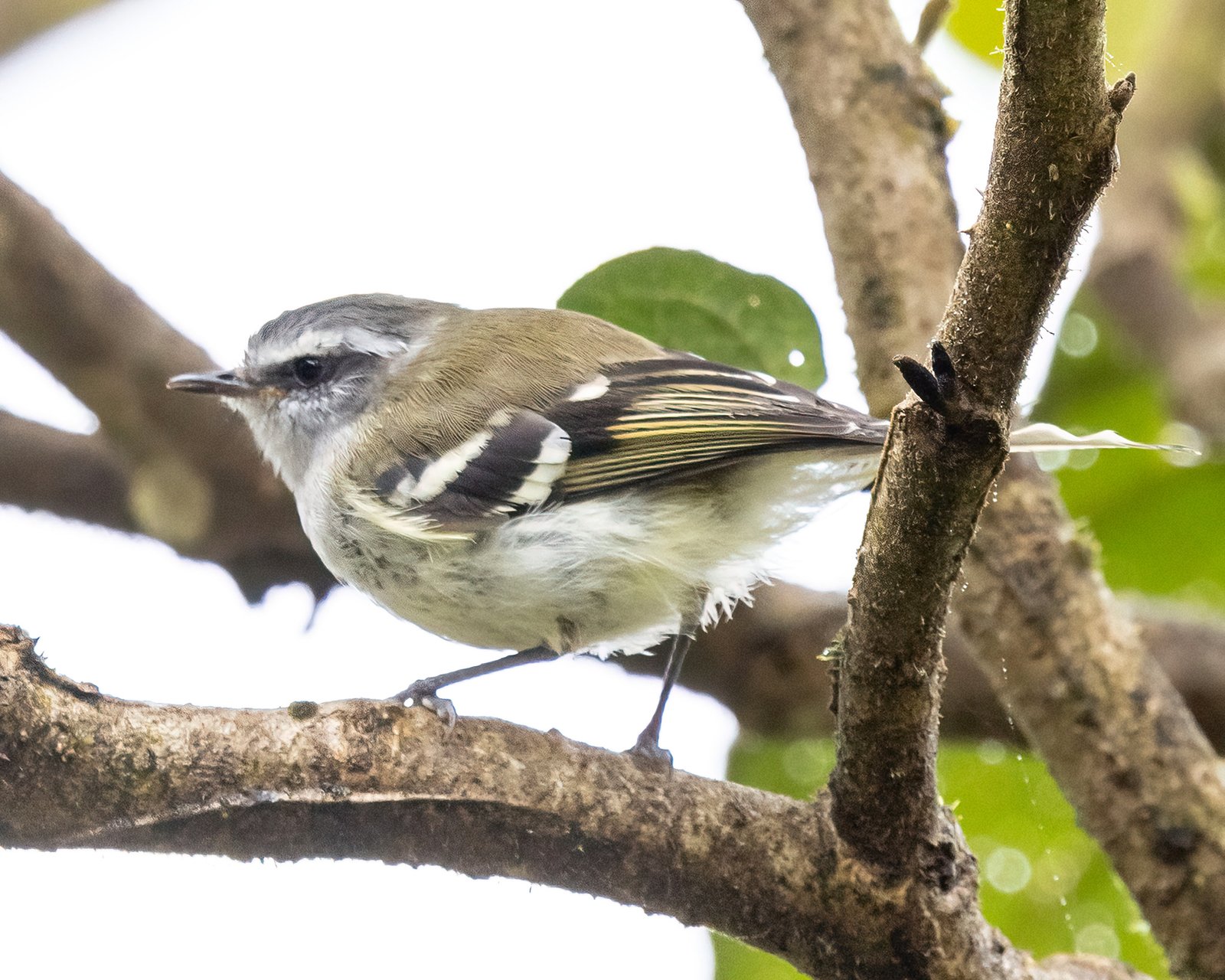
The White-banded Tyrannulet is a small grey and olive tyrant of the uppermost montane forests of the Andes. It lives in the canopy and along forest edges just below the treeline and often joins mixed flocks of tanagers and other songbirds. The two broad white wing bars are its main feature.
Voice
A high, nasal, slightly falling call, tsiieuw or squee, and a fast, dry chatter.
Recording: David Monroy Rengifo — CC BY-NC-SA 4.0 · xeno-canto
Identification
12 cm, with a small, thin bill and a fairly long tail. The crown is grey, with a long white supercilium and a dark eye-stripe. The back is olive-grey, the rump greener. The wings are blackish, with two broad white wing bars and pale edges to the secondaries. The throat and breast are pale grey, and the belly is whitish with a yellowish wash on the flanks. The sexes are alike; juveniles have buffy wing bars.
Confusion species
White-tailed Tyrannulet Mecocerculus poecilocercus is smaller, lives lower and has white in the outer tail feathers and yellower wing bars. White-throated Tyrannulet Mecocerculus leucophrys is larger and browner, with a puffed-out white throat, an upright posture and buffy wing bars. Rufous-winged Tyrannulet Mecocerculus calopterus has a rufous patch in the wing and lives on the western slope, much lower.
Habitat
Humid montane forest, cloud forest and elfin forest up to the treeline, Polylepis woodland and shrubby forest edges, roughly between 2500 and 3600 m, locally higher. It actively searches for small insects among leaves and moss in the canopy and on the outside of the crowns. The nest is a cup of moss and plant fibres in a tree.
Where the bird is most at home, classified by the vegetation units of the Andes and the west coast.


Range and movements
In Colombia in all three Andean ranges. In Ecuador on both slopes of the Andes. In Peru along the whole length of the Andes, mainly on the eastern slope. In Bolivia in the highlands of the eastern slope, south to Cochabamba. Absent from the Galápagos. Outside the guide area in the Andes of western Venezuela.
- Resident
- dark = core range, pale = thinly spread
How and when to look
Walk along forest edges and clearings in the highest cloud forest and watch for mixed flocks; the bird often sits in the outer branches and gives its nasal call.
Conservation status
Least Concern. The species is fairly common in suitable forest, but locally depends on the remaining forest near the treeline.
Scientific name
Mecocerculus stictopterus | (Sclater, 1859)
Sclater described the species in 1859 as Elainia stictoptera; because it was later moved to another genus, the author and year stand in brackets. The genus Mecocerculus was introduced in 1862 by Sclater. The genus name comes from Greek mēkos, 'length', and kerkos, 'tail', with the Latin diminutive suffix -ulus: 'little long-tail'. The species name comes from Greek stiktos, 'spotted', and pteron, 'wing', referring to the white wing bars. The specimen the first description was based on came from Matus, Chimborazo, Ecuador.