All species › Passerines › Tyrant flycatchers and allies › White-throated Tyrannulet
White-throated Tyrannulet | Mecocerculus leucophrys
Witkeeltachuri | Tiranillo barbiblanco | Tiranete-de-garganta-branca
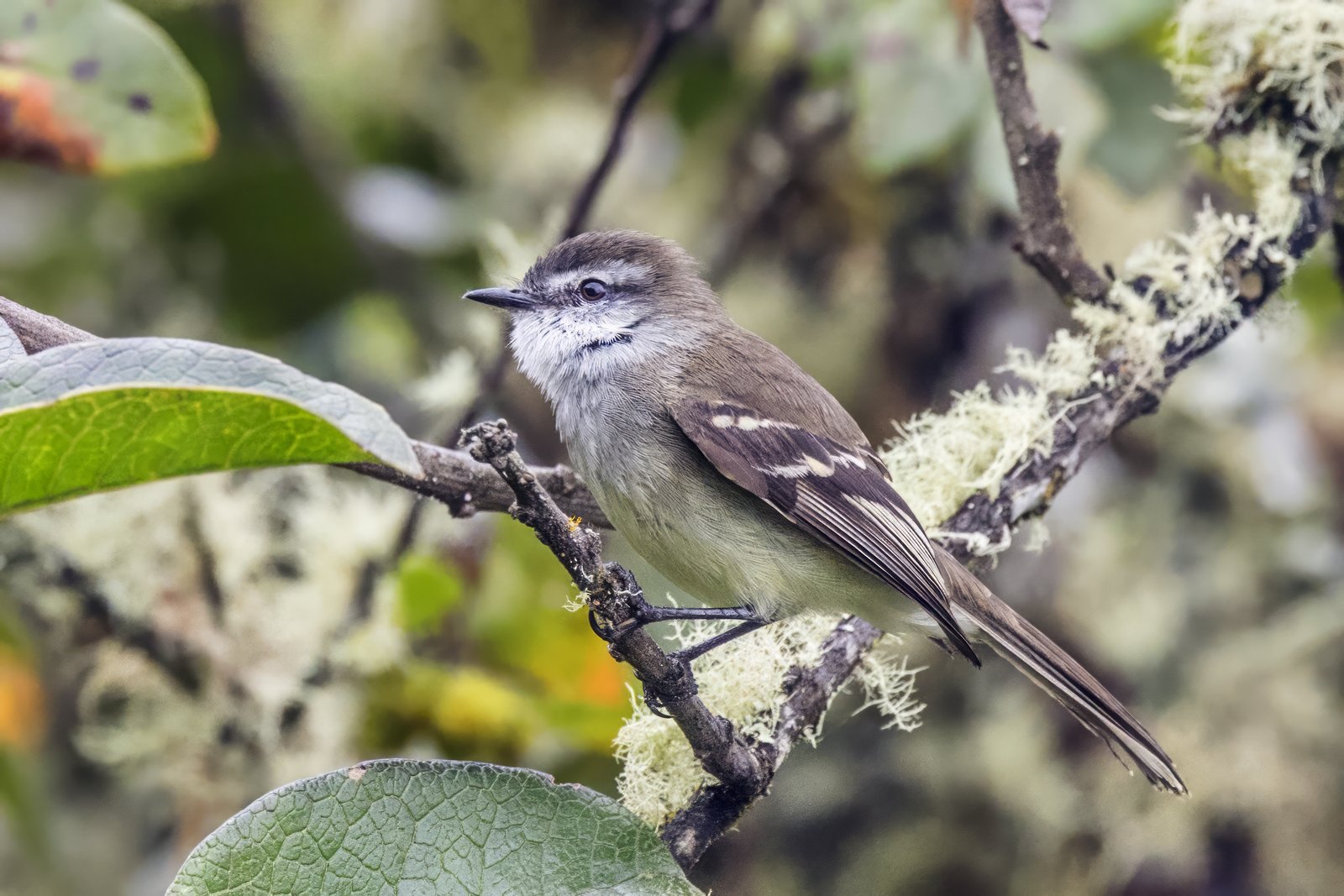
The White-throated Tyrannulet is an upright, long-tailed tyrant of the upper forest edges, scrub and Polylepis woodland of the Andes. Its white throat is characteristic and is often puffed out so that it protrudes like a small ball. It is one of the most widespread small tyrants of the highlands, from Venezuela to Argentina.
Voice
A fast, dry chatter, tsi-tsi-tsi-tsi, and high, short calls tsik, often repeated.
Recording: Juan Freile — CC BY-NC-SA 4.0 · xeno-canto
Identification
14 cm, with a small bill and a long tail. The upperparts are olive-brown to greyish brown, with a short, faint white supercilium. The wings are dark brown, with two broad buffy to whitish wing bars. The throat is bright white and contrasts with the grey breast; the belly is pale yellow to whitish. The sexes are alike. There are several subspecies, differing in the tone of the upperparts and wing bars.
Confusion species
White-banded Tyrannulet Mecocerculus stictopterus is smaller and greyer, with a long white supercilium and pure white wing bars, and sits less upright. Tufted Tit-Tyrant Anairetes parulus is smaller, with a spiky crest and a streaked breast. White-crested Tyrannulet Serpophaga subcristata is smaller and greyer, without the contrasting white throat, and lives lower.
Habitat
Forest edges and scrub near the treeline, Polylepis woodland, elfin forest, shrubby páramo and puna and dry montane scrub in the inter-Andean valleys, roughly between 2000 and 4200 m. It searches for insects among leaves and also catches them in short sallies. It occurs alone, in pairs or in mixed flocks. The nest is a cup of moss, grass and spider web in a shrub or tree.
Where the bird is most at home, classified by the vegetation units of the Andes and the west coast.


Range and movements
In Colombia in all three Andean ranges and in the Sierra Nevada de Santa Marta. In Ecuador on both slopes and in the inter-Andean valleys. In Peru along the whole length of the Andes. In Bolivia in the highlands and the dry valleys of the eastern slope. Absent from the Galápagos. Outside the guide area in Venezuela, on the tepuis and in north-western Argentina.
- Resident
- dark = core range, pale = thinly spread
How and when to look
Search Polylepis groves and scrub along mountain roads near the treeline; the bird often perches in the open on a branch, upright and with its white throat puffed out.
Conservation status
Least Concern. The species is fairly common in the highlands and tolerates small forest patches and scrub.
Scientific name
Mecocerculus leucophrys | (d'Orbigny, ACVMD & de Lafresnaye, 1837)
D'Orbigny, ACVMD & de Lafresnaye described the species in 1837 as M[uscicapa] leucophrys; because it was later moved to another genus, the author and year stand in brackets. The genus Mecocerculus was introduced in 1862 by Sclater. The genus name comes from Greek mēkos, 'length', and kerkos, 'tail', with the Latin diminutive suffix -ulus: 'little long-tail'. The species name comes from Greek leukos, 'white', and ophrus, 'eyebrow', referring to the white supercilium. The specimen the first description was based on came from Yanacachi, La Paz, Bolivia.