All species › Passerines › Tyrant flycatchers and allies › Rufous-winged Tyrannulet
Rufous-winged Tyrannulet | Mecocerculus calopterus
Roodvleugeltachuri | Tiranillo alirrufo | Tiranete-de-asa-ruiva
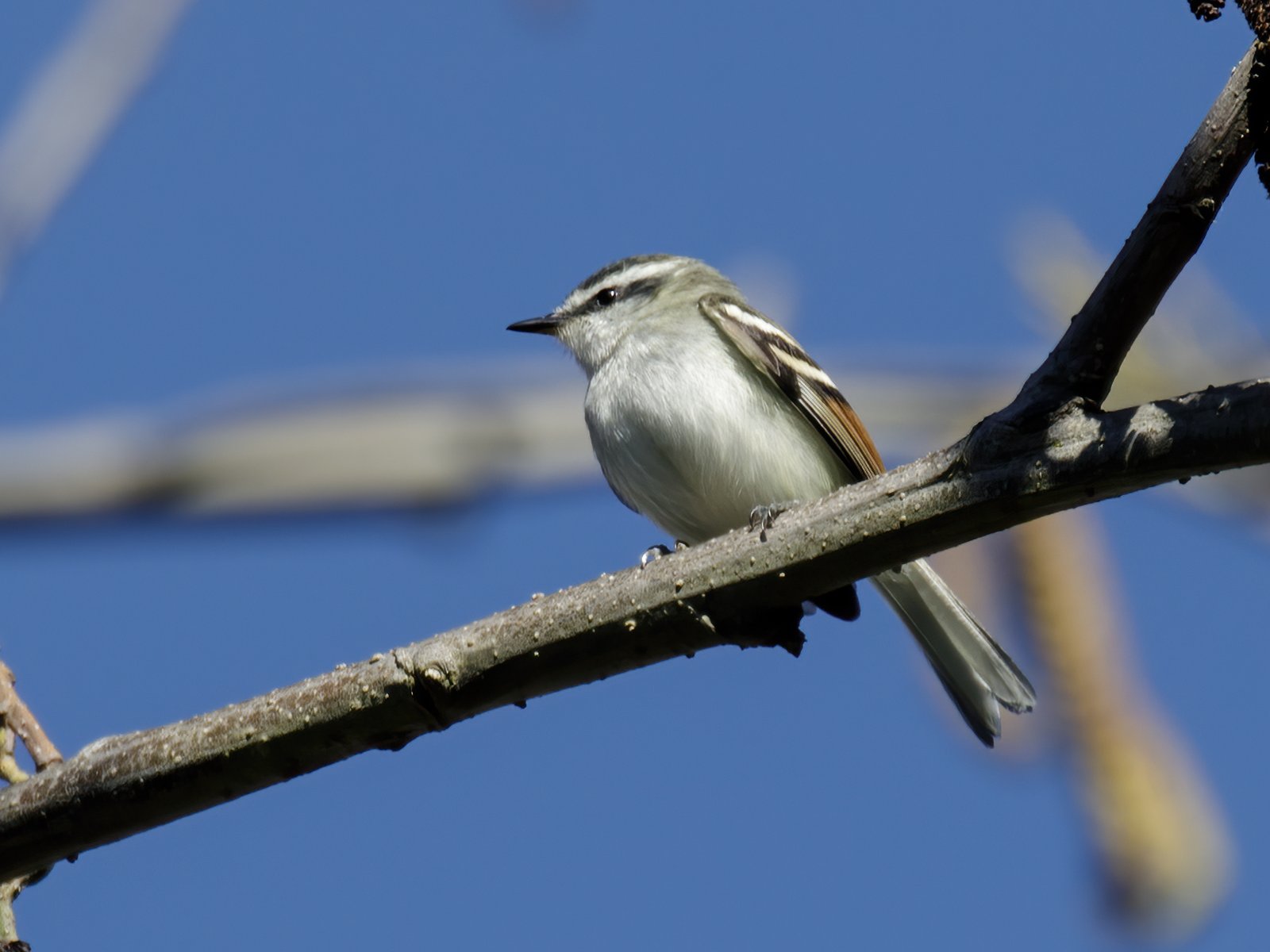
The Rufous-winged Tyrannulet is a small tyrant of the forests on the western slope of the Andes in south-western Ecuador and north-western Peru. It lives high in the canopy, often in mixed flocks. The rufous patch in the dark wing separates it from all its relatives.
Voice
A high, somewhat shrill call and a short series of fast, descending notes.
Recording: Paul Coopmans — CC BY-NC-SA 4.0 · xeno-canto
Identification
11 cm, with a small, thin bill. The crown is grey, with a long white supercilium and a dark eye-stripe. The back is olive-green. The wings are blackish, with two white wing bars and a large rufous patch at the base of the secondaries. The tail is dark, with pale outer edges. The underparts are whitish, with a grey wash on the breast and pale yellow on the belly. The sexes are alike.
Confusion species
White-banded Tyrannulet Mecocerculus stictopterus lacks the rufous wing patch and lives much higher. Southern Beardless Tyrannulet Camptostoma obsoletum has a small crest, buffy wing bars and no rufous in the wing. Tyrannulets of the genus Zimmerius have yellow wing edgings without a rufous patch and often hold the tail cocked.
Habitat
Humid and semi-humid montane forest, the upper parts of deciduous forest and forest edges with tall trees, roughly between 600 and 2100 m. It searches for small insects among the leaves in the canopy, often with tanagers, vireos and other tyrants. Little is known about the nest.
Where the bird is most at home, classified by the vegetation units of the Andes and the west coast.


Range and movements
In Ecuador on the western slope of the Andes in the south-west, mainly in El Oro and Loja. In Peru in the north-west, on the western slope in Tumbes, Piura, Lambayeque and Cajamarca. Absent from Colombia, Bolivia and the Galápagos. It does not occur outside the guide area.
- Resident
- dark = core range, pale = thinly spread
How and when to look
Search the humid forests of the western slope in south-western Ecuador and north-western Peru, for example at Buenaventura and Jorupe, and follow mixed flocks in the canopy.
Conservation status
Least Concern, but with a small range. Forest on the western slope is heavily fragmented by clearance for farming and ranching.
Scientific name
Mecocerculus calopterus | (Sclater, 1859)
Sclater described the species in 1859 as Formicivora caloptera; because it was later moved to another genus, the author and year stand in brackets. The genus Mecocerculus was introduced in 1862 by Sclater. The genus name comes from Greek mēkos, 'length', and kerkos, 'tail', with the Latin diminutive suffix -ulus: 'little long-tail'. The species name comes from Greek kalos, 'fair, fine', and pteron, 'wing', referring to the rufous wing patch. The specimen the first description was based on came from Pallatanga, Chimborazo, Ecuador.