All species › Passerines › Tyrant flycatchers and allies › Sulphur-bellied Tyrannulet
Sulphur-bellied Tyrannulet | Mecocerculus minor
Geelbuiktachuri | Tiranillo ventriazufrado | Tiranete-de-barriga-sulfúrea
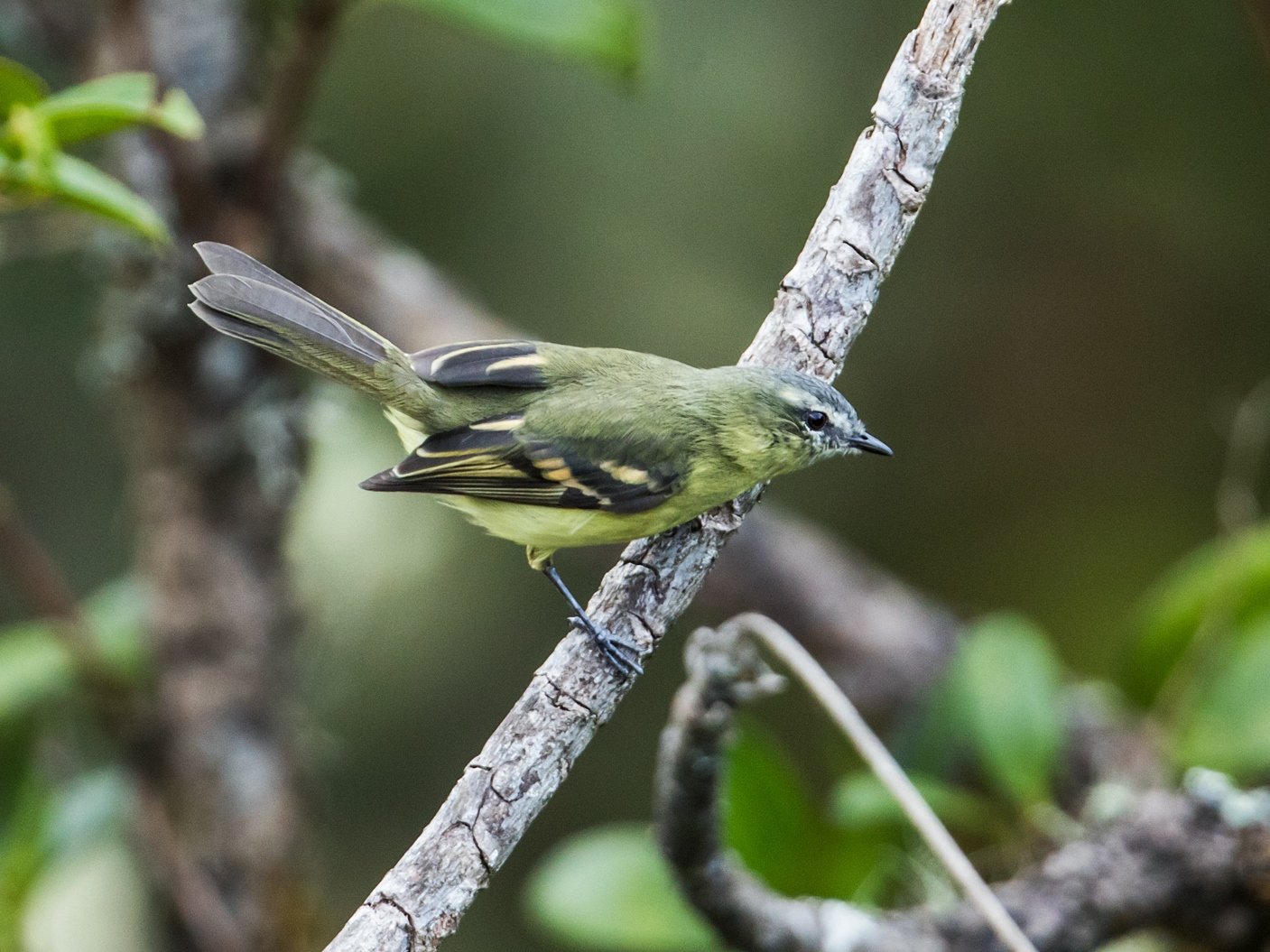
The Sulphur-bellied Tyrannulet is a small tyrant of the cloud forest on the eastern slope of the northern Andes. In shape it resembles the other tyrannulets of the genus Mecocerculus, but it is yellow below. It lives in the middle and upper levels of the forest and often travels with mixed flocks.
Voice
A thin, high call, psiieu, and a short, fast series of high notes.
Recording: Guilherme Melo — CC BY-NC-SA 4.0 · xeno-canto
Identification
12 cm, with a small, thin bill and a fairly long tail. The crown is grey, with a white supercilium and a dark eye-stripe. The back is olive-green. The wings are blackish, with two broad buffy-yellow wing bars. The throat is pale grey to whitish, the breast washed olive and the belly sulphur-yellow. The sexes are alike.
Confusion species
White-banded Tyrannulet Mecocerculus stictopterus is grey and white below, with white wing bars, and usually lives higher. White-tailed Tyrannulet Mecocerculus poecilocercus has white outer tail feathers and is whiter below. Tyrannulets of the genera Phylloscartes and Pogonotriccus have a dark patch on the ear-coverts and often a different posture with a raised tail.
Habitat
Cloud forest and upper montane forest, forest edges and older secondary growth, roughly between 1700 and 2900 m. It searches for small insects among leaves and moss in the middle and upper levels of the forest, often in mixed flocks with tanagers and other songbirds. Little is known about the nest.
Where the bird is most at home, classified by the vegetation units of the Andes and the west coast.


Range and movements
In Colombia on the eastern slope of the Eastern Andes and locally in the Central Andes. In Ecuador on the eastern slope of the Andes. In Peru on the eastern slope in the north, south to about Cajamarca and Amazonas. Absent from Bolivia and the Galápagos. Outside the guide area in western Venezuela.
- Resident
- dark = core range, pale = thinly spread
How and when to look
Follow mixed flocks in the cloud forest along roads on the eastern slope in Ecuador, for example in the Papallacta valley and near Cosanga, and look for a small tyrant with a yellow belly and a grey head.
Conservation status
Least Concern. The species is locally fairly common in cloud forest; deforestation on the eastern slope reduces its habitat.
Scientific name
Mecocerculus minor | (Taczanowski, 1879)
Taczanowski described the species in 1879 as Leptopogon minor; because it was later moved to another genus, the author and year stand in brackets. The genus Mecocerculus was introduced in 1862 by Sclater. The genus name comes from Greek mēkos, 'length', and kerkos, 'tail', with the Latin diminutive suffix -ulus: 'little long-tail'. The species name comes from Latin minor, 'smaller'. The specimen the first description was based on came from Tambillo, Cajamarca, Peru.