All species › Passerines › Tyrant flycatchers and allies › Sulphury Flycatcher
Sulphury Flycatcher | Tyrannopsis sulphurea
Zwaveltiran | Mosquero azufrado | Suiriri-de-garganta-rajada
The Sulphury Flycatcher is a stocky flycatcher of the Amazonian lowlands that is closely tied to moriche or aguaje palms (Mauritia flexuosa). Pairs often sit high in or near a palm and call loudly in duet. In the guide area it lives in the lowlands east of the Andes.
Voice
A loud, shrill, somewhat grating jwee-jwee-jwee or chweeeh, often in duet by the pair, and squeaky notes when excited.
Recording: Mauricio Cuellar Ramirez (@Birding.travel) — CC BY-NC-SA 4.0 · xeno-canto
Identification
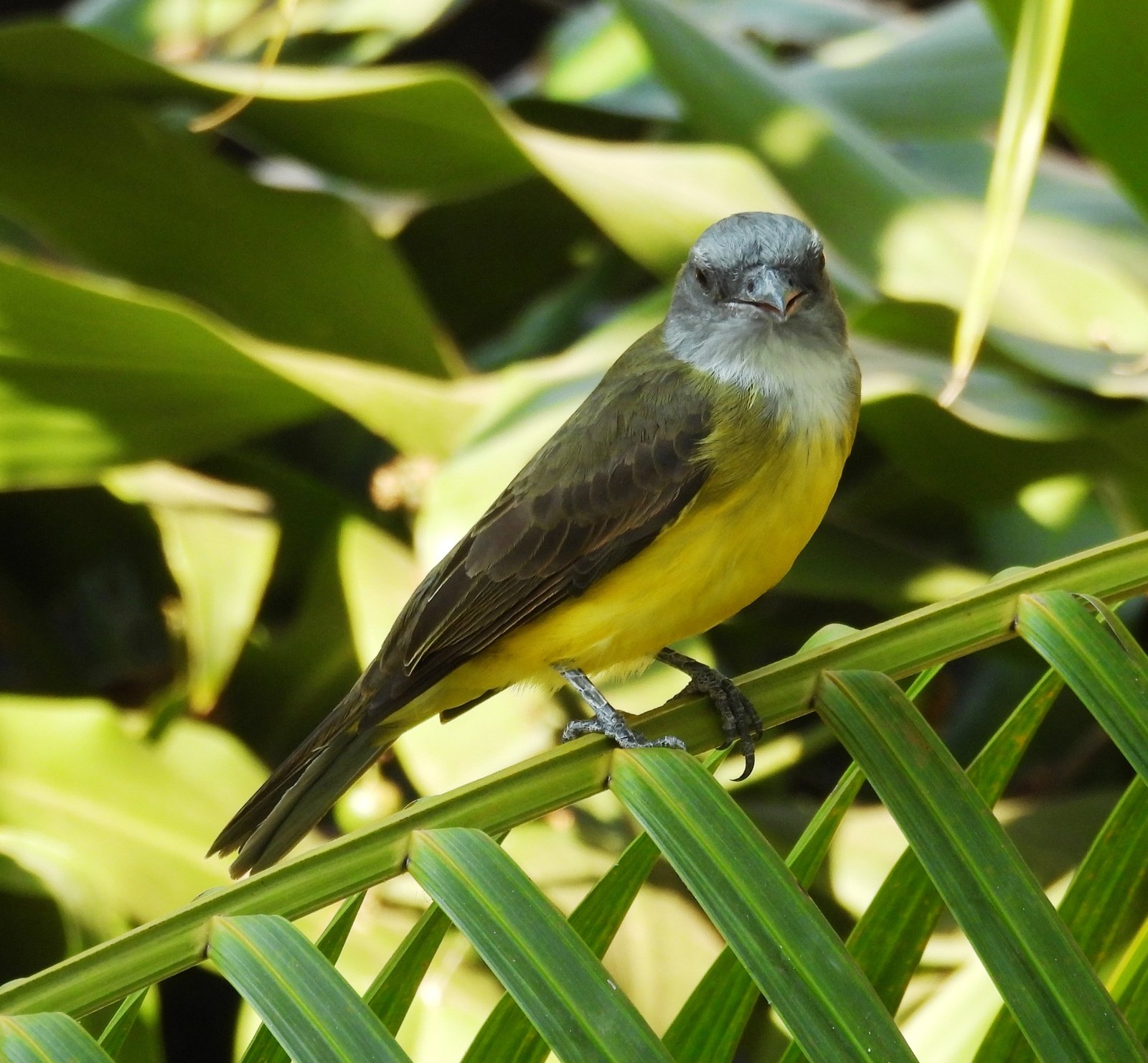
19–20 cm. A stocky flycatcher with a short, square tail and a fairly short, heavy black bill. The head is dark grey with a blackish mask and a concealed yellow crown patch. Back and wings are olive-green to olive-brown. The throat is white, the sides of the breast greyish-olive with faint streaking, the belly bright yellow. Sexes alike.
Confusion species
Tropical Kingbird Tyrannus melancholicus is slimmer, with a longer, forked tail, a paler grey head without a distinct mask and an olive breast. Boat-billed Flycatcher Megarynchus pitangua has a black crown with a white supercilium and a very broad bill. Dusky-chested Flycatcher Myiozetetes luteiventris is smaller, with a small bill and an olive-streaked breast.
Habitat
Swampy places and open country with moriche or aguaje palms, palm swamps, edges of várzea, forest edges and villages with palms, mostly below 500 m. It sallies from a high perch for insects and eats fruit. It nests among the leaf bases in the crown of palms.
Where the bird is most at home, classified by the vegetation units of the Andes and the west coast.


Range and movements
Colombia: in the lowlands east of the Andes, in the Llanos and the Amazon region. Ecuador: locally in the eastern lowlands. Peru: in the Amazonian lowlands. Bolivia: in the north and north-east. Absent from the Galápagos. Outside the guide area in Venezuela, the Guianas, Trinidad and the Amazon region of Brazil.
- Resident
- dark = core range, pale = thinly spread
How and when to look
Search at stands of moriche or aguaje palms, also in open country and near villages. Pairs often sit at the top of a palm and are mostly heard in the morning.
Conservation status
Least Concern. Locally common, but dependent on palm stands that in some places are cut for their fruit.
Scientific name
Tyrannopsis sulphurea | (Spix, 1825)
Spix described the species in 1825 as Muscicapa sulphurea; because it was later moved to another genus, the author and year stand in brackets. The genus Tyrannopsis was introduced in 1905 by Ridgway. The genus name combines Tyrannus (Latin, 'tyrant') with Greek opsis, 'appearance': 'resembling a kingbird'. The specific name is Latin sulphureus, 'sulphur-coloured', after the yellow underparts. The specimen the first description was based on came from Manaus, Amazonas, Brazil.