All species › Passerines › Tyrant flycatchers and allies › Scale-crested Pygmy Tyrant
Scale-crested Pygmy Tyrant | Lophotriccus pileatus
Schubkuifdwergtiran | Cimerillo crestiescamado | Maria-de-crista-escamada
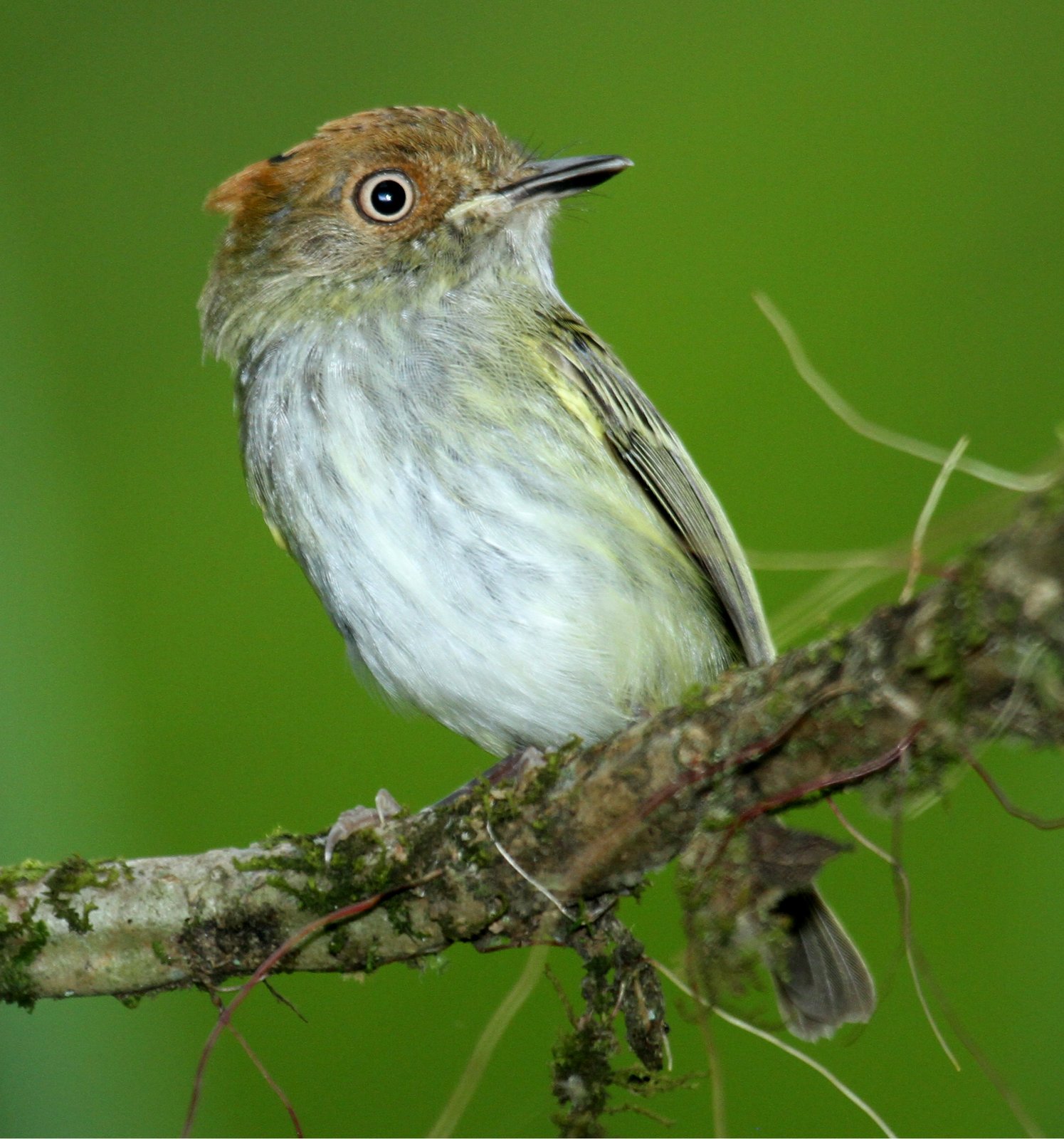
The Scale-crested Pygmy Tyrant is a small tyrant flycatcher of the montane forests of the northern and central Andes, with a crest of black feathers edged rufous. Its loud, trilling call is one of the most frequently heard sounds in the middle levels of montane forest, while the bird itself usually stays hidden.
Voice
A loud, sharp 'prreet' or 'trrreet', often rising, and series of dry 'kreek' notes; loud for the bird's size.
Recording: Alain Verneau — CC BY-NC-SA 4.0 · xeno-canto
Identification
10 cm, with a rather long, flat bill and a medium-length tail. The crest consists of long black feathers with broad rufous edges; it is usually held flat, so that the crown looks scaled rufous. The upperparts are olive-green, the wings dusky with two narrow yellowish wing bars. The throat and breast are whitish with distinct grey streaks, and the belly is pale yellow. The eye is pale yellow to orangey. The sexes are nearly alike.
Confusion species
Double-banded Pygmy Tyrant Lophotriccus vitiosus has a crest with grey to olive edges, without rufous, and lives in the lowlands. Long-crested Pygmy Tyrant Lophotriccus eulophotes has a longer crest with grey edges and lives in bamboo in the lowlands of south-eastern Peru. White-bellied Pygmy Tyrant Myiornis albiventris is much smaller, with a stubby tail and no crest.
Habitat
Humid lower montane forest, cloud forest, foothill forest and forest edges with dense undergrowth, roughly between 600 and 2200 m, locally higher or lower. It keeps to the lower and middle levels and catches insects with short sallies to the undersides of leaves. The nest is a hanging globular nest with a side entrance.
Where the bird is most at home, classified by the vegetation units of the Andes and the west coast.


Range and movements
Colombia: in all three Andean ranges and on the Pacific slope. Ecuador: on both slopes of the Andes, in the west also in the lower hills. Peru: on the east slope south to Puno and locally on the west slope in the north. Bolivia: at most in the far north-west. Absent from the Galápagos. Outside the guide area from Costa Rica to Panama and in Venezuela.
- Resident
- dark = core range, pale = thinly spread
How and when to look
Listen in montane forest at around 1500 m, for example along roads on the west slope of Ecuador, for the loud 'prreet'; follow the sound into the undergrowth, where the bird sits quietly on a thin twig.
Conservation status
Least Concern. The species also occurs in secondary forest and along forest edges.
Scientific name
Lophotriccus pileatus | (Tschudi, 1844)
Tschudi described the species in 1844 as E[uscarthmus] pileatus; because it was later moved to another genus, the author and year stand in brackets. The genus Lophotriccus was introduced in 1884 by Berlepsch. The genus name combines Greek lophos, 'crest', with trikkos, an unidentified small bird. The species name comes from Latin pileatus, 'capped', referring to the scaly crest. The specimen the first description was based on came from Vitoc Valley, Junín, Peru.