All species › Passerines › Tyrant flycatchers and allies › Double-banded Pygmy Tyrant
Double-banded Pygmy Tyrant | Lophotriccus vitiosus
Dubbelbanddwergtiran | Cimerillo doblebandeado | Maria-fiteira
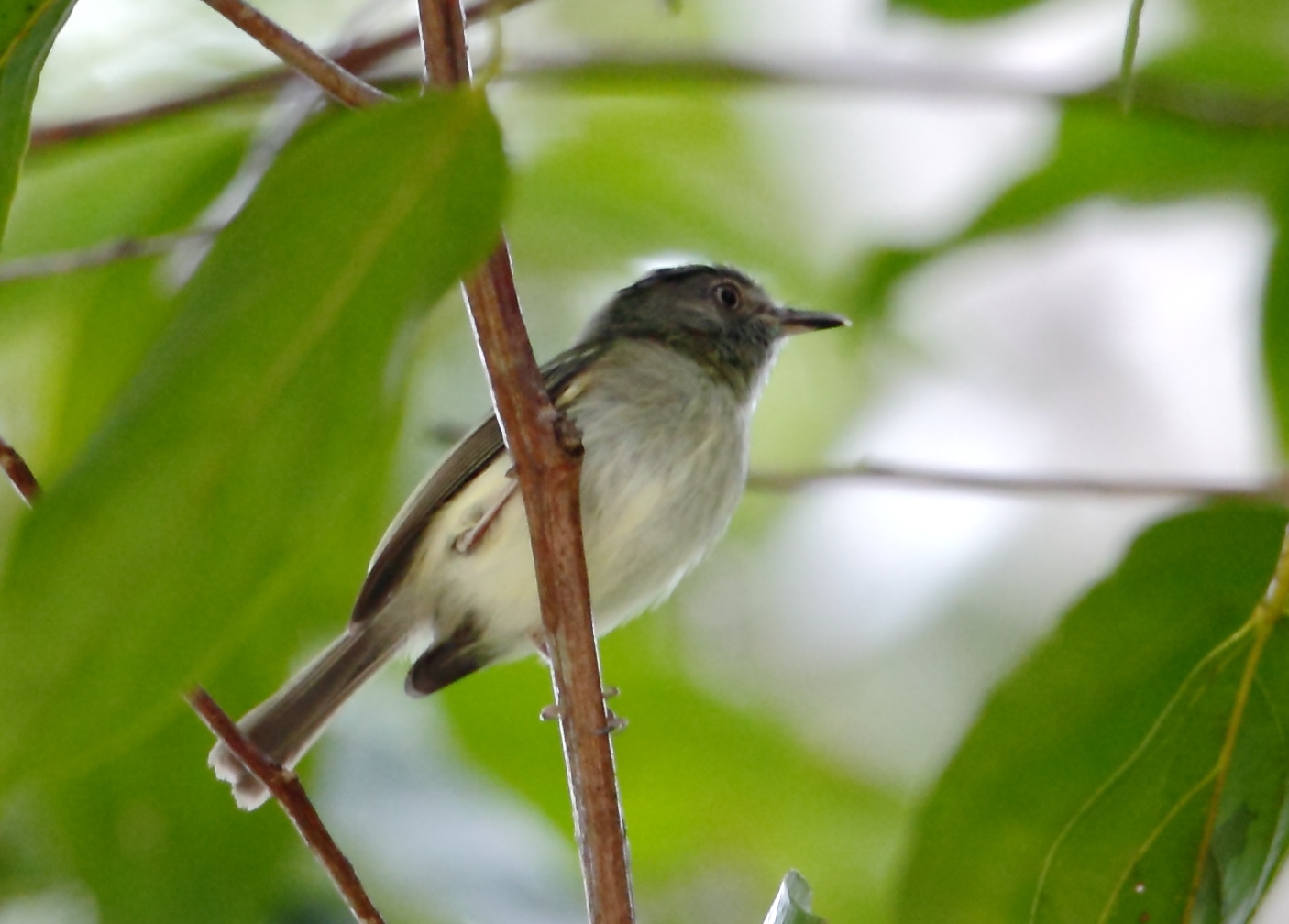
The Double-banded Pygmy Tyrant is a small, crested tyrant flycatcher of the Amazonian lowlands north of the Amazon and the Marañón. The name refers to its two yellowish wing bars; the dark crest is usually held flat.
Voice
A dry, rolling trill, 'prrrrt', often repeated, and short, sharp 'kreek' calls.
Recording: JAYRSON ARAUJO DE OLIVEIRA — CC BY-NC-SA 4.0 · xeno-canto
Identification
10 cm, with a rather long, flat bill. The crest consists of blackish feathers with grey to olive edges. The upperparts are olive-green, the wings dusky with two distinct yellowish wing bars. The throat and breast are whitish with grey streaks, and the belly is pale yellow. The eye is pale yellow. The sexes are nearly alike.
Confusion species
Scale-crested Pygmy Tyrant Lophotriccus pileatus has rufous edges to the crest feathers and lives higher, in montane forest. Helmeted Pygmy Tyrant Lophotriccus galeatus has a crest with grey edges and less distinct wing bars, and lives in the far east of Colombia. Short-tailed Pygmy Tyrant Myiornis ecaudatus is much smaller, with a grey head, a white face and almost no tail.
Habitat
Humid lowland forest on terra firme and in várzea, forest edges, riverine forest and tall secondary forest, up to about 1000 m. It keeps to the lower and middle levels, often in vine tangles, and catches insects with short sallies to leaves. The nest is a hanging globular nest with a side entrance.
Where the bird is most at home, classified by the vegetation units of the Andes and the west coast.


Range and movements
Colombia: in the south-east, in the Amazonian lowlands. Ecuador: in the Amazonian lowlands. Peru: in the north-east, north of the Amazon and the Marañón. Absent from Bolivia and the Galápagos. Outside the guide area in the Guianas and northern Brazil.
- Resident
- dark = core range, pale = thinly spread
How and when to look
Listen in lowland forest around Iquitos or in eastern Ecuador for the rolling trill in the undergrowth and middle level, especially along forest edges and clearings.
Conservation status
Least Concern. The species has a large range and tolerates edges and secondary forest.
Scientific name
Lophotriccus vitiosus | (Bangs & Penard, 1921)
Bangs & Penard described the species in 1921 as Cometornis vitiosus; because it was later moved to another genus, the author and year stand in brackets. The genus Lophotriccus was introduced in 1884 by Berlepsch. The genus name combines Greek lophos, 'crest', with trikkos, an unidentified small bird. The species name comes from Latin vitiosus, 'faulty, defective'; why Bangs and Penard (1921) chose it is not known. The specimen the first description was based on came from Sarayacu, Ucayali River, Peru.