All species › Passerines › Tyrant flycatchers and allies › Long-crested Pygmy Tyrant
Long-crested Pygmy Tyrant | Lophotriccus eulophotes
Langkuifdwergtiran | Cimerillo crestilargo | Maria-topetuda
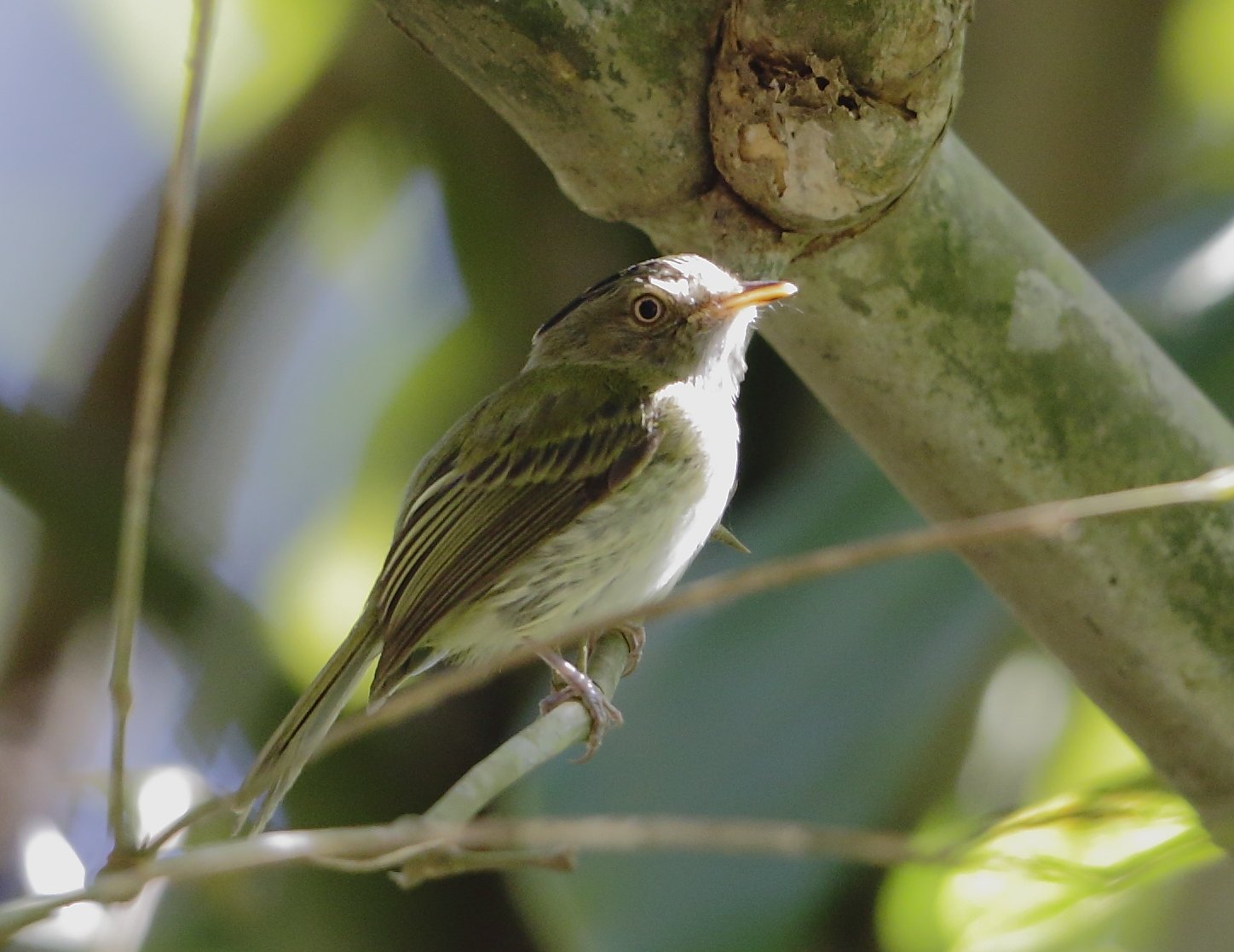
The Long-crested Pygmy Tyrant is a small tyrant flycatcher of bamboo thickets and riverine forest in the Amazonian lowlands of south-eastern Peru and northern Bolivia. It has a long, narrow crest that usually lies flat and is raised when excited. The species is closely tied to Guadua bamboo.
Voice
Short, dry, rolling trills and single sharp trrt calls, often repeated for long periods from cover.
Recording: GABRIEL LEITE — CC BY-NC-SA 3.0 · xeno-canto
Identification
10 cm, with a rather long, flat bill and a short tail. The upperparts are olive-green. The crest consists of long, blackish feathers with grey edges. The throat and breast are dull white with fine grey streaks, the belly pale yellow. The wing bars are faint and the iris is pale. The sexes are alike; juveniles have a shorter crest.
Confusion species
Double-banded Pygmy Tyrant Lophotriccus vitiosus has two distinct yellow wing bars and a shorter crest and lives in the canopy of terra firme forest. Flammulated Bamboo Tyrant Hemitriccus flammulatus shares the same bamboo but is larger, lacks a crest and has a broader bill. Short-tailed Pygmy Tyrant Myiornis ecaudatus is smaller and has an almost absent tail.
Habitat
Dense Guadua bamboo thickets, forest edges along rivers and the margins of seasonally flooded forest in the lowlands, up to about 600 m. It takes small insects from the undersides of leaves with short upward sallies, usually low to mid-level. The nest is probably a hanging pouch as in related species.
Where the bird is most at home, classified by the vegetation units of the Andes and the west coast.


Range and movements
Peru: in the Amazonian lowlands of the south-east (Madre de Dios, the lowlands of Cuzco and Puno, and locally further north in Ucayali). Bolivia: in the north (Pando, Beni and the lowlands of La Paz). Absent from Colombia, Ecuador and the Galápagos. Outside the guide area in western Brazil (Acre and south-western Amazonas).
- Resident
- dark = core range, pale = thinly spread
How and when to look
Listen in bamboo thickets along rivers in Madre de Dios for a dry, rolling trill; the bird usually sits still in the dense bamboo and moves with short hops.
Conservation status
Least Concern. The species has a restricted range and depends on bamboo and riverine forest, but this habitat is still widespread in south-western Amazonia.
Scientific name
Lophotriccus eulophotes | Todd, 1925
Todd described the species in 1925 and placed it straight away in the genus where it still stands. The genus Lophotriccus was introduced in 1884 by Berlepsch. The genus name combines Greek lophos, 'crest', with trikkos, an unidentified small bird. The species name comes from Greek eulophos, 'well-crested', referring to the long crest. The specimen the first description was based on came from Hiutanaã, Rio Purus, Amazonas, Brazil.