All species › Passerines › Tyrant flycatchers and allies › Helmeted Pygmy Tyrant
Helmeted Pygmy Tyrant | Lophotriccus galeatus
Helmdwergtiran | Cimerillo de casquete | Caga-sebinho-de-penacho
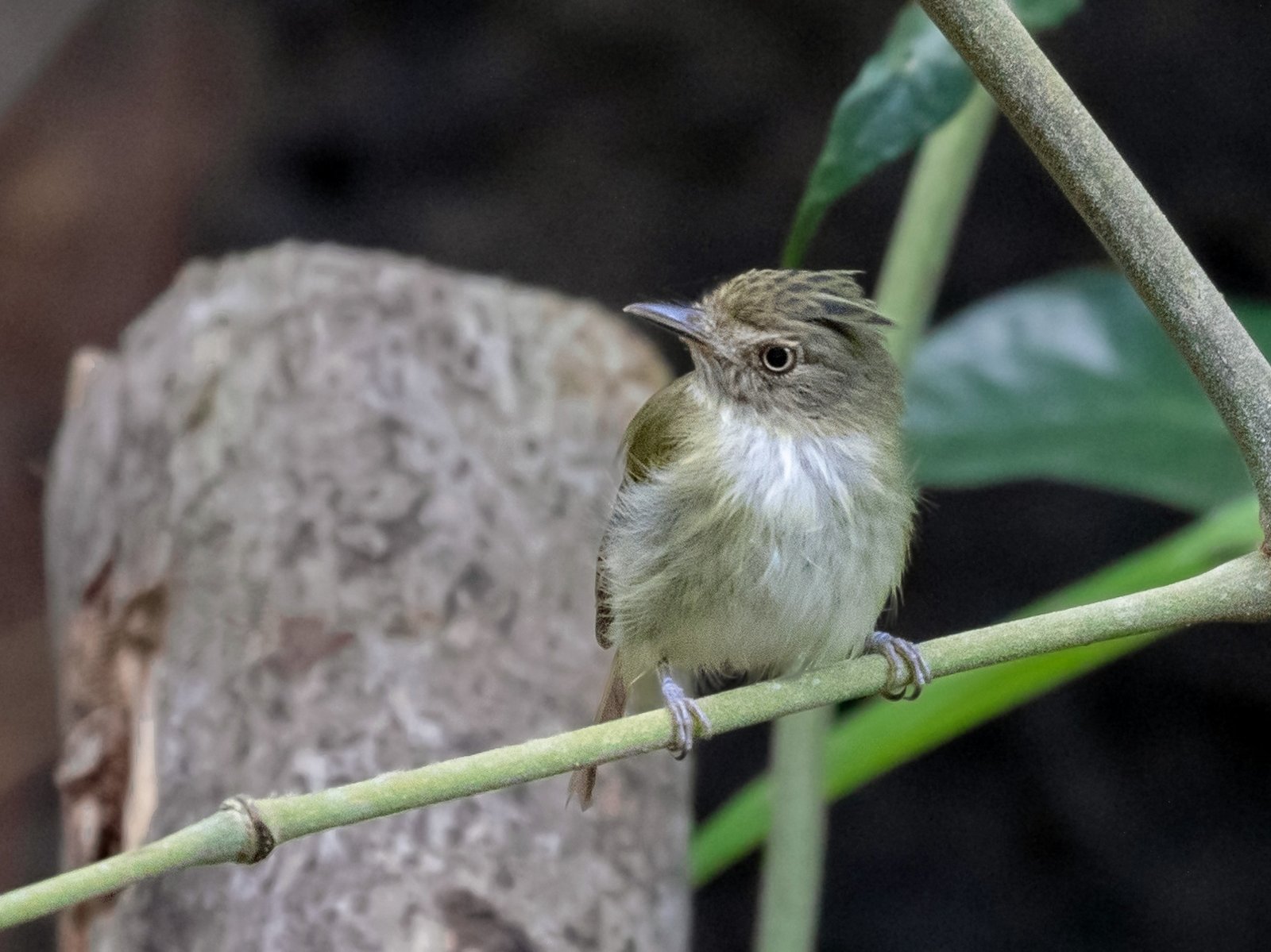
The Helmeted Pygmy Tyrant is a small tyrant flycatcher of lowland forest north of the Amazon. Its crest consists of elongated, grey-edged feathers that give the crown a streaked, helmet-like look. In the guide area it occurs only in the far east of Colombia and in north-eastern Peru.
Voice
Series of dry, sharp ticks that often accelerate and run into a short, rolling trill, usually repeated from the middle storey of the forest.
Recording: JAYRSON ARAUJO DE OLIVEIRA — CC BY-NC-SA 4.0 · xeno-canto
Identification
10 cm, with a rather long, flat bill and a short tail. The upperparts are olive-green, the crown dark olive-grey with long feathers edged pale grey. The throat and breast are dull white with grey streaks, the belly yellowish white. The wing bars are faint and the iris is pale yellow to orangish. The sexes are alike.
Confusion species
Double-banded Pygmy Tyrant Lophotriccus vitiosus has two distinct yellow wing bars and a crest with paler edges. Pale-eyed Pygmy Tyrant Atalotriccus pilaris also has a pale iris but no crest, shows wing bars and lives in drier woodland. White-eyed Tody-Tyrant Hemitriccus zosterops has a pale eye-ring and no streaked crown.
Habitat
The middle storey and lower canopy of humid lowland forest, especially forest edges, clearings, white-sand forest and secondary forest, in the guide area up to about 300 m. It takes small insects with short sallies to the undersides of leaves. The nest is a hanging pouch with a side entrance.
Where the bird is most at home, classified by the vegetation units of the Andes and the west coast.


Range and movements
Colombia: in the east, in the Amazon basin and the Orinoco drainage (Guainía, Vaupés, Amazonas). Peru: in the north-east, in Loreto, mainly north of the Amazon. Absent from Ecuador, Bolivia and the Galápagos. Outside the guide area in southern Venezuela, the Guianas and northern Brazil.
- Resident
- dark = core range, pale = thinly spread
How and when to look
Search the white-sand forest around Iquitos and at Allpahuayo-Mishana; listen for dry ticks running into a trill and look in the middle storey for a small bird with a streaked crown.
Conservation status
Least Concern. The species occurs over a large area of the Amazonian lowlands and also tolerates secondary forest and forest edges.
Scientific name
Lophotriccus galeatus | (Boddaert, 1783)
Boddaert described the species in 1783 as Motacilla Galeata; because it was later moved to another genus, the author and year stand in brackets. The genus Lophotriccus was introduced in 1884 by Berlepsch. The genus name combines Greek lophos, 'crest', with trikkos, an unidentified small bird. The species name comes from Latin galeatus, 'helmeted', referring to the crest. The specimen the first description was based on came from Cayenne, French Guiana.