All species › Passerines › Tyrant flycatchers and allies › Sharp-tailed Grass Tyrant
Sharp-tailed Grass Tyrant | Culicivora caudacuta
Puntstaarttiran | Tachurí coludo | Papa-moscas-do-campo
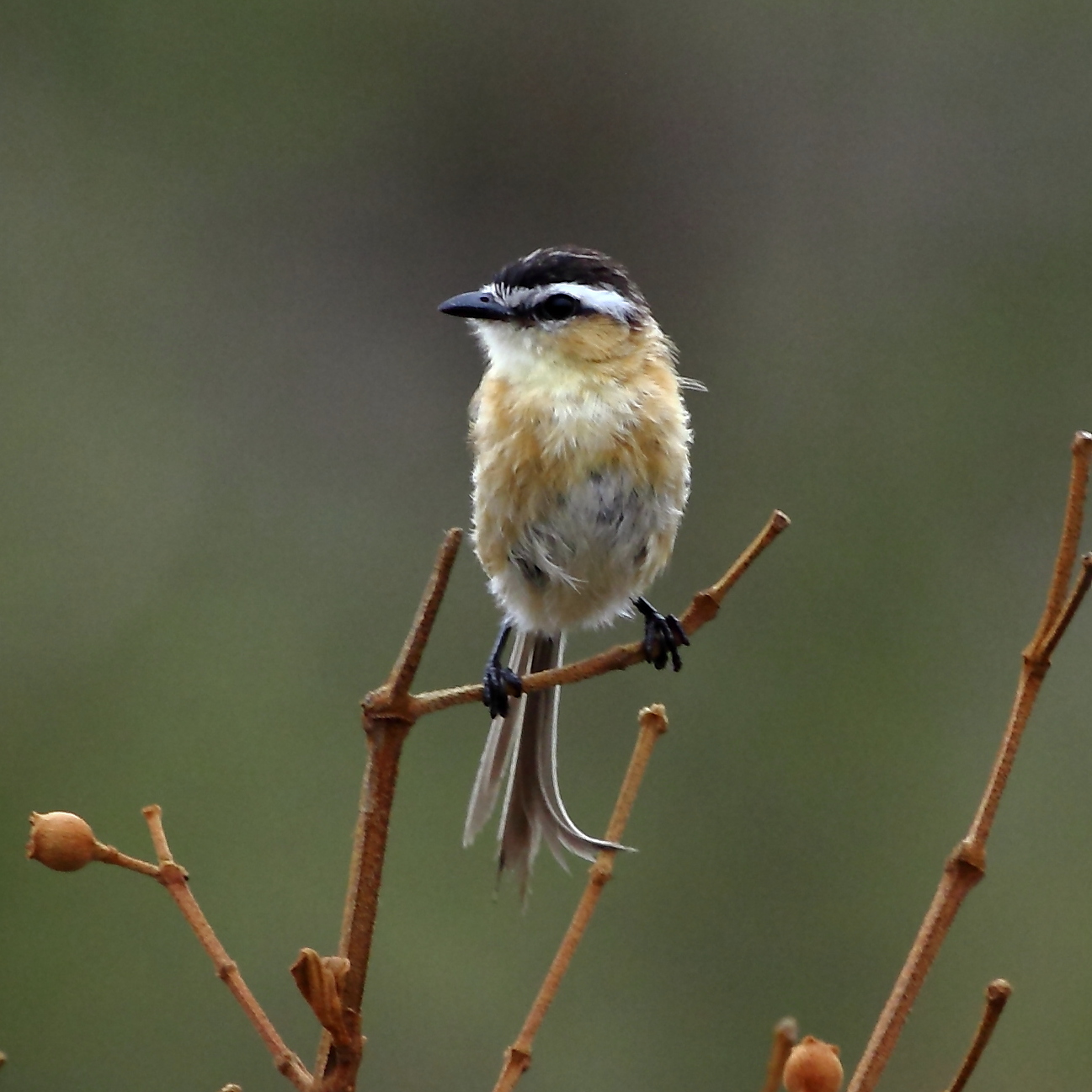
The Sharp-tailed Grass Tyrant is a tiny, streaked tyrant of tall natural grassland in the cerrado and savannas of South America. The long, narrow tail with pointed feather tips is unique among tyrants. In the guide area it occurs only in the savannas of eastern Bolivia and very locally in south-eastern Peru.
Voice
Soft, high, somewhat squeaky calls, and a short, soft song of buzzy notes, often in pairs or small groups.
Recording: JAYRSON ARAUJO DE OLIVEIRA — CC BY-NC-SA 4.0 · xeno-canto
Identification
11 cm, nearly half of which is tail, with a small, thin bill. The crown is brown streaked black, with a broad white supercilium and a dark eye-stripe. The upperparts are brown streaked black. The tail is long, graduated and narrow, with pointed, somewhat frayed feather tips. The throat and belly are white, the breast sides and flanks warm buff. The sexes are alike.
Confusion species
Bearded Tachuri Polystictus pectoralis has a shorter, normal tail and an unstreaked back; the male has a speckled throat. Rufous-sided Scrub Tyrant Euscarthmus rufomarginatus has an unstreaked brown back and a yellow belly. Female seedeaters are shorter-tailed and have a thick bill.
Habitat
Tall natural grassland, campo and dry to humid savanna with scattered low shrubs, in the lowlands up to about 1000 m. It climbs grass stems and catches small insects in the grass. It occurs in pairs or small groups, sometimes with seedeaters. It avoids heavily grazed and ploughed land. The nest is a cup low in the grass.
Where the bird is most at home, classified by the vegetation units of the Andes and the west coast.


Range and movements
In Bolivia in the savannas and cerrado of the eastern lowlands, in Beni and Santa Cruz. In Peru known only from the Pampas del Heath in Madre de Dios. Absent from Colombia, Ecuador and the Galápagos. Outside the guide area in the cerrado of Brazil, in Paraguay and locally in north-eastern Argentina.
- Resident
- dark = core range, pale = thinly spread
How and when to look
Search tall, ungrazed grassland in eastern Santa Cruz, for example in the Noel Kempff Mercado area, and look for small birds with long, pointed tails climbing up the stems.
Conservation status
Least Concern under the current assessment, formerly treated as Vulnerable. The population is declining through conversion of grassland and cerrado to fields and pasture and through fires.
Scientific name
Culicivora caudacuta | (Vieillot, 1818)
Vieillot described the species in 1818 as Muscicapa caudacuta; because it was later moved to another genus, the author and year stand in brackets. The genus Culicivora was introduced in 1827 by Swainson. The genus name comes from Latin culex, 'gnat', and -vorus, 'eating': 'gnat-eater'. From Latin cauda, 'tail', and acutus, 'pointed': 'sharp-tailed'. The specimen the first description was based on came from Paraguay.