All species › Passerines › Tyrant flycatchers and allies › White-headed Marsh Tyrant
White-headed Marsh Tyrant | Arundinicola leucocephala
Witkopwatertiran | Viudita cabeciblanca | Freirinha
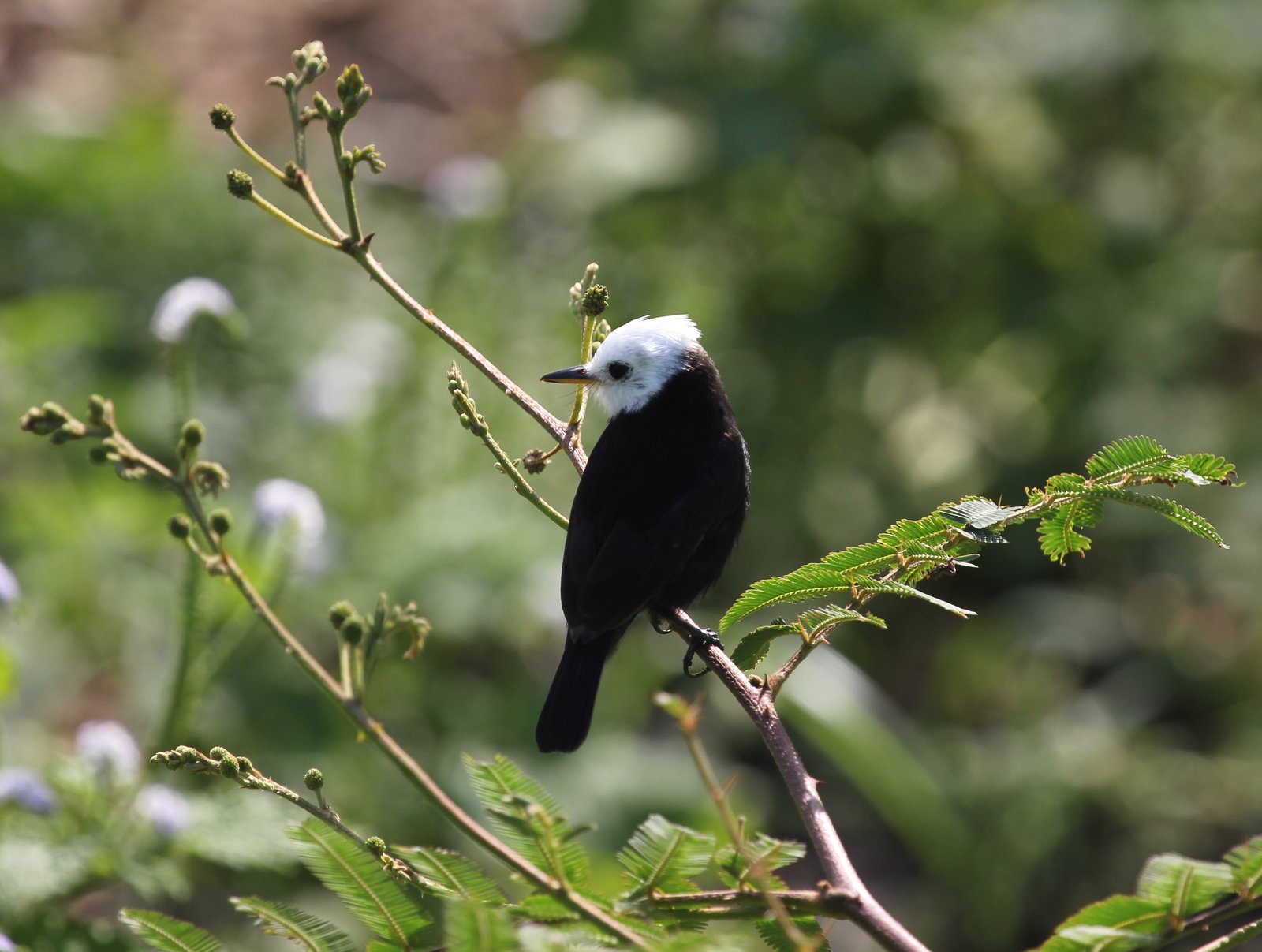
The White-headed Marsh Tyrant is a small marsh tyrant whose male is entirely black with a white head. It perches low on reed stems, small shrubs and posts at the edge of open water and sallies from there after insects. The female is greyish-brown with a white head and hardly resembles the male.
Voice
Usually silent. A soft, short tseep and a dry click.
Recording: JAYRSON ARAUJO DE OLIVEIRA — CC BY-NC-SA 4.0 · xeno-canto
Identification
12.5 cm. The male is black, with the whole head and throat white. The bill is black with a pale base to the lower mandible. The female is greyish-brown above and pale grey to whitish below, with a white forehead, face and throat and a darker tail. Juveniles resemble the female, with a brownish wash to the head.
Confusion species
Pied Water Tyrant Fluvicola pica is white with black wings, tail and back, and has a white belly, whereas the male White-headed Marsh Tyrant has a black body. Females may resemble a female Riverside Tyrant Knipolegus orenocensis or Amazonian Black Tyrant Knipolegus poecilocercus, but these lack the white face. Spectacled Tyrant Hymenops perspicillatus, a winter visitor in Bolivia, is larger and has a yellow eye-ring and white wing patches.
Habitat
Marshes with reeds and low shrubs, banks of lakes and oxbow lakes with floating plants, wet grassland, ditches and rice fields in the lowlands, mostly below 500 m. It hunts insects low over water and vegetation. The nest is a globular structure of grass and plant fibres with a side entrance, low in a shrub over water.
Where the bird is most at home, classified by the vegetation units of the Andes and the west coast.


Range and movements
Colombia: in the Caribbean lowlands, the Magdalena valley, the Llanos and the Amazonian lowlands. Ecuador: in the Amazonian lowlands. Peru: in the Amazonian lowlands. Bolivia: in the lowlands of the north and east, including the Beni savannas. Absent west of the Andes in Ecuador and Peru and from the Galápagos. Outside the guide area in Venezuela, the Guianas, Trinidad, Brazil, Paraguay and north-eastern Argentina.
- Resident
- dark = core range, pale = thinly spread
How and when to look
Search along the banks of oxbow lakes and in marshy pastures; the birds perch low and fairly openly on reed stems or posts. A boat trip along a lake shore usually produces sightings.
Conservation status
Least Concern. Common in suitable marshland.
Scientific name
Arundinicola leucocephala | (Linnaeus, 1764)
Linnaeus described the species in 1764 as Pipra leucocephala; because it was later moved to another genus, the author and year stand in brackets. The genus Arundinicola was introduced in 1840 by D'Orbigny, ACVMD. The genus name comes from Latin arundo, 'reed', and -cola, 'dweller': 'reed dweller'. The species name comes from Greek leukos, 'white', and kephalē, 'head'. The specimen the first description was based on came from Suriname.