All species › Passerines › Tyrant flycatchers and allies › Many-colored Rush Tyrant
Many-colored Rush Tyrant | Tachuris rubrigastra
Ornaattachuri | Tachurí sietecolores | Papa-piri
The Many-colored Rush Tyrant is a very small, multicoloured tyrant flycatcher of reedbeds and rush marshes. It lives both in the coastal marshes of Peru and on the lakes of the altiplano, up to over 4000 m. The genus Tachuris contains only this species.
Voice
Dry, ticking calls, tic or tic-tic, and a short, soft, scratchy song.
Recording: Cristian Pinto Fernandez — CC BY-NC-SA 4.0 · xeno-canto
Identification
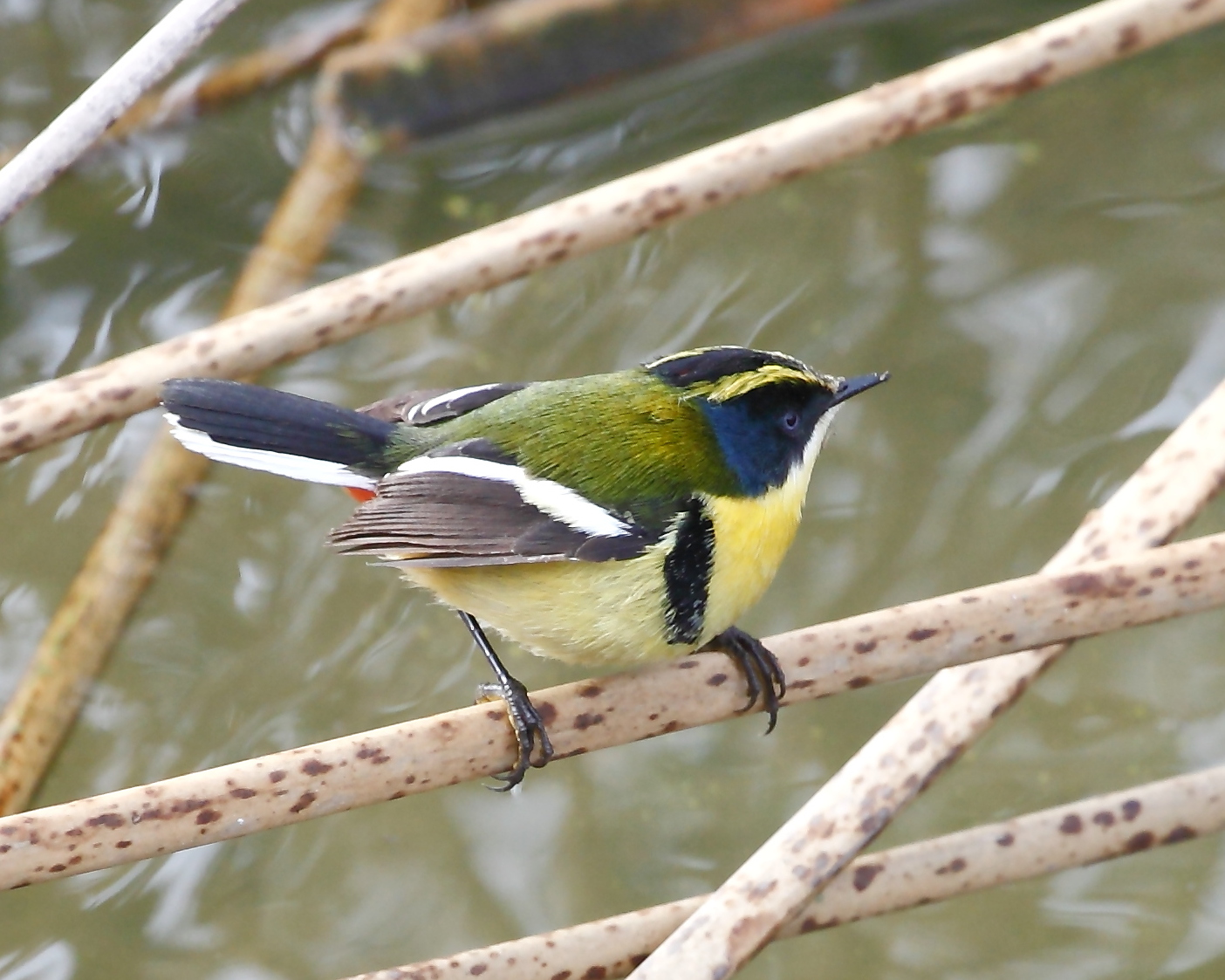
11 cm, with a thin bill and a fairly short tail. The crown is black with a concealed red central patch, bordered by a broad yellow supercilium; the face is dark. The back is green, the wings black with a white wing bar, the tail black with white outer feathers. The underparts are bright yellow, with a black patch on the side of the breast and orange-pink undertail coverts. The sexes are alike; juveniles are duller.
Confusion species
Wren-like Rushbird Phleocryptes melanops lives in the same reedbeds, but is brown and streaked, without yellow. Subtropical Doradito Pseudocolopteryx acutipennis is plain olive above and yellow below, without black and white markings. Ticking Doradito Pseudocolopteryx citreola is also olive and yellow and lacks the black head and the white wing bar.
Habitat
Reedbeds and rush marshes with totora (Schoenoplectus) and cattail in freshwater and brackish marshes, on lake shores and lagoons, from sea level to over 4000 m. It climbs along the stems and catches small insects, often just above the water. The nest is a deep, cone-shaped cup of plant material, attached to reed stems.
Where the bird is most at home, classified by the vegetation units of the Andes and the west coast.


Range and movements
In Peru along the coast in marshes and lagoons, and in the highlands on lakes such as Lake Junín and Lake Titicaca. In Bolivia on the altiplano, mainly around Lake Titicaca. Absent from Colombia, Ecuador and the Galápagos. Outside the guide area in Chile, Argentina, Paraguay, Uruguay and southern Brazil.
- Resident
- dark = core range, pale = thinly spread
How and when to look
At Pantanos de Villa near Lima and in the totora reedbeds along Lake Titicaca near Puno. Wait at the edge of the reeds; the bird often comes out briefly onto a stem and gives itself away by its ticking calls.
Conservation status
Least Concern. The species is locally common, but depends on marshes, which on the coast are being drained and built over.
Scientific name
Tachuris rubrigastra | (Vieillot, 1817)
Vieillot described the species in 1817 as Sylvia rubrigastra; because it was later moved to another genus, the author and year stand in brackets. The genus Tachuris was introduced in 1835 by De Lafresnaye. The genus name comes from tachurí, a Guaraní name ('ant-eater, grub-eater') for various small birds, used by Félix de Azara. The species name combines Latin ruber, 'red', with Greek gastēr, 'belly', after the red undertail area. The specimen the first description was based on came from Paraguay.