All species › Passerines › Tyrant flycatchers and allies › Long-tailed Tyrant
Long-tailed Tyrant | Colonia colonus
Langstaarttiran | Tirano colilargo | Viuvinha
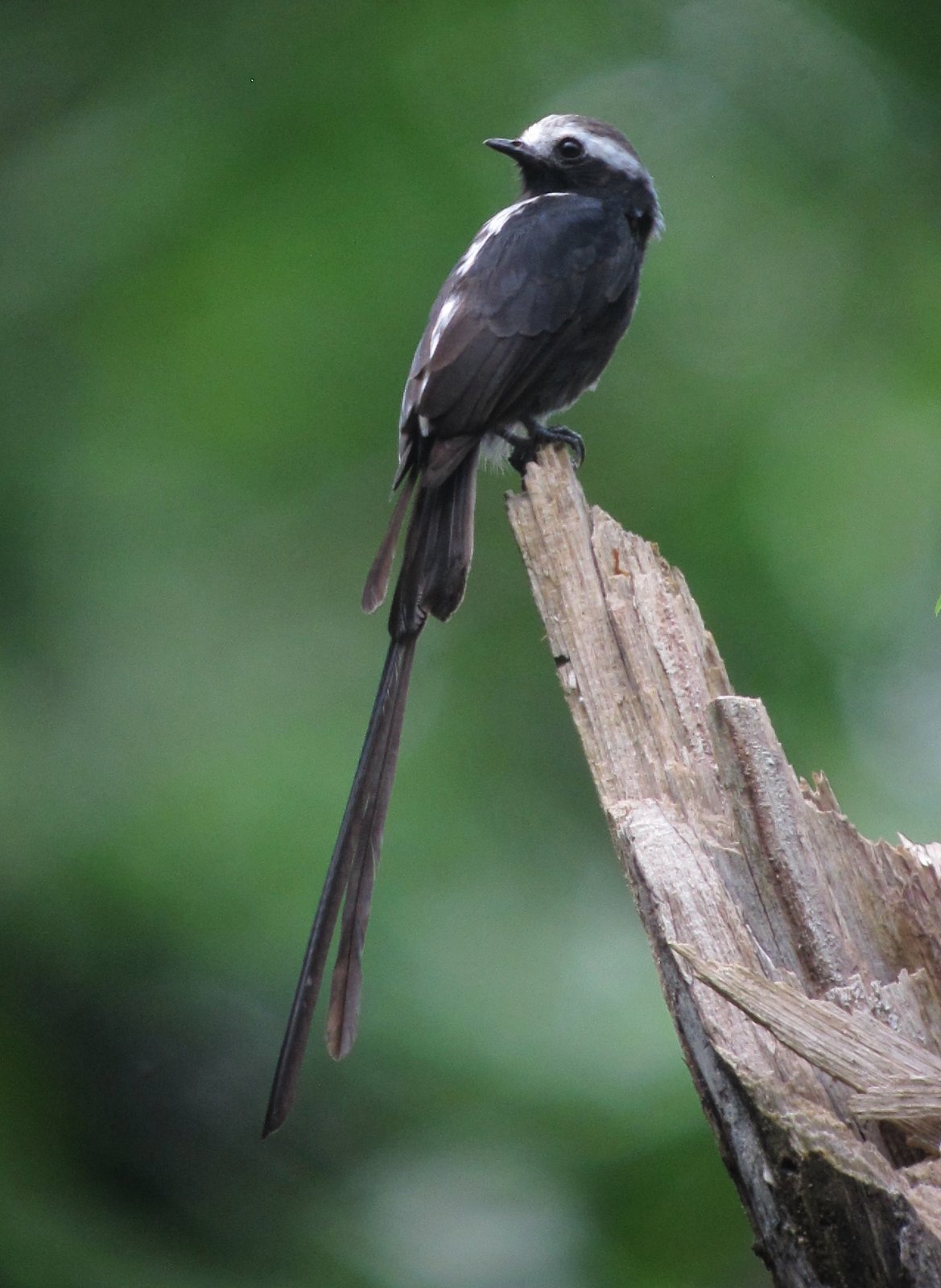
The Long-tailed Tyrant is a black tyrant with a greyish-white crown and, in the male, two greatly elongated central tail feathers. It almost always perches on top of a dead tree or a bare branch at the forest edge and sallies from there after flying insects. Pairs and small family groups keep the same perches for long periods.
Voice
A soft, rising whistle, sweet or weet, often repeated, also by both birds of a pair. Not loud.
Recording: JAYRSON ARAUJO DE OLIVEIRA — CC BY-NC-SA 4.0 · xeno-canto
Identification
18–25 cm, of which up to about 10 cm in the male consists of the elongated central tail feathers. Almost entirely black, with a greyish-white forehead, a greyish-white crown and supercilium and a whitish stripe or patch on the back. The bill is short and black. The female has shorter central tail feathers and a greyer crown. Juveniles are duller blackish-brown, with short central tail feathers.
Confusion species
Males of the black tyrants, such as Amazonian Black Tyrant Knipolegus poecilocercus and Riverside Tyrant Knipolegus orenocensis, are black or slaty, without a pale crown and without elongated tail feathers, and live in riverside vegetation. Black Phoebe Sayornis nigricans has a white belly and perches by running water. Flying swallows can resemble a sallying Long-tailed Tyrant, but do not return to the same branch.
Habitat
Forest edges, clearings with dead trees, riverbanks and cut-over areas in humid lowland and foothill forest, and semi-open country with tall, bare trees such as shaded coffee and cacao. Mainly between 300 and 1500 m, locally lower and higher. It hunts flying insects from a high, bare perch. It nests in an old woodpecker hole or another cavity in a dead tree.
Where the bird is most at home, classified by the vegetation units of the Andes and the west coast.


Range and movements
Colombia: on the Pacific side, in the Magdalena and Cauca valleys and in the foothills east of the Andes. Ecuador: in the west in the lowlands and foothills, in the east in the foothills and adjacent lowlands. Peru: along the eastern slope of the Andes and in the adjacent lowlands. Bolivia: in the Yungas foothills and adjacent lowlands. Absent from the Galápagos. Outside the guide area from Honduras to Panama, in Venezuela and, separately, in south-eastern Brazil, Paraguay and north-eastern Argentina.
- Resident
- dark = core range, pale = thinly spread
How and when to look
Search along roads through the foothills where dead trees stand at the forest edge; the birds often perch at the top and return to the same branch after each flight. The male is recognisable in silhouette by its long central tail feathers.
Conservation status
Least Concern. It locally benefits from forest edges and clearings.
Scientific name
Colonia colonus | (Vieillot, 1818)
Vieillot described the species in 1818 as Muscicapa colonus; because it was later moved to another genus, the author and year stand in brackets. The genus Colonia was introduced in 1828 by Gray. The genus name is based on 'El Colon' of Félix de Azara (1805) and the species name colonus, Latin for 'farmer, colonist'; Spanish settlers in Paraguay and Argentina called the bird colon. Latin colonus, 'farmer, rustic; colonist, inhabitant'. Spanish settlers in Paraguay and Argentina called this bird colon. The specimen the first description was based on came from Paraguay.