All species › Passerines › Tyrant flycatchers and allies › Yellow Tyrannulet
Yellow Tyrannulet | Capsiempis flaveola
Gele looftiran | Mosquerito amarillo | Marianinha-amarela
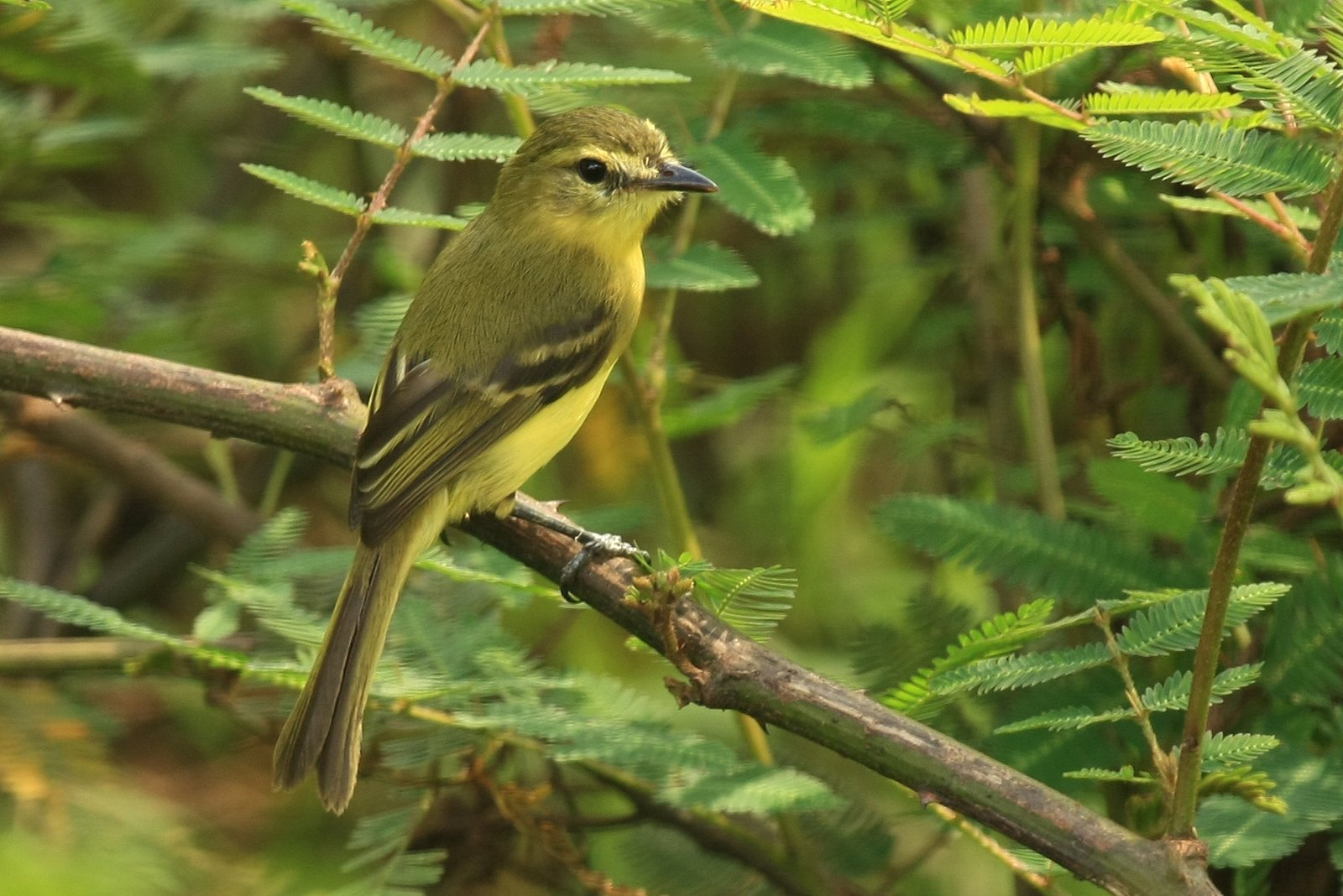
The Yellow Tyrannulet is a small, mainly yellow, long-tailed tyrant flycatcher that moves through shrubbery and forest edges in pairs or family groups. It often holds its tail cocked and flicks it from side to side. The species is widespread in the lowlands of Central and South America and in the guide area has a western and an eastern population.
Voice
A fast, dry chatter or rolling trill, di-di-di-di-dit, often given as a duet by the pair, and short, sharp calls.
Recording: Juan Freile — CC BY-NC-SA 4.0 · xeno-canto
Identification
11 cm, with a short, narrow bill and a rather long tail. The upperparts are olive-green, the head slightly greener, with a distinct yellow eyebrow and a dark eyestripe. The wings are dark, with two yellowish wing bars and yellow edges to the flight feathers. The underparts are bright yellow, washed olive on the sides of the breast. The sexes are alike; young birds are duller.
Confusion species
Yellow-crowned Tyrannulet Tyrannulus elatus has a grey head with a yellow crown patch, a shorter tail and a different voice. Golden-faced Tyrannulet Zimmerius chrysops has a yellow face but no obvious wing bars, and lives higher in the mountains. Yellow-olive Flatbill Tolmomyias sulphurescens has a broad, flat bill and a greyish head. Ecuadorian Tyrannulet Phylloscartes gualaquizae has a grey crown and stays higher in the canopy of foothill forest.
Habitat
Shrubbery, young secondary forest, forest edges, clearings with bushes and riverbanks, in the east also bamboo; mainly in the lowlands and foothills up to about 1200 m, locally higher. It searches for insects among the leaves in low and middle foliage, often in pairs and sometimes with mixed flocks. The nest is a small cup of plant fibres in a shrub.
Where the bird is most at home, classified by the vegetation units of the Andes and the west coast.


Range and movements
Colombia: in the north, in the Caribbean lowlands and the Magdalena valley, in the llanos and locally in the east. Ecuador: in the west from Esmeraldas to El Oro, and locally in the eastern lowlands. Peru: in the east, mainly in San Martín, Loreto, Cusco and Madre de Dios, and in the far north-west in Tumbes. Bolivia: in the north, mainly in Beni and Pando. Absent from the Galápagos. Outside the guide area from Nicaragua to Venezuela, the Guianas, Brazil, Paraguay and north-eastern Argentina.
- Resident
- dark = core range, pale = thinly spread
How and when to look
In shrubbery along forest edges and roads, watch for pairs with cocked tails and listen for their duetting chatter. In western Ecuador the species is regularly found in secondary growth around Mindo and in the lowlands of Guayas.
Conservation status
Least Concern. The species benefits from secondary growth and forest edges and is fairly common over much of its range.
Scientific name
Capsiempis flaveola | (Lichtenstein, 1823)
Lichtenstein described the species in 1823 as M[uscicapa] flaveola; because it was later moved to another genus, the author and year stand in brackets. The genus Capsiempis was introduced in 1860 by Cabanis & Heine. The genus name comes from Greek kaptō (kapsō), 'to gulp down', and empis, 'gnat'. Latin flaveolus, 'yellowish', after the yellow plumage. The specimen the first description was based on came from Bahia, Brazil.