All species › Passerines › Tyrant flycatchers and allies › Cinnamon Attila
Cinnamon Attila | Attila cinnamomeus
Kaneelattila | Atila canelo | Tinguaçu-ferrugem
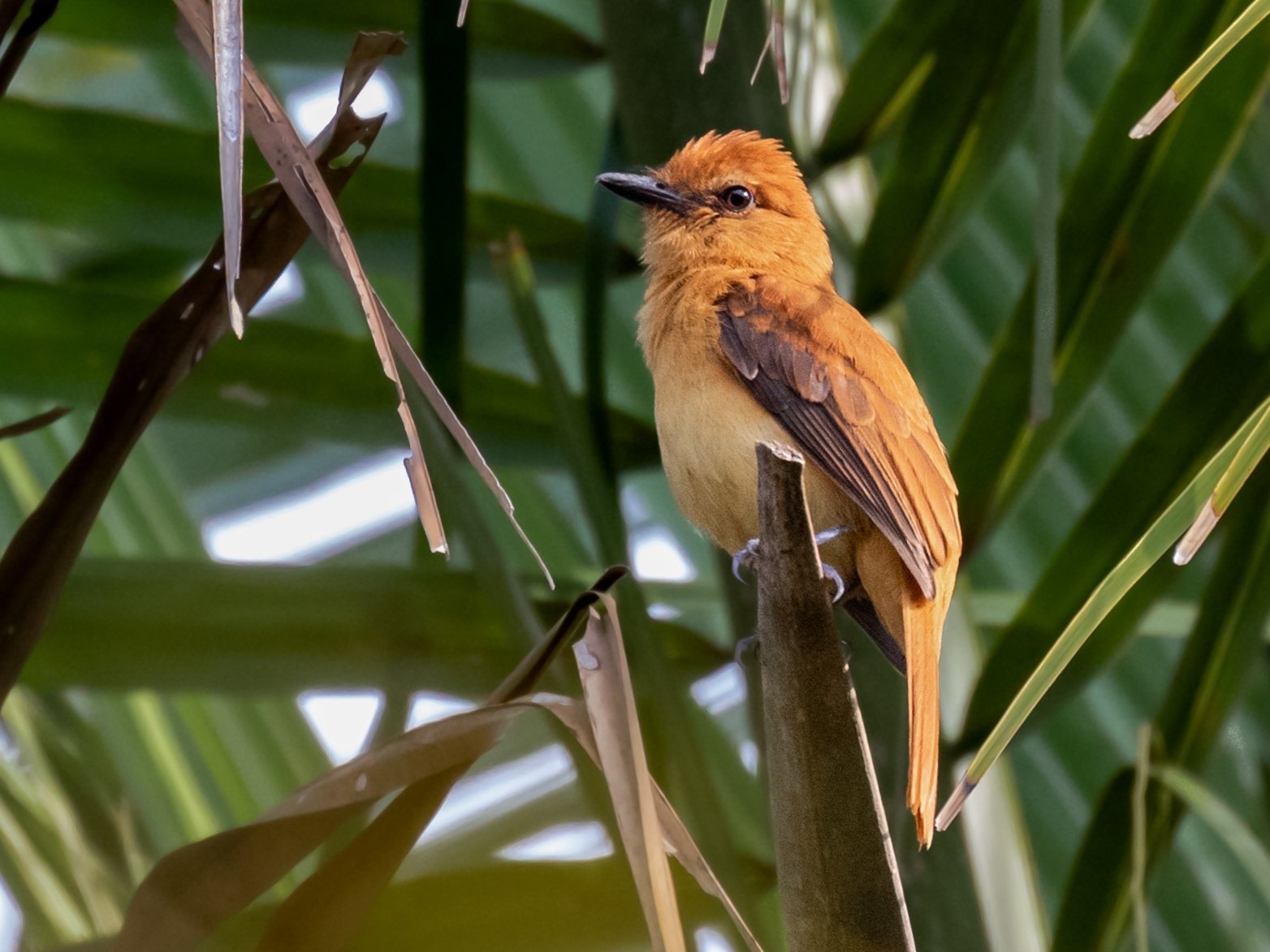
The Cinnamon Attila is a uniformly cinnamon-rufous attila of flooded forest in Amazonia. It sits still for long periods in the middle storey and reveals itself mainly by its loud, whistled song. It is less variable in colour than the Bright-rumped Attila.
Voice
A loud, whistled, two-part tuu-tweeer, the second note slurred, repeated at intervals; also a rising series of whistles.
Recording: JAYRSON ARAUJO DE OLIVEIRA — CC BY-NC-SA 4.0 · xeno-canto
Identification
19 cm. A sturdy attila with a large head and a black bill hooked at the tip. The upperparts are cinnamon-rufous, the rump slightly paler and more ochre. Wings and tail are darker, with blackish primaries and rufous edges. The underparts are paler cinnamon, the belly pale ochre-rufous. The eye is dark. Sexes alike.
Confusion species
Rufous Mourner Rhytipterna holerythra occurs in the guide area only west of the Andes, is smaller and lacks the hooked bill. Bright-rumped Attila Attila spadiceus has a yellow rump, a streaked breast and wing-bars. Citron-bellied Attila Attila citriniventris has a grey head and a lemon-yellow belly. White-eyed Attila Attila bolivianus has a white eye.
Habitat
Várzea, igapó, swamp forest, palm swamps and forest along oxbow lakes and rivers, mainly in the middle storey and at forest edges along the water; in the lowlands, mostly below 500 m. It catches large insects and small vertebrates, which it snatches from leaves and branches, and also eats fruit.
Where the bird is most at home, classified by the vegetation units of the Andes and the west coast.


Range and movements
Colombia: in Amazonia and the east. Ecuador: in the eastern lowlands. Peru: in the lowlands east of the Andes. Bolivia: in the lowlands of the north. Absent from the Galápagos. Outside the guide area in southern Venezuela, the Guianas and Amazonian Brazil.
- Resident
- dark = core range, pale = thinly spread
How and when to look
Listen along rivers and oxbow lakes, for instance from a canoe, for the slurred, whistled song. The bird often sits for a long time on one branch in the middle storey at the water's edge.
Conservation status
Least Concern. Widespread in flooded forest in Amazonia.
Scientific name
Attila cinnamomeus | (Gmelin, 1789)
Gmelin described the species in 1789 as [Muscicapa] cinnamomea; because it was later moved to another genus, the author and year stand in brackets. The genus Attila was introduced in 1831 by Lesson. The genus name refers to Attila the Hun, who attacked Rome and Orléans in the 5th century. The species name comes from Latin cinnamomeus, 'cinnamon-coloured'. The specimen the first description was based on came from Cayenne, French Guiana.