All species › Passerines › Tyrant flycatchers and allies › Ochraceous Attila
Ochraceous Attila | Attila torridus
Okerattila | Atila ocráceo | Tinguaçu-ocráceo
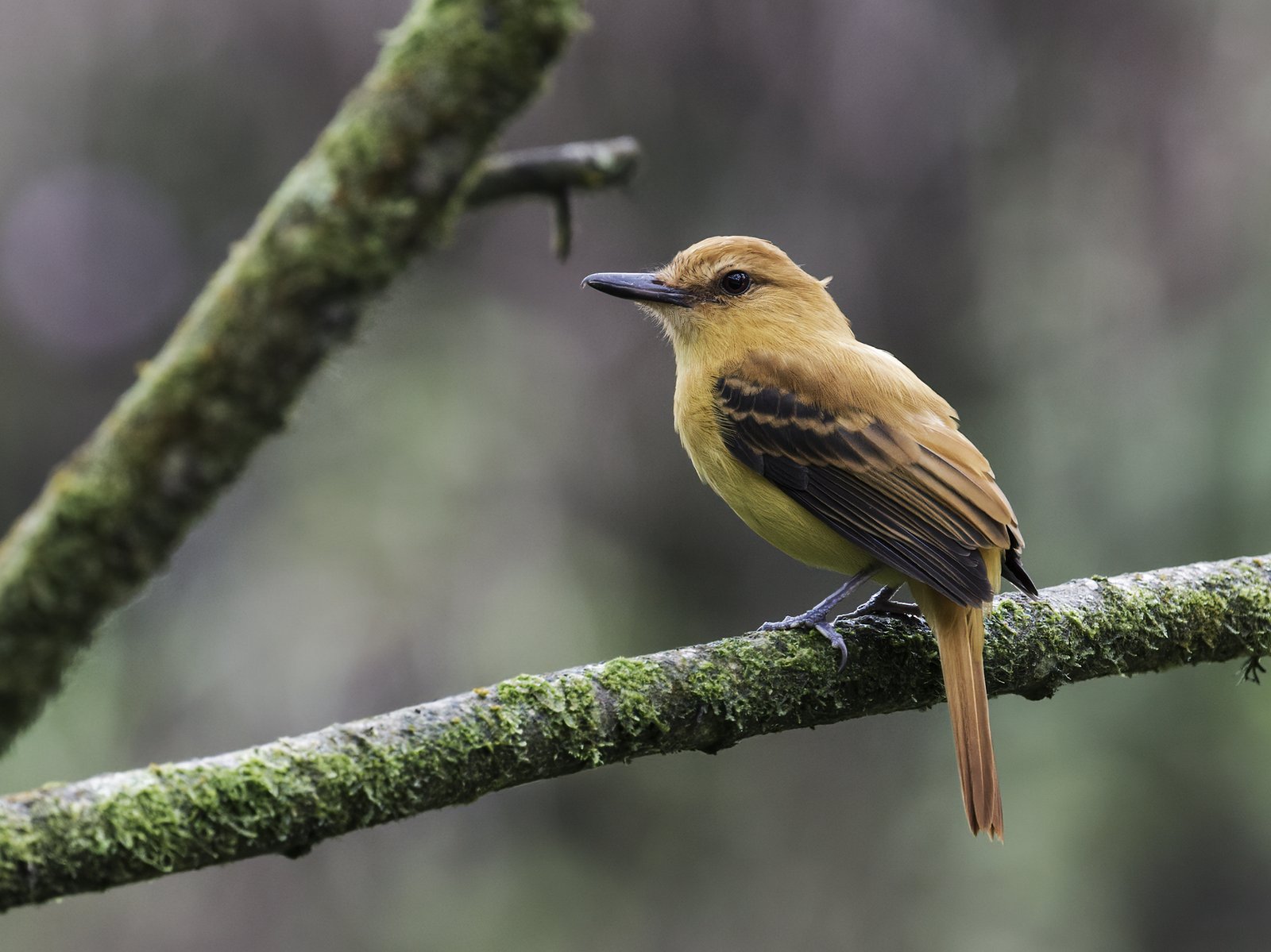
The Ochraceous Attila is the largest attila of the guide area and a characteristic species of the forests west of the Andes in Ecuador and adjacent Colombia and Peru. It often sits still for long periods in the middle storey and is identified mainly by its loud song.
Voice
A loud series of whistles, wee-wee-wee-wee-weeeer, increasing in volume and ending on a falling note; also single, sharp whistles.
Recording: Peter de Rouw — CC BY-NC-SA 4.0 · xeno-canto
Identification
20–21 cm. A large, sturdy attila with a heavy bill hooked at the tip. Head, underparts and rump are ochre-yellow to ochre-cinnamon, the mantle more rufous. The wings are blackish, with broad cinnamon edges and wing-bars; the tail is cinnamon-rufous. The throat and belly are paler, more yellowish. Sexes alike.
Confusion species
Bright-rumped Attila Attila spadiceus is smaller, with a streaked breast, a yellow rump and a darker, olive or rufous mantle. Rufous Mourner Rhytipterna holerythra is smaller, uniformly rufous-brown, without a hooked bill and without pale wing-bars. Tropical Royal Flycatcher Onychorhynchus coronatus is smaller, with a flat, broad bill.
Habitat
Humid and semi-humid forest, older secondary growth and forest edges, in the south also the more humid parts of dry forest; from the lowlands to about 1500 m, mostly lower. It forages in the middle storey and canopy for large insects, small lizards and fruit.
Where the bird is most at home, classified by the vegetation units of the Andes and the west coast.


Range and movements
Colombia: rare in the extreme south-west (Nariño). Ecuador: in the lowlands and foothills west of the Andes, from Esmeraldas to El Oro and Loja. Peru: in the north-west, in Tumbes and adjacent Piura. Not in Bolivia and absent from the Galápagos. Occurs nowhere outside the guide area.
- Resident
- dark = core range, pale = thinly spread
How and when to look
Search in forest reserves in western Ecuador, such as in the coastal hills and the foothills of the western Andes, and listen in the morning for the swelling whistled series.
Conservation status
Near Threatened. The population is declining owing to the clearance of humid and semi-humid forest in western Ecuador and north-western Peru.
Scientific name
Attila torridus | Sclater, 1860
Sclater described the species in 1860 and placed it straight away in the genus where it still stands. The genus Attila was introduced in 1831 by Lesson. The genus name refers to Attila the Hun, who attacked Rome and Orléans in the 5th century. The species name comes from Latin torridus, 'parched, scorched', probably referring to the ochre colour or the hot lowlands. The specimen the first description was based on came from Babahoyo, Los Ríos, Ecuador.