All species › Passerines › Tyrant flycatchers and allies › Citron-bellied Attila
Citron-bellied Attila | Attila citriniventris
Geelbuikattila | Atila ventricitrino | Tinguaçu-de-barriga-amarela
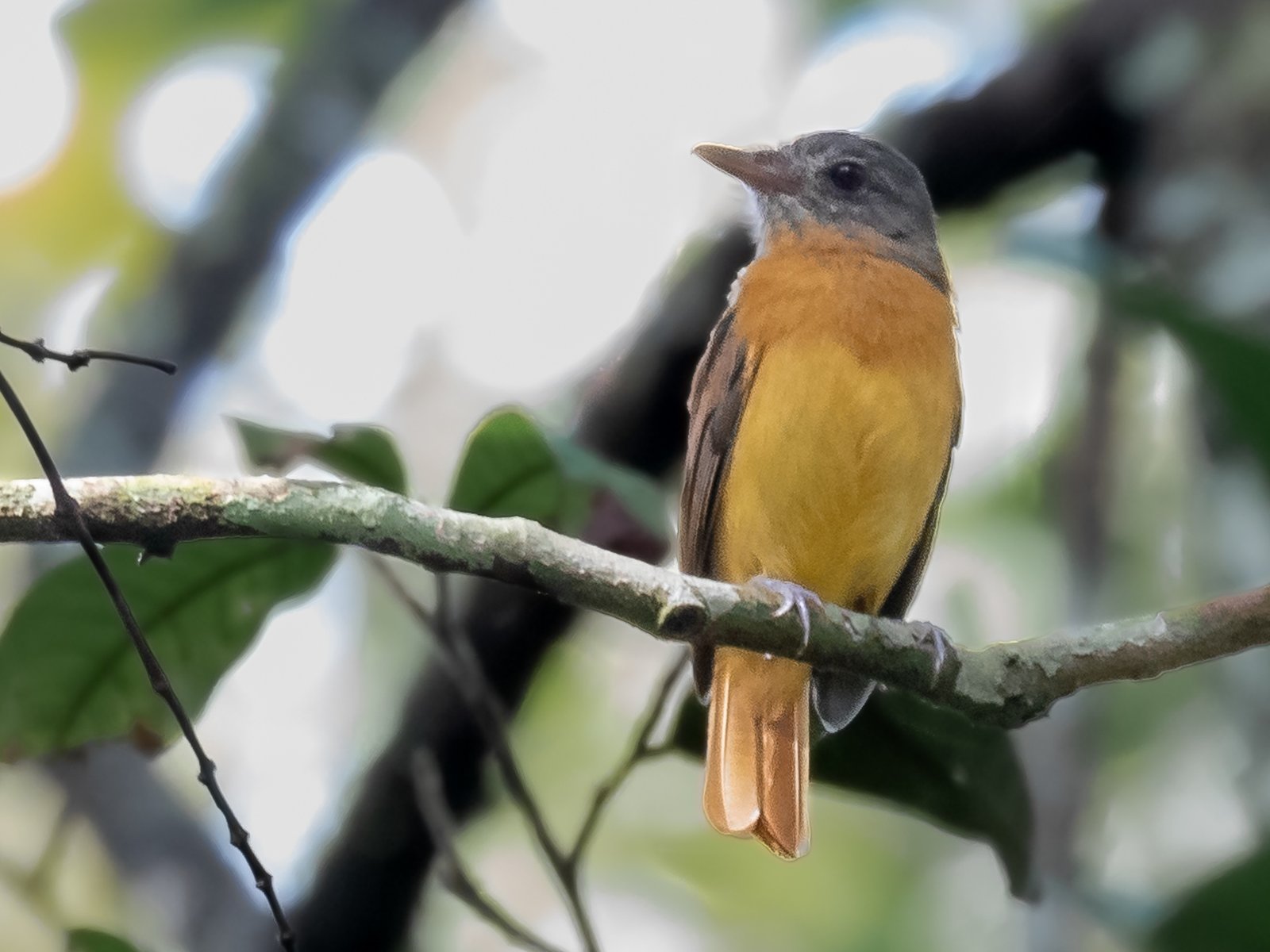
The Citron-bellied Attila is an attila of western Amazonia, where it occurs mainly in forest on poor white-sand soils. It lives high in the canopy and is detected mainly by its long, whistled song.
Voice
A long series of clear whistles that gradually rises and increases in volume and ends abruptly, sometimes with a final falling note.
Recording: JAYRSON ARAUJO DE OLIVEIRA — CC BY-NC-SA 4.0 · xeno-canto
Identification
18 cm. A medium-sized attila with a black bill hooked at the tip. The head is grey, the mantle rufous-brown and the rump cinnamon-rufous. Wings and tail are brown with rufous edges. The throat is greyish, the breast cinnamon, merging into a citron to yellow belly. The eye is dark. Sexes alike.
Confusion species
Bright-rumped Attila Attila spadiceus has a yellow rump, a streaked breast and distinct wing-bars. Cinnamon Attila Attila cinnamomeus is uniformly cinnamon-rufous, without a grey head or yellow belly, and lives in flooded forest. White-eyed Attila Attila bolivianus has a white eye and uniformly rufous underparts.
Habitat
Humid terra firme lowland forest, especially forest on white sand with a low, dense canopy (varillal), mostly below 300 m. It forages in the middle storey and canopy for large insects and fruit.
Where the bird is most at home, classified by the vegetation units of the Andes and the west coast.

Range and movements
Colombia: in the south-east, in Amazonia. Ecuador: local and scarce in the eastern lowlands. Peru: in the north-east, mainly in Loreto. Not in Bolivia and absent from the Galápagos. Outside the guide area in southern Venezuela and north-western Amazonian Brazil.
- Resident
- dark = core range, pale = thinly spread
How and when to look
Search in white-sand forest around Iquitos in Peru, such as in the reserves along the road to Nauta, and listen in the morning for the rising whistled series from the canopy.
Conservation status
Least Concern. Locally distributed, but its white-sand habitat is fragmented and is being cleared in some places.
Scientific name
Attila citriniventris | Sclater, 1859
Sclater described the species in 1859 and placed it straight away in the genus where it still stands. The genus Attila was introduced in 1831 by Lesson. The genus name refers to Attila the Hun, who attacked Rome and Orléans in the 5th century. The species name comes from Latin citrinus, 'citron-yellow', and venter, 'belly'. The specimen the first description was based on came from Río Ucayali, Peru.