All species › Passerines › Tyrant flycatchers and allies › Buff-throated Tody-Tyrant
Buff-throated Tody-Tyrant | Hemitriccus rufigularis
Bruinkeeltodietiran | Titirijí gorjirrufo | Maria-de-garganta-ocre
The Buff-throated Tody-Tyrant is a small, olive tyrant flycatcher of the lower east slope of the Andes, from Ecuador to Bolivia. It lives mainly on forested ridges in the foothills and has a local, patchy distribution.
Voice
A series of short, slightly nasal notes, sometimes accelerating, and single dry 'tik' calls.
Recording: Juan Freile — CC BY-NC-SA 4.0 · xeno-canto
Identification
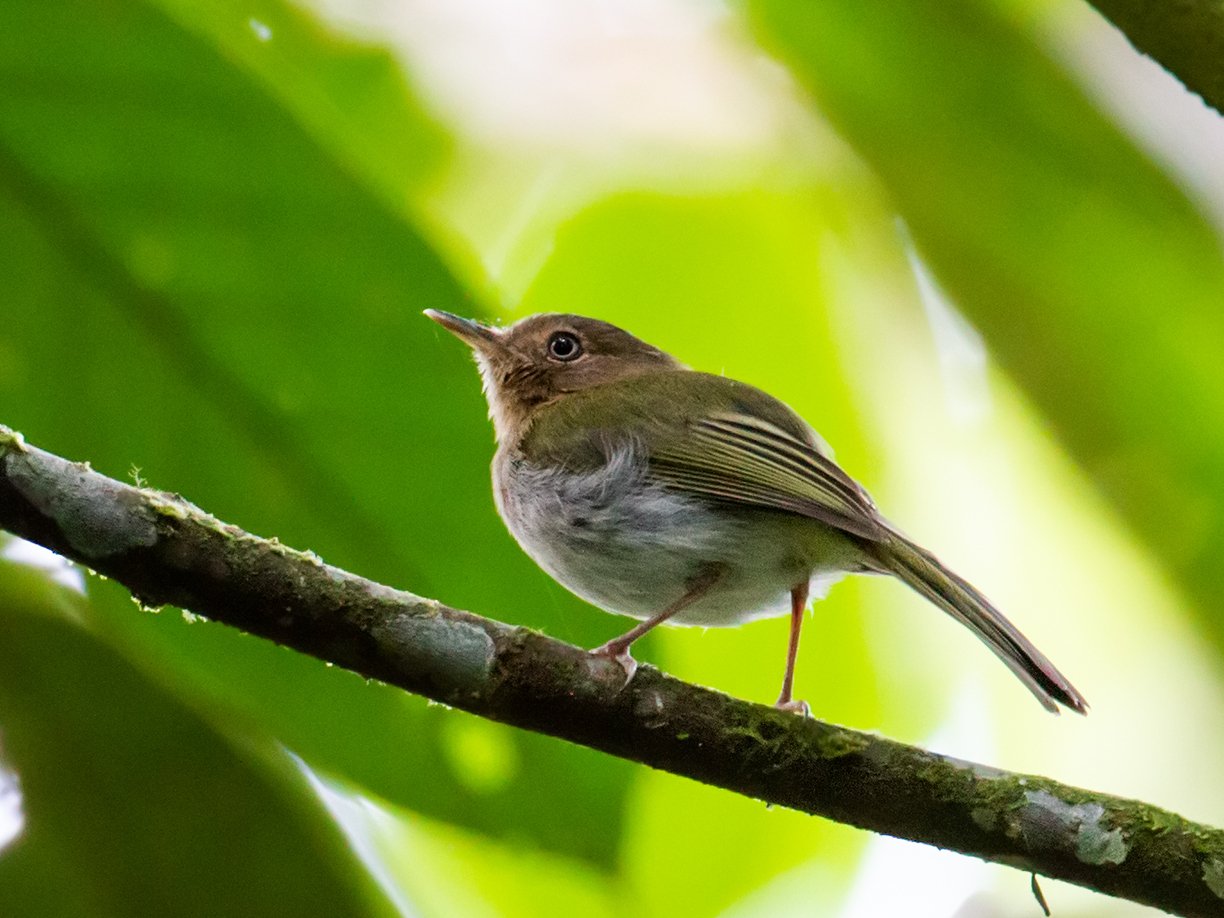
11 cm, with a rather long, flat bill. The upperparts are olive-green, without wing bars; the flight feathers have narrow pale edges. The lores, throat and upper breast are buff to pale brown, the breast is faintly streaked olive-grey, and the belly is whitish with a yellow tinge. The eye is dark. The sexes are alike.
Confusion species
Cinnamon-breasted Tody-Tyrant Hemitriccus cinnamomeipectus has a warmer cinnamon colour extending onto the breast, a yellow belly and a pale eye, and lives higher, on mossy ridges. White-eyed Tody-Tyrant Hemitriccus zosterops has a white eye-ring, wing bars and a greyish throat, and lives in the lowlands. Yungas Tody-Tyrant Hemitriccus spodiops has grey lores and no buff throat, and lives in the Yungas of Bolivia.
Habitat
Humid foothill and lower montane forest, especially on ridges and steep slopes, roughly between 600 and 1500 m. It keeps to the middle level and the lower canopy and catches insects with short sallies to leaves. The nest has been little described.
Where the bird is most at home, classified by the vegetation units of the Andes and the west coast.


Range and movements
Ecuador: local on the east slope, mainly in the south. Peru: scattered along the east slope over the full length of the country. Bolivia: in the foothills of La Paz, Cochabamba and Santa Cruz. Absent from Colombia and the Galápagos. Does not occur outside the guide area.
- Resident
- dark = core range, pale = thinly spread
How and when to look
Search ridge-top forest at around 1000 m on the east slope, for example along roads that cross the foothills, and listen for the series of nasal notes.
Conservation status
Least Concern. The species has a patchy distribution, and deforestation of the foothill zone is a local threat.
Scientific name
Hemitriccus rufigularis | (Cabanis, 1873)
Cabanis described the species in 1873 as Euscarthmus rufigularis; because it was later moved to another genus, the author and year stand in brackets. The genus Hemitriccus was introduced in 1860 by Cabanis & Heine. The genus name comes from Greek hēmi-, 'half, small', and trikkos, an unidentified small bird, used by ornithologists for tyrant flycatchers. The species name comes from Latin rufus, 'rufous', and gula, 'throat'. The specimen the first description was based on came from Monterico, Peru.