All species › Passerines › Tyrant flycatchers and allies › Cinnamon-breasted Tody-Tyrant
Cinnamon-breasted Tody-Tyrant | Hemitriccus cinnamomeipectus
Kaneelborsttodietiran | Titirijí pechicanelo | Maria-de-peito-canela
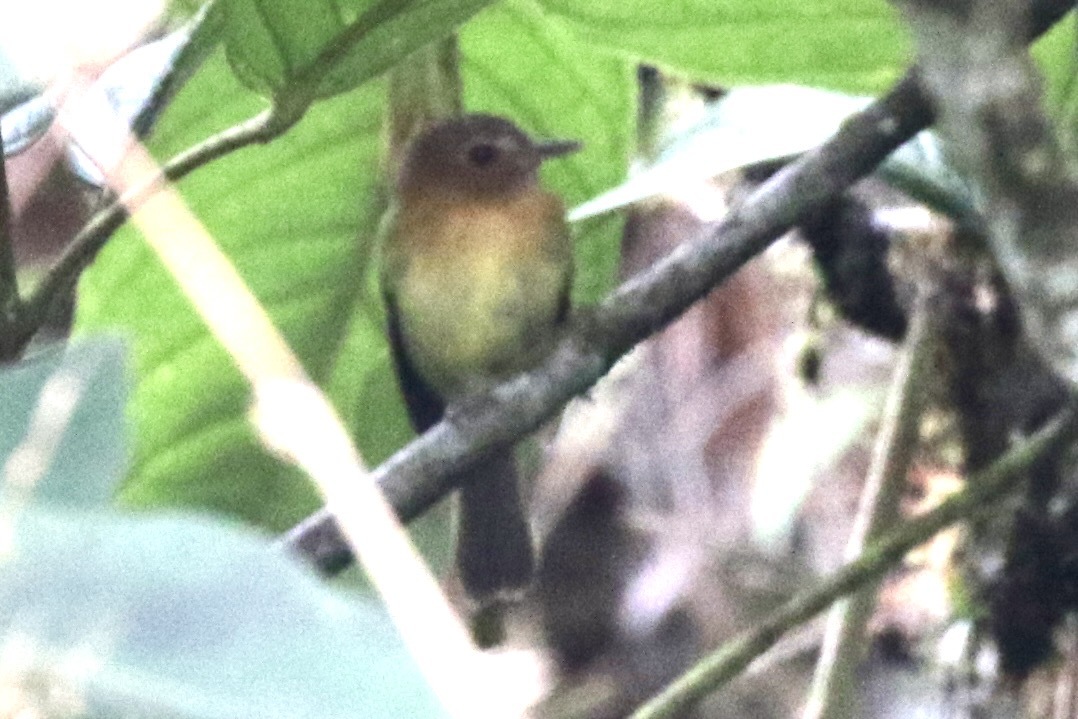
The Cinnamon-breasted Tody-Tyrant is a small tyrant flycatcher with a cinnamon throat and breast, found only on a few isolated ridges on the east slope of the Andes in southern Ecuador and northern Peru. It lives in low, mossy cloud forest on the crests of sandstone ridges and was described only in 1982.
Voice
Short series of high, sharp ticks and a thin, dry trill. Calls mainly in the morning.
Recording: Paul Coopmans — CC BY-NC-SA 4.0 · xeno-canto
Identification
10 cm, with a rather long, flat bill and a short tail. The upperparts are olive-green, the crown slightly browner. The lores, cheeks, throat and breast are warm cinnamon, and the belly is pale yellow. The wings are dusky with narrow yellow edges, without obvious wing bars. The eye is pale yellow to orange. The sexes are alike.
Confusion species
Buff-throated Tody-Tyrant Hemitriccus rufigularis has only the throat and upper breast buff, a whitish belly and a dark eye, and lives lower, in foothill forest. Black-throated Tody-Tyrant Hemitriccus granadensis has a blackish throat and pale spectacles, and lives in higher cloud forest.
Habitat
Low, dense, mossy cloud forest and elfin forest on narrow ridges, often on poor sandstone soils, roughly between 1700 and 2200 m. It sits quietly in the middle and lower levels and catches small insects with short sallies to the undersides of leaves. The nest has been little described.
Where the bird is most at home, classified by the vegetation units of the Andes and the west coast.


Range and movements
Ecuador: only in the south-east, in the Cordillera del Cóndor and nearby ridges in Zamora-Chinchipe. Peru: in the north, on isolated ridges on the east slope in Amazonas and San Martín. Absent from Colombia, Bolivia and the Galápagos. Does not occur outside the guide area.
- Resident
- dark = core range, pale = thinly spread
How and when to look
Search mossy ridges at around 2000 m in the Cordillera del Cóndor or northern Peru, along trails that follow the crest; listen for the high series of ticks and look into the low, dense forest.
Conservation status
Least Concern. The range is small and fragmented, and mining and deforestation in the Cordillera del Cóndor are a local threat.
Scientific name
Hemitriccus cinnamomeipectus | Fitzpatrick & O'Neill, 1979
Fitzpatrick & O'Neill described the species in 1979 and placed it straight away in the genus where it still stands. The genus Hemitriccus was introduced in 1860 by Cabanis & Heine. The genus name comes from Greek hēmi-, 'half, small', and trikkos, an unidentified small bird, used by ornithologists for tyrant flycatchers. The species name comes from Latin cinnamomeus, 'cinnamon-coloured', and pectus, 'breast'. The specimen the first description was based on came from Cordillera del Cóndor above San José de Lourdes, Cajamarca, Peru.