All species › Passerines › Tyrant flycatchers and allies › Black-throated Tody-Tyrant
Black-throated Tody-Tyrant | Hemitriccus granadensis
Zwartkeeltodietiran | Titirijí gorjinegro | Maria-de-garganta-preta
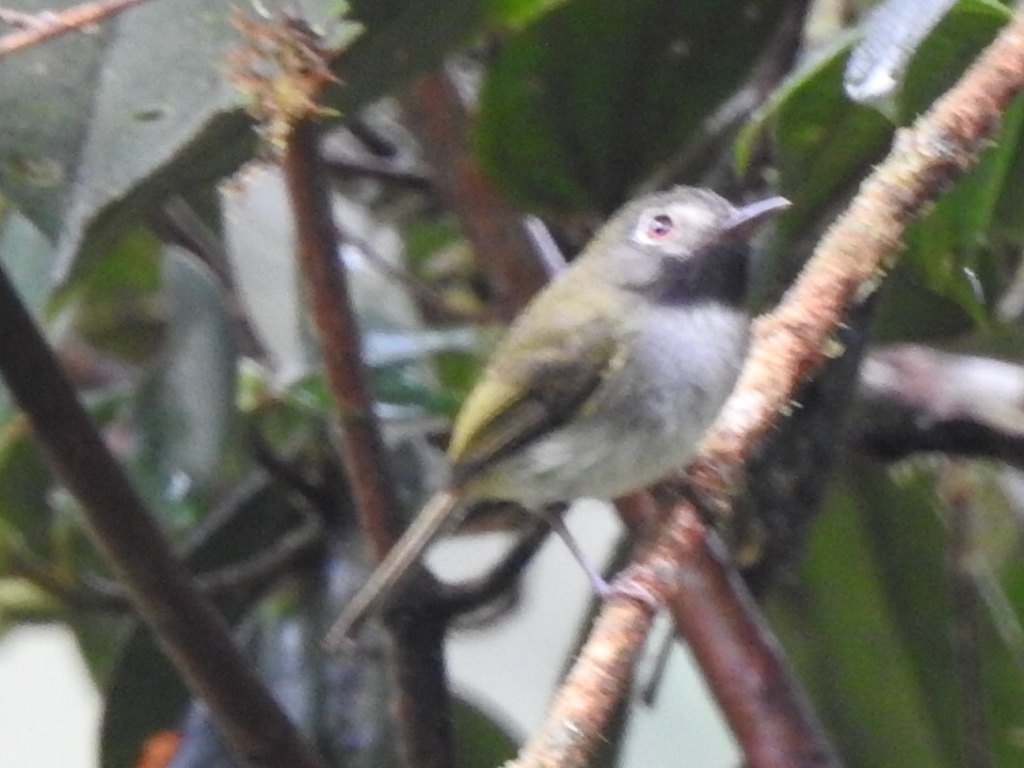
The Black-throated Tody-Tyrant is a small tyrant of Andean montane forest, from Colombia to Bolivia. It has a black throat and pale spectacles around the eye. It is the tody-tyrant of the higher montane forests in the guide area.
Voice
Sharp, single pit calls and rapid, dry series such as pit-pit-pit-pit.
Recording: Fabrice Schmitt — CC BY-NC-SA 4.0 · xeno-canto
Identification
10 cm, with a flat bill and a fairly short tail. The upperparts are olive-green, the wings dark with olive edgings and no distinct wing bars. The lores and eye-ring form white to ochre spectacles; in the south (Peru, Bolivia) the face is more ochre-brown. The chin and throat are black, the breast grey, the belly whitish. The sexes are alike.
Confusion species
Scale-crested Pygmy Tyrant Lophotriccus pileatus has a crest with rufous feather edges, a streaked breast and a pale iris. Cinnamon-breasted Tody-Tyrant Hemitriccus cinnamomeipectus has a cinnamon breast. Buff-throated Tody-Tyrant Hemitriccus rufigularis has a pale ochre throat and lives lower, in foothill forest. Yungas Tody-Tyrant Hemitriccus spodiops in Bolivia has no black throat and also lives lower.
Habitat
Undergrowth and edges of cloud forest and upper montane forest, often with Chusquea bamboo, also scrub at forest edges, mostly between 1800 and 3300 m. It forages alone or in pairs low to mid-level for insects, which it picks from leaves with short sallies.
Where the bird is most at home, classified by the vegetation units of the Andes and the west coast.


Range and movements
Colombia: in all three Andean ranges, in the Sierra Nevada de Santa Marta and the Serranía de Perijá. Ecuador: on both slopes of the Andes. Peru: along the eastern side of the Andes from north to south. Bolivia: in the Yungas of La Paz and Cochabamba. Absent from the Galápagos. Outside the guide area in Venezuela.
- Resident
- dark = core range, pale = thinly spread
How and when to look
Listen in the undergrowth of cloud forest along mountain roads for sharp pit calls; the black throat can be seen when the bird comes forward at the forest edge.
Conservation status
Least Concern. The species has a large range, but is sensitive to the clearance of montane forest.
Scientific name
Hemitriccus granadensis | (Hartlaub, 1843)
Hartlaub described the species in 1843 as Todirostrum granadense; because it was later moved to another genus, the author and year stand in brackets. The genus Hemitriccus was introduced in 1860 by Cabanis & Heine. The genus name comes from Greek hēmi-, 'half, small', and trikkos, an unidentified small bird, used by ornithologists for tyrant flycatchers. The species name refers to New Granada (present-day Colombia), not necessarily the type locality. The specimen the first description was based on came from Santa Elena, Antioquia, Colombia.