All species › Passerines › Tyrant flycatchers and allies › Zimmer's Tody-Tyrant
Zimmer's Tody-Tyrant | Hemitriccus minimus
Witkeeltodietiran | Titirijí de Zimmer | Maria-mirim
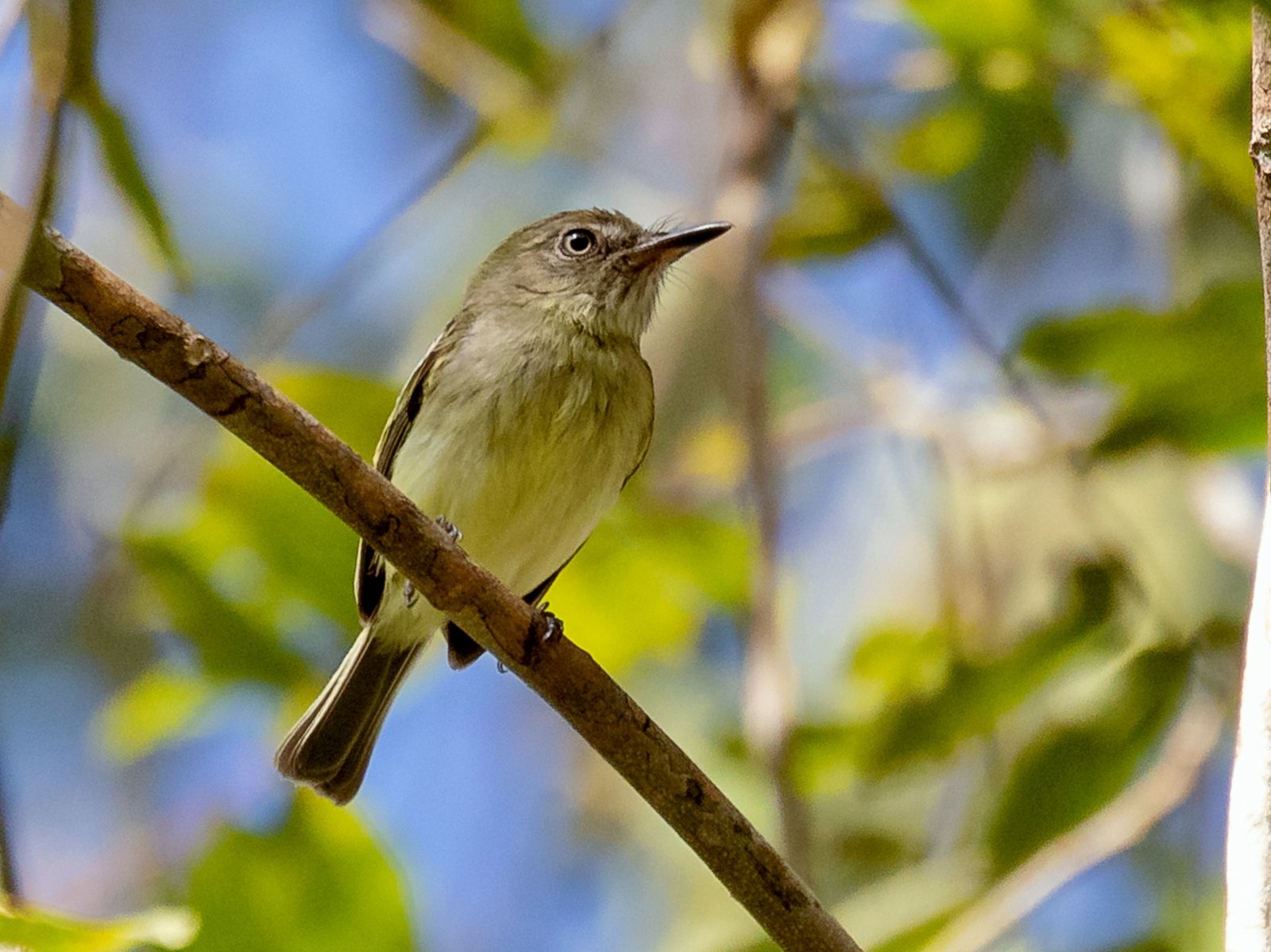
Zimmer's Tody-Tyrant is a very small, olive-green tyrant of Amazonian forest, especially forest on poor white sand. It lives high in the forest and is usually noticed by its call. In the guide area it is very local.
Voice
Short series of high, dry notes and short rattles from the upper part of the forest.
Recording: Jacob Wijpkema — CC BY-NC-SA 4.0 · xeno-canto
Identification
9.5 cm, with a flat bill and a short tail. The upperparts are olive-green. The wings are dark with two narrow pale wing bars and distinct pale edges to the tertials. The throat is whitish, the breast greyish olive with faint streaks, the belly pale yellow. The sexes are alike.
Confusion species
White-eyed Tody-Tyrant Hemitriccus zosterops is slightly larger, has yellower wing bars and a more distinct white eye-ring. White-bellied Tody-Tyrant Hemitriccus griseipectus has whiter underparts. Snethlage's Tody-Tyrant Hemitriccus minor and Acre Tody-Tyrant Hemitriccus cohnhafti are very similar and are best separated by voice.
Habitat
White-sand forest and tall humid terra firme lowland forest, also forest edges, in the lowlands. It forages alone or in pairs in the middle levels and the canopy for insects, which it picks from leaves with short sallies.
Where the bird is most at home, classified by the vegetation units of the Andes and the west coast.


Range and movements
Peru: very local in the north-east, in white-sand forest near Iquitos, and scattered elsewhere in the eastern lowlands. Bolivia: in the north-east (Beni, Santa Cruz). A few records are known from Ecuador, but its occurrence there is uncertain. Absent from Colombia and the Galápagos. Outside the guide area in Brazil south of the Amazon.
- Resident
- dark = core range, pale = thinly spread
How and when to look
Search the white-sand forest of Allpahuayo-Mishana near Iquitos or in north-eastern Bolivia; listen for high, dry series from the canopy.
Conservation status
Least Concern. White-sand forest is local and vulnerable to logging and clearance.
Scientific name
Hemitriccus minimus | (Todd, 1925)
Todd described the species in 1925 as Snethlagea minima; because it was later moved to another genus, the author and year stand in brackets. The genus Hemitriccus was introduced in 1860 by Cabanis & Heine. The genus name comes from Greek hēmi-, 'half, small', and trikkos, an unidentified small bird, used by ornithologists for tyrant flycatchers. The species name comes from Latin minimus, 'smallest'. The specimen the first description was based on came from Itaituba, Rio Tapajós, Pará, Brazil.