All species › Swifts › Hummingbirds › Butterfly Coquette
Butterfly Coquette | Lophornis verreauxii
Groenkuifkoketkolibrie | Coqueta mariposa | Topetinho-verde-amazônico
The Butterfly Coquette is a tiny hummingbird of the Amazonian lowlands and the low foothills east of the Andes. It was long treated as a subspecies of the Festive Coquette of south-eastern Brazil. The male has a green crest with red feather tips and long green, white-tipped plumes at the sides of the head.
Voice
Usually silent. When feeding short tsip or chip calls.
Recording: Juan Freile — CC BY-NC-SA 4.0 · xeno-canto
Identification
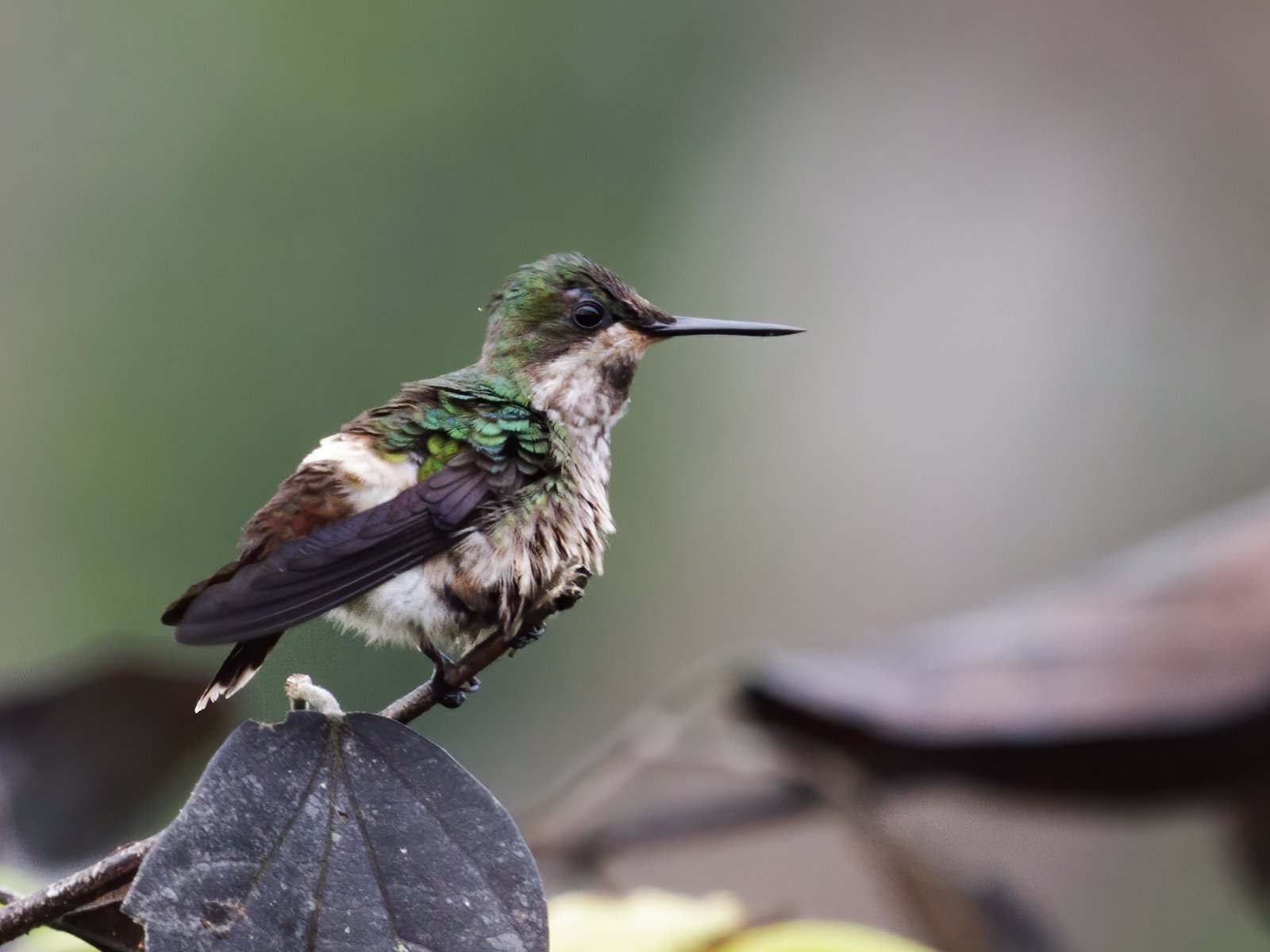
8 cm, with a short, straight bill. The male has a dark green head with a green crest whose feathers have red tips, and long green cheek tufts with white tips. The back is green with a golden sheen; a white band crosses the rump and the uppertail coverts are dark reddish brown. The underparts are green, with white thighs, and the tail is maroon. The female lacks the crest and tufts, and has a whitish malar stripe, a golden sheen on the breast, less reddish brown on the uppertail coverts and the same white rump band.
Confusion species
Rufous-crested Coquette Lophornis delattrei and Spangled Coquette Lophornis stictolophus have rufous crests and live mainly higher, in the foothills; their females have a rufous or rufous-spotted throat. Wire-crested Thorntail Discosura popelairii and Black-bellied Thorntail Discosura langsdorffi also have a white rump band, but the males have a long, pointed tail. In eastern Bolivia Dot-eared Coquette Lophornis gouldii has been recorded as a vagrant; the male has a rufous crest and white, green-dotted ear tufts.
Habitat
Edges of humid lowland forest, riverine forest, white-sand scrub forest, terra firme forest, secondary forest and scrubby clearings, up to about 1000 m. It visits small flowers, often high in flowering trees, and takes small insects.
Where the bird is most at home, classified by the vegetation units of the Andes and the west coast.


Range and movements
In Colombia in the Amazonian lowlands of the south-east; in Ecuador in the eastern lowlands and low foothills; in Peru in the eastern lowlands; in Bolivia in the lowlands and foothills of the north and centre of the country. Scarce and local throughout. Absent from the Galápagos. Outside the guide area in western Brazil, east to Mato Grosso, and with a separate subspecies locally in southern Venezuela.
- Resident
- dark = core range, pale = thinly spread
How and when to look
At flowering trees at forest edges, along rivers and in clearings in the Amazonian lowlands, for example around Rurrenabaque in Bolivia. The birds often feed high in the canopy and are better followed from a canopy tower or a high riverbank.
Conservation status
Least Concern. The species has a large range and also occurs in secondary forest and scrubby country.
Scientific name
Lophornis verreauxii | Bourcier, 1853
Bourcier described the species in 1853 and placed it straight away in the genus where it still stands. The genus Lophornis was introduced in 1829 by Lesson. The genus name combines Greek lophos, 'crest', with ornis, 'bird'. The species name honours Jean Baptiste Édouard Verreaux (1810–1868), French natural history dealer and collector. The specimen the first description was based on came from Peru.