All species › Swifts › Hummingbirds › Ecuadorian Piedtail
Ecuadorian Piedtail | Phlogophilus hemileucurus
Ecuadoraanse eksterstaart | Colibrí colipinto ecuatoriano | Rabo-malhado-equatoriano
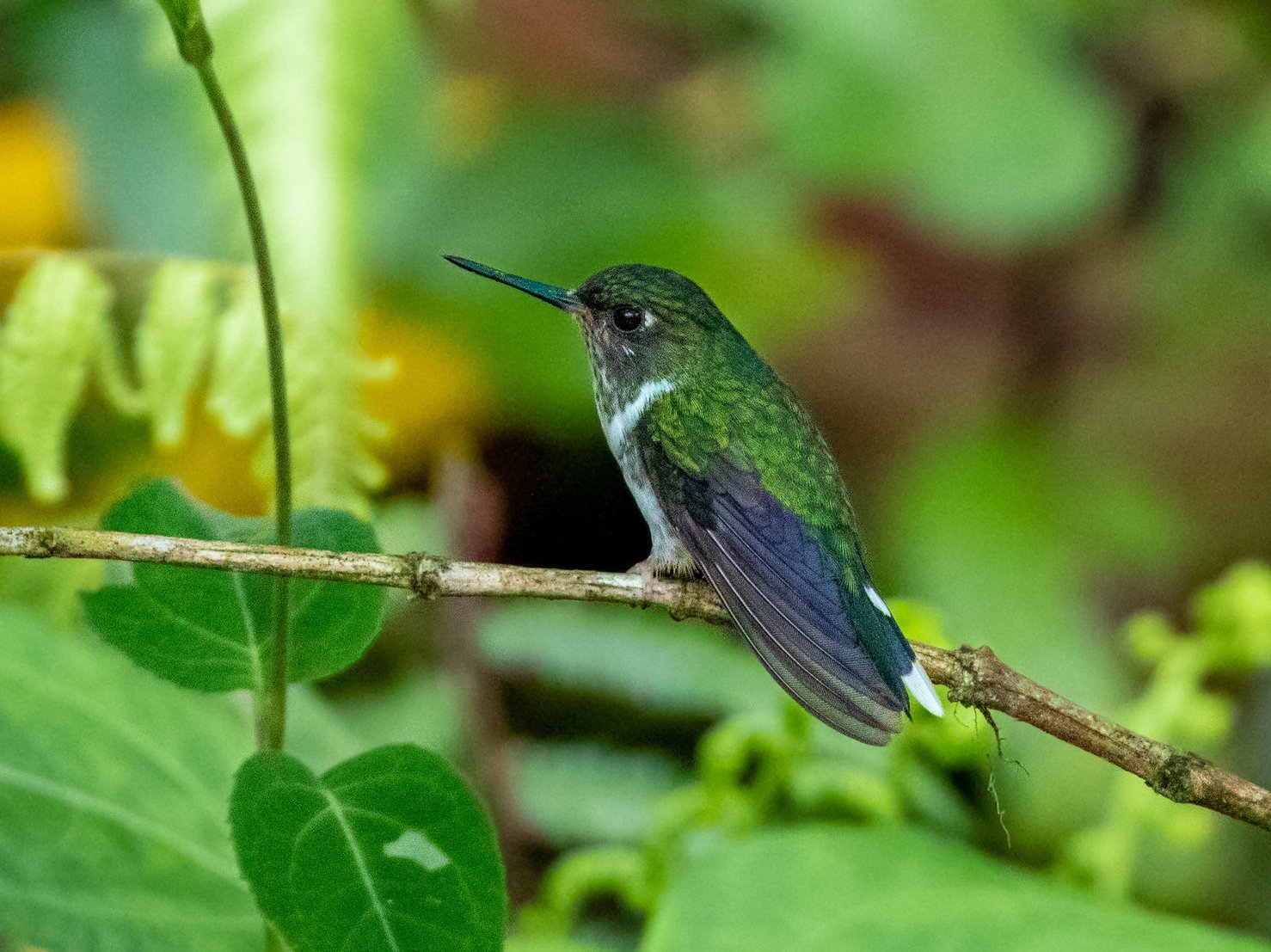
The Ecuadorian Piedtail is a small green-and-white hummingbird of the interior of foothill forest on the eastern slope of the Andes. The name refers to the black-and-white tail. It feeds low in the understorey and often follows a fixed route between scattered flowers.
Voice
Not very vocal. It gives a thin, high tsit, mainly when feeding.
Recording: Mauricio Cuellar Ramirez (@Birding.travel) — CC BY-NC-SA 4.0 · xeno-canto
Identification
7–8 cm, with a straight, black bill of medium length. The upperparts are glossy green, with a small white spot behind the eye. The throat and underparts are white, with green spots on the sides of the breast forming an incomplete breast band. The central tail feathers are green; the others are white with a broad black band, giving a black-and-white pattern when the tail is spread. The sexes are nearly alike.
Confusion species
Peruvian Piedtail Phlogophilus harterti lives further south, in central and south-eastern Peru, and has buff instead of white underparts and a buff-and-black tail. Females of the whitetips, such as Rufous-vented Whitetip Urosticte ruficrissa, are also white with green spots below, but have a green tail with white tips only. Speckled Hummingbird Adelomyia melanogenys is browner, with a dark ear patch and pale tail tips.
Habitat
Interior and edges of humid foothill and lower montane forest, especially in the understorey along streams and in ravines, at roughly 500 to 1500 m. It visits small flowers of shrubs and herbs close to the ground and takes small insects.
Where the bird is most at home, classified by the vegetation units of the Andes and the west coast.


Range and movements
In Colombia local on the eastern slope in the south; in Ecuador along the entire eastern slope; in Peru in the north on the eastern slope. Absent from Bolivia and the Galápagos. Does not occur outside the guide area.
- Resident
- dark = core range, pale = thinly spread
How and when to look
Along trails and streams in the interior of foothill forest on the eastern slope of Ecuador, for example in the Sumaco area. Wait at a patch of flowering shrubs in the understorey, which the birds visit on their regular round.
Conservation status
Least Concern. Deforestation in the foothills of the eastern slope locally reduces its habitat.
Scientific name
Phlogophilus hemileucurus | Gould, 1860
Gould described the species in 1860 and placed it straight away in the genus where it still stands. He introduced the genus Phlogophilus in that same work. The genus name comes from Greek phlox, phlogos, 'flame', and philos, 'loving'. The specific name comes from Greek hēmi-, 'half', leukos, 'white', and oura, 'tail': half-white tail. The specimen the first description was based on came from Río Napo, Ecuador/Peru.