All species › Swifts › Hummingbirds › Peruvian Piedtail
Peruvian Piedtail | Phlogophilus harterti
Peruaanse eksterstaart | Colibrí colipinto peruano | Rabo-malhado-peruano
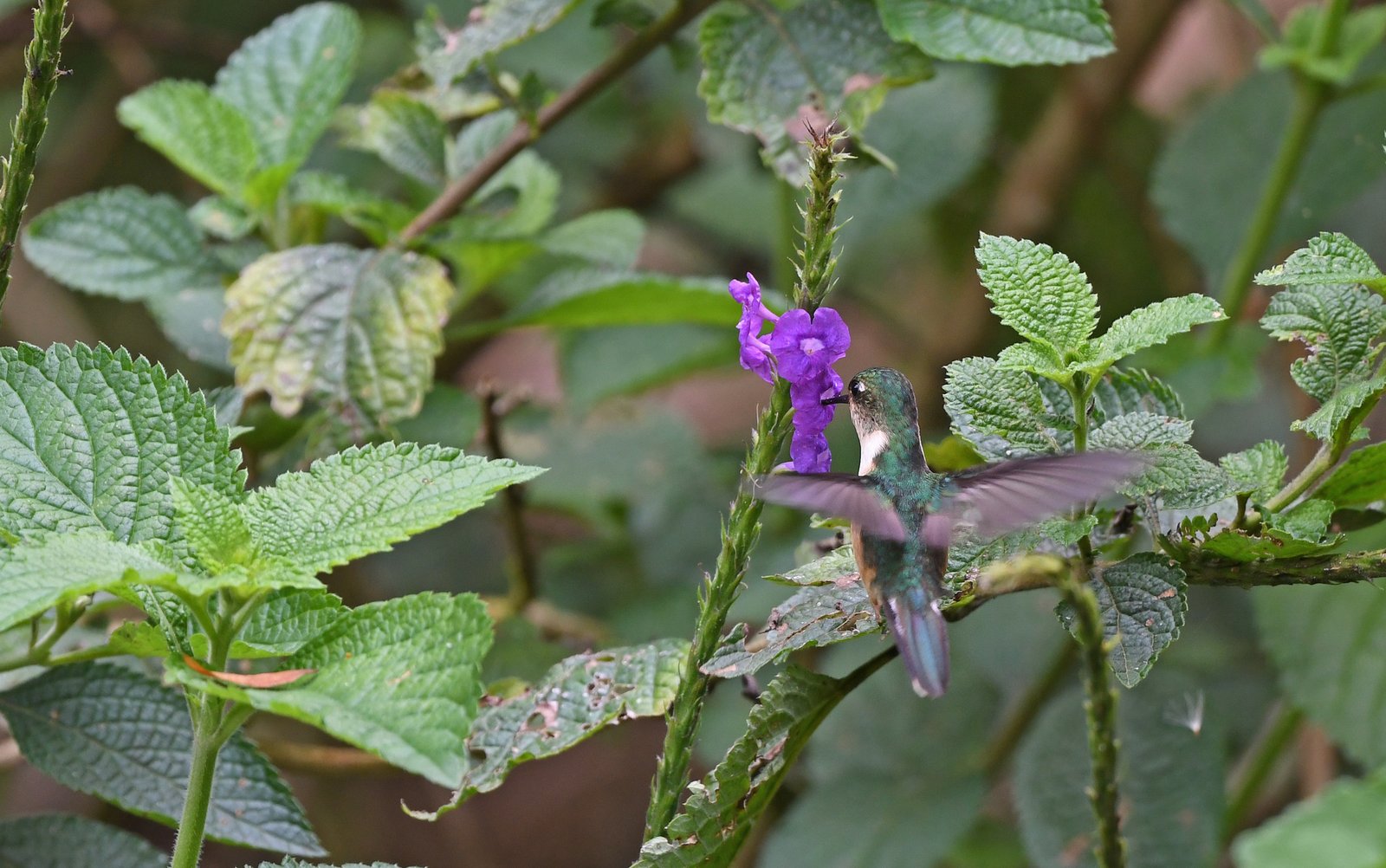
The Peruvian Piedtail is a small hummingbird of the interior of foothill forest on the eastern slope of the Andes and occurs only in Peru. It is the southern counterpart of the Ecuadorian Piedtail. Like that species it feeds low in the understorey.
Voice
The song is a thin, shrill series of notes descending in pitch.
Recording: Fabrice Schmitt — CC BY-NC-SA 4.0 · xeno-canto
Identification
7–8 cm, with a straight, black bill. The upperparts are green, with a white spot behind the eye. The throat and centre of the breast are white, the rest of the underparts buff. The central tail feathers are green with a broad black tip; the others are buff with a broad black band. The sexes are alike; juveniles have buff fringes on the head and neck.
Confusion species
Ecuadorian Piedtail Phlogophilus hemileucurus lives further north, south to northern Peru, and has white underparts and a black-and-white tail. Speckled Hummingbird Adelomyia melanogenys is browner, with a dark ear patch and a spotted throat, and usually lives higher. Geoffroy's Daggerbill Schistes geoffroyi has a white stripe behind the eye, a white patch on the side of the breast and a green tail with a dark band.
Habitat
Interior of primary and secondary humid foothill and lower montane forest, at roughly 750 to 1500 m, most numerous around 1000 m. It feeds low in the understorey at small flowers and takes small insects.
Where the bird is most at home, classified by the vegetation units of the Andes and the west coast.


Range and movements
Only in Peru, with a patchy distribution on the eastern slope of the Andes in the departments of Huánuco, Pasco, Cusco and Puno. Absent from Colombia, Ecuador, Bolivia and the Galápagos. Does not occur outside the guide area.
- Resident
- dark = core range, pale = thinly spread
How and when to look
In the understorey along trails in foothill forest on the eastern slope, for example on the lower parts of the Manu road in Cusco. Wait at flowering shrubs in the forest interior.
Conservation status
Least Concern. Its habitat is largely intact. Logging and conversion to farmland are local threats, but the species tolerates altered forest as long as forest patches and secondary growth remain.
Scientific name
Phlogophilus harterti | Berlepsch & Sztolcman, 1901
Berlepsch & Sztolcman described the species in 1901 and placed it straight away in the genus where it still stands. The genus Phlogophilus was introduced in 1860 by Gould. The genus name comes from Greek phlox, phlogos, 'flame', and philos, 'loving'. The specific name honours Ernst Hartert (1859–1933), German ornithologist and director of Walter Rothschild's museum at Tring. The specimen the first description was based on came from Huanaypata, Peru.