All species › Swifts › Hummingbirds › Orange-throated Sunangel
Orange-throated Sunangel | Heliangelus mavors
Oranjekeelzonnekolibrie | Solángel gorginaranja | Anjo-do-sol-de-garganta-laranja
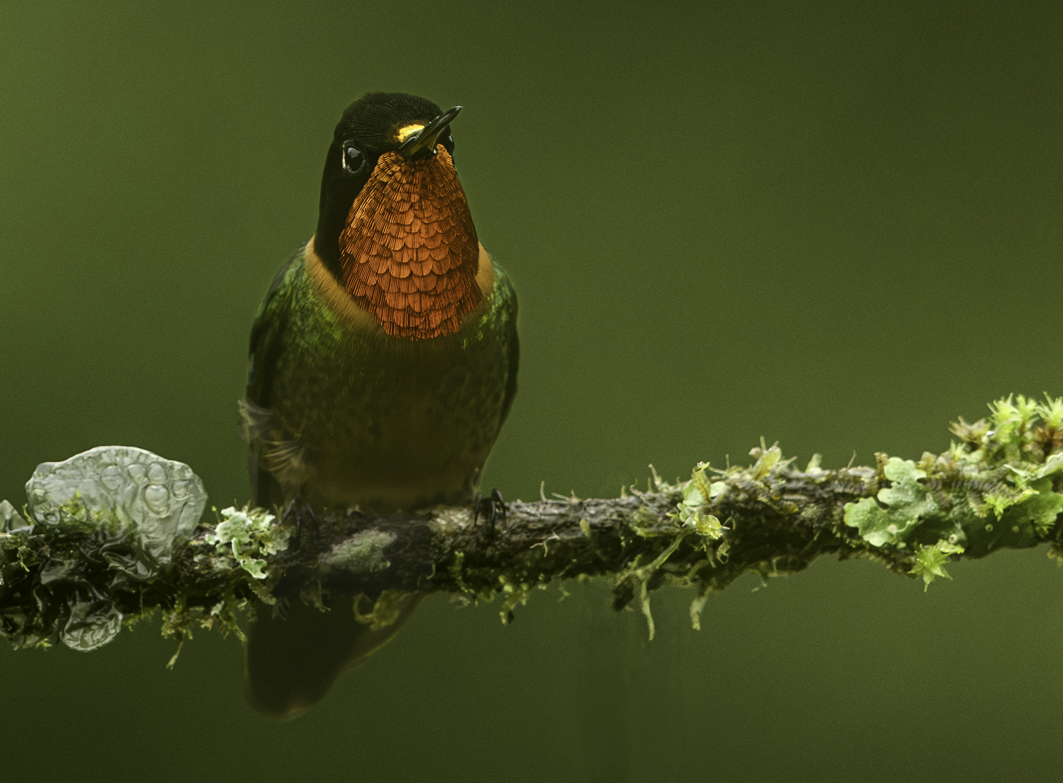
The Orange-throated Sunangel is a medium-sized hummingbird of forest edges and shrubby country in the mountains of Venezuela and north-eastern Colombia. The male has a glittering coppery orange throat and frontal patch. In the guide area it is restricted to the northern part of the Eastern Andes.
Voice
A repeated, high, faint, cricket-like trill, given in flight and from a perch.
Recording: Joe Klaiber — CC BY-NC-SA 4.0 · xeno-canto
Identification
10–11 cm, with a short, straight, black bill. The male has a shining green crown and back, a glittering coppery orange patch above the bill and a coppery orange throat and upper breast. A cinnamon-buff band separates the upper breast from the lower breast, which is spotted golden green. The central tail feathers are golden green, the outer ones dark bronze with pale tips. The female resembles the male, but the throat and upper breast are reddish brown with pale speckles.
Confusion species
The male Longuemare's Sunangel Heliangelus clarisse has a rosy throat and a white breast band, the female a dull brownish throat. Tourmaline Sunangel Heliangelus exortis lives further south in Colombia and has a blue-green and pink throat without orange. In female sunangels the throat colour is the main feature.
Habitat
Edges of humid cloud forest and elfin forest, shrubby pastures and páramo, and also drier scrub, at roughly 2000 to 3200 m. It visits flowers of shrubs and often sits on a projecting twig, from which it makes short flights; on landing it often holds its wings raised briefly.
Where the bird is most at home, classified by the vegetation units of the Andes and the west coast.


Range and movements
In Colombia only in the north of the Eastern Andes, from the Venezuelan border south to Boyacá; scarce there. Absent from Ecuador, Peru, Bolivia and the Galápagos. Outside the guide area in the Andes of Venezuela, from Lara south-west.
- Resident
- dark = core range, pale = thinly spread
How and when to look
At forest edges and in shrubby pastures above 2000 m in the north of the Eastern Andes, such as the Tamá border region. In the Venezuelan Andes it is locally common at flowering shrubs.
Conservation status
Least Concern. The population appears stable; the species is locally common in Venezuela and uncommon to rare in Colombia.
Scientific name
Heliangelus mavors | Gould, 1848
Gould described the species in 1848 and placed it straight away in the genus where it still stands. He introduced the genus Heliangelus in that same work. The genus name combines Greek hēlios, 'sun', with angelos, 'angel'. The species name is Latin Mavors, an old name for Mars, the god of war, possibly referring to the fiery orange throat. The specimen the first description was based on came from Andes of Venezuela and Colombia.