All species › Swifts › Hummingbirds › Longuemare's Sunangel
Longuemare's Sunangel | Heliangelus clarisse
Longuemares zonnekolibrie | Solángel de Longuemare | Anjo-do-sol-de-longuemare
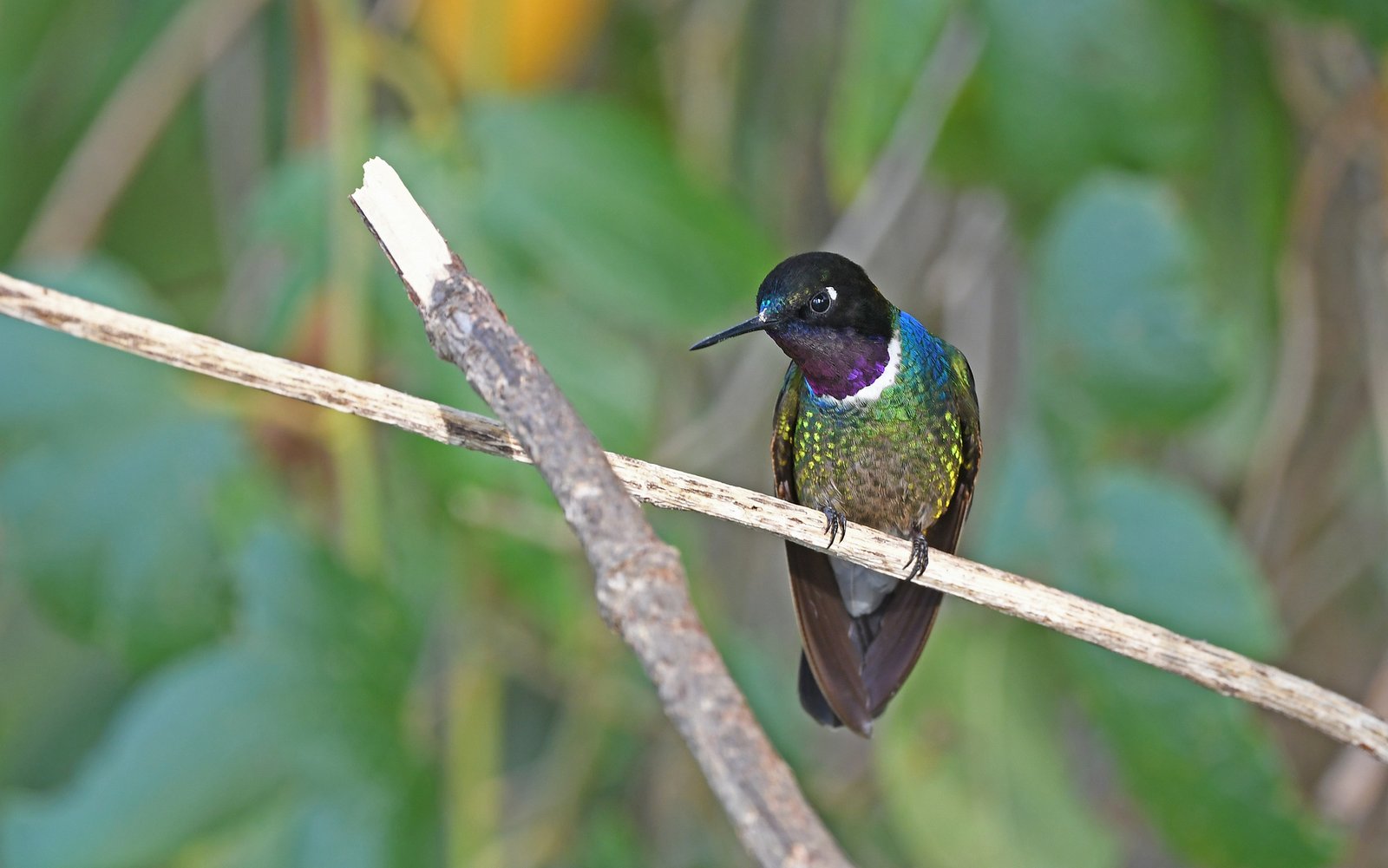
Longuemare's Sunangel is a hummingbird of forest edges and shrubby country in the mountains of eastern Colombia and western Venezuela. The male has a glittering rosy throat and a white band across the breast. The species was formerly included in Amethyst-throated Sunangel, which occurs further south.
Voice
A repeated, dry, upslurred tsik or tsit.
Recording: Sergio Córdoba Córdoba (Colección de Sonidos Ambientales - Instituto Humboldt) — CC BY-NC-SA 3.0 · xeno-canto
Identification
9–10 cm, with a short, straight, black bill and a slightly forked, dark tail. The male has a glittering blue-green frontlet, bronzy green upperparts and a glittering rosy throat, below which is a white breast band; the belly is spotted green. The female has a dull brown throat with rufous or bronzy green flecks and a less spotted belly. Juveniles resemble the female. The subspecies differ mainly in the colour of the frontlet and throat.
Confusion species
The male Orange-throated Sunangel Heliangelus mavors, which may occur in the same area in the north of the Eastern Andes, has a coppery orange throat and a cinnamon breast band. Tourmaline Sunangel Heliangelus exortis lacks the white breast band and has a blue-green and pink throat. Amethyst-throated Sunangel Heliangelus amethysticollis is very similar, but lives much further south, from southern Ecuador to Bolivia.
Habitat
Edges of humid cloud forest and elfin forest, and also open country such as shrubby fields, open woodland, overgrown ravines and páramo, at roughly 1800 to 3600 m. It visits flowers of shrubs; on landing it often holds its wings raised briefly.
Where the bird is most at home, classified by the vegetation units of the Andes and the west coast.


Range and movements
In Colombia in the Eastern Andes and the Serranía de Perijá, with a separate subspecies in the Tamá region on the Venezuelan border. Absent from Ecuador, Peru, Bolivia and the Galápagos. Outside the guide area in western Venezuela.
- Resident
- dark = core range, pale = thinly spread
How and when to look
At forest edges and in shrubby ravines above 2000 m in the Eastern Andes, including the mountains around Bogotá. It also visits hummingbird feeders.
Conservation status
Least Concern. The population appears stable; the species is fairly common to common and no major threats are known.
Scientific name
Heliangelus clarisse | (de Longuemare, 1841)
De Longuemare described the species in 1841 as Ornismya clarisse; because it was later moved to another genus, the author and year stand in brackets. The genus Heliangelus was introduced in 1848 by Gould. The genus name combines Greek hēlios, 'sun', with angelos, 'angel'. The species name honours Clarisse Parzudaki, née Moreuil (1807–1884), wife of the French naturalist and dealer Charles Parzudaki. The specimen the first description was based on came from Bogotá, Colombia.