All species › Swifts › Hummingbirds › Amethyst-throated Sunangel
Amethyst-throated Sunangel | Heliangelus amethysticollis
Amethistzonnekolibrie | Solángel gorgiamatista | Anjo-do-sol-de-garganta-ametista
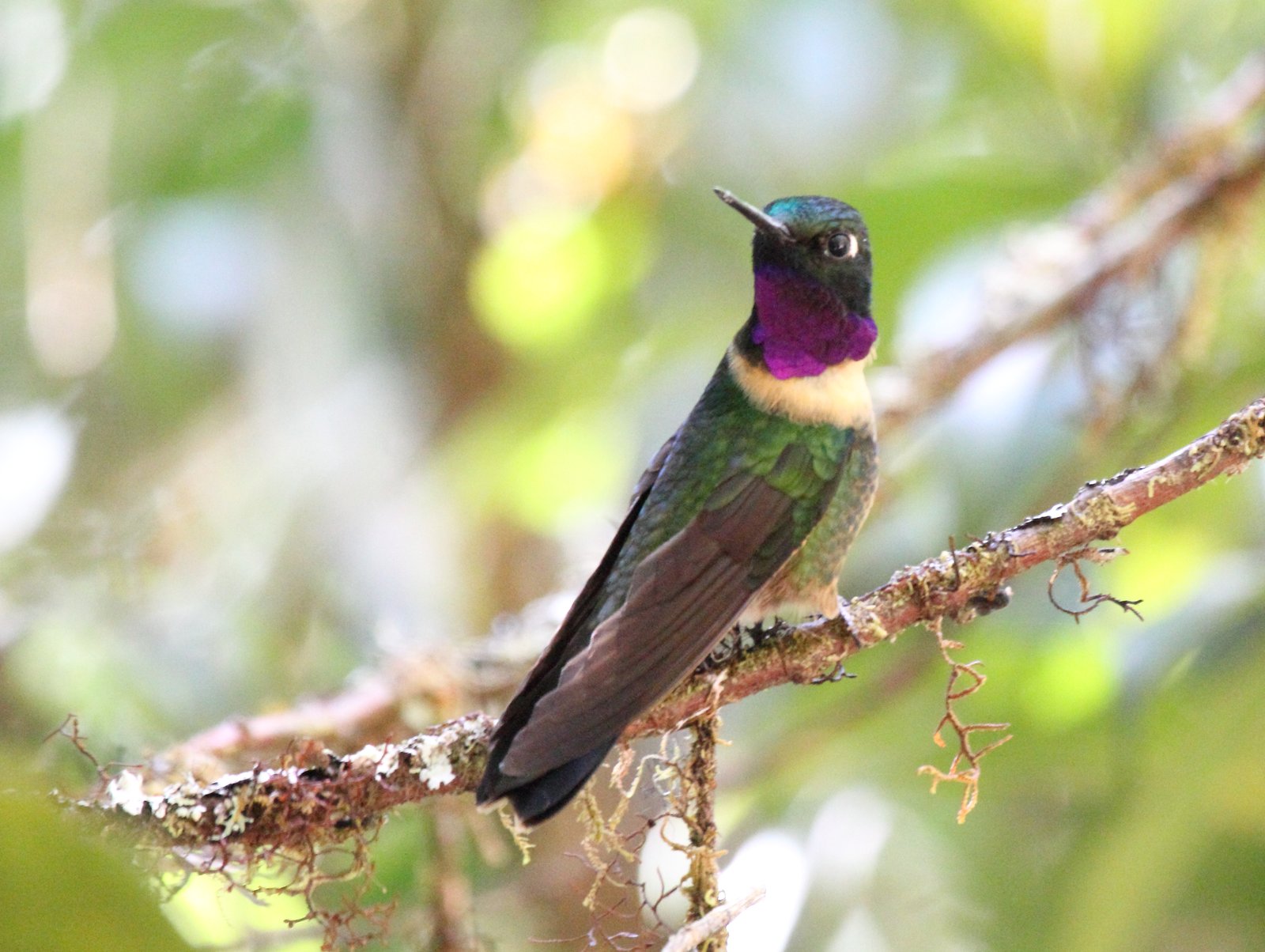
The Amethyst-throated Sunangel is a medium-sized sunangel of humid montane forest on the eastern slope of the Andes, from southern Ecuador to Bolivia. The male has a rosy purple throat above a cinnamon breast band; in the female the throat is rufous. Like other sunangels it often clings to a flower instead of hovering in front of it.
Voice
A short, dry, buzzy trill, repeated at intervals, and dry ticking notes while feeding.
Recording: John V. Moore — CC BY-NC-SA 4.0 · xeno-canto
Identification
10–11 cm, with a short, straight, black bill and a slightly forked tail. The male is dark glossy green above, with a small glittering green frontlet. The throat and upper breast form a rosy purple (amethyst) gorget, bordered below by a narrow black and a broader cinnamon or whitish band; the lower breast is glittering green and the belly buff with green spots. The central tail feathers are bronze-green, the outer ones blue-black. The female resembles the male but has a rufous throat flecked with black. In southern Ecuador and northern Peru (the form laticlavius) the throat is redder purple and the breast band whiter.
Confusion species
Purple-throated Sunangel Heliangelus viola is larger and greener below, with a deep violet throat and a blue-green breast band, and lives mainly on the western slope and in dry valleys. Flame-throated Sunangel Heliangelus micraster has an orange to reddish-orange throat. Tourmaline Sunangel Heliangelus exortis lacks the pale breast band and has grey, green-spotted underparts. Tyrian Metaltail Metallura tyrianthina is smaller, with a green throat and a coppery red tail.
Habitat
The interior and edges of humid montane forest, cloud forest and elfin forest, also shrubby clearings, mostly between about 1800 and 3200 m, in Peru up to 3700 m. It defends a feeding territory at flowers with short corollas, feeds up to about 6 m above the ground and stays close to cover. It takes many insects from a perch. The nest is a cup of plant fibres, moss and lichen, hanging from a strand of moss under a sheltering leaf.
Where the bird is most at home, classified by the vegetation units of the Andes and the west coast.


Range and movements
In Ecuador in the south, in Loja and Zamora-Chinchipe. In Peru along the eastern slope of the Andes over almost the entire length of the country, also in the Apurímac and Urubamba valleys. In Bolivia on the eastern slope of the Andes in La Paz and Cochabamba. Absent from Colombia and the Galápagos. Not found outside the guide area; the forms of Colombia and Venezuela are treated as separate species.
- Resident
- dark = core range, pale = thinly spread
How and when to look
In cloud forest on the eastern slope, for example along roads through the Yungas of Bolivia and the eastern slope in southern Peru. Watch for a small hummingbird guarding a flowering shrub and moving from flower to flower in short flights.
Conservation status
Least Concern. The species has a large range in montane forest; deforestation affects its habitat locally.
Scientific name
Heliangelus amethysticollis | (d'Orbigny, ACVMD & de Lafresnaye, 1838)
D'Orbigny, ACVMD & de Lafresnaye described the species in 1838 as Ornismya amethysticollis; because it was later moved to another genus, the author and year stand in brackets. The genus Heliangelus was introduced in 1848 by Gould. The genus name combines Greek hēlios, 'sun', with angelos, 'angel'. The species name combines Latin amethystus, 'amethyst', with collum, 'neck', referring to the amethyst throat. The specimen the first description was based on came from Yuracarés country, Cochabamba, Bolivia.