All species › Swifts › Hummingbirds › Gorgeted Sunangel
Gorgeted Sunangel | Heliangelus strophianus
Gekraagde zonnekolibrie | Solángel de gorguera | Anjo-do-sol-de-gorjal
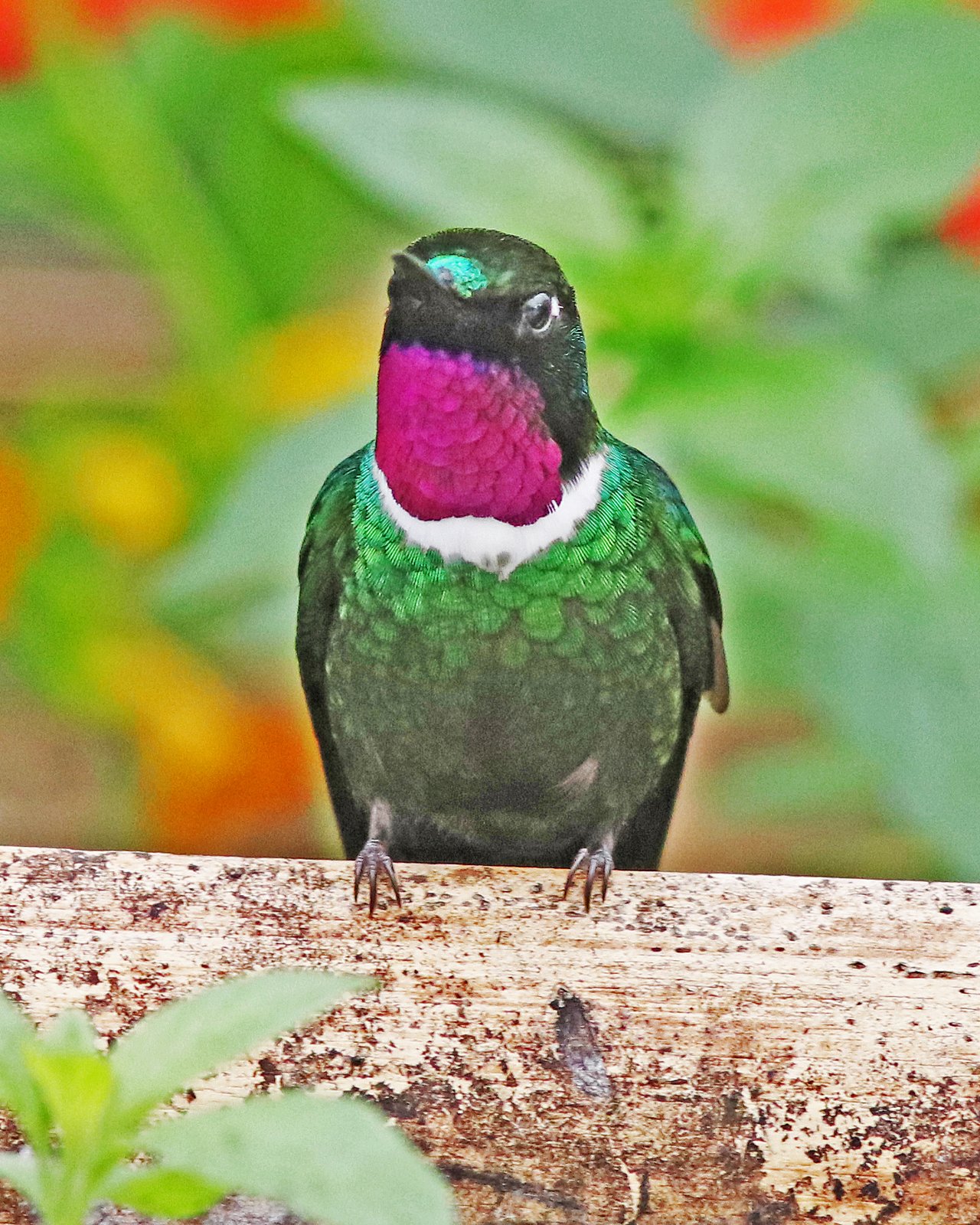
The Gorgeted Sunangel is a dark sunangel of the western slope of the Andes in south-western Colombia and north-western Ecuador. The male has a rosy violet throat with a white breast band below it, like a collar. It usually stays in or close to cover and defends its own group of flowers.
Voice
The song is a series of two or three high notes followed by a slightly lower note. The call is a dry chatter ending in a soft, drawn-out note; it also gives a high twitter.
Recording: John V. Moore — CC BY-NC-SA 4.0 · xeno-canto
Identification
10–11 cm, with a short, straight, blackish bill and a dark steel-blue, slightly forked tail. Both sexes are velvety dark green above, with a small white spot behind the eye; the underparts are dark green, speckled grey towards the rear. The male has a small glittering green frontlet and a rosy violet gorget, bordered below by a white breast band. The female lacks the coloured throat: her chin is greyish brown with white feather edges, sometimes with a few rosy feathers, and her white breast band is narrower.
Confusion species
Tourmaline Sunangel Heliangelus exortis has a similar pink throat but no white breast band, has white undertail coverts instead, and lives higher, mainly on the eastern slope. Purple-throated Sunangel Heliangelus viola has a deep violet throat with a blue-green band below and lives further south. Glowing Puffleg Eriocnemis vestita has large white leg puffs and glittering green underparts. Tyrian Metaltail Metallura tyrianthina is smaller, with a coppery red tail.
Habitat
Humid to wet montane forest, forest edges, shrubby borders and thickets, inside forest mainly in damp ravines, roughly between 1200 and 2800 m, scarce above 2500 m. It takes nectar mainly from low flowers, sometimes up to the lower canopy, and avoids open ground. Seasonal altitudinal movements are likely. The female incubates alone; the clutch is two white eggs.
Where the bird is most at home, classified by the vegetation units of the Andes and the west coast.


Range and movements
In Colombia only in the south-west, on the western slope of the Andes in Nariño. In Ecuador on the western slope of the Andes in the north and centre of the country, with a local and patchy distribution. Absent from Peru, Bolivia and the Galápagos. Not found outside the guide area.
- Resident
- dark = core range, pale = thinly spread
How and when to look
Search thickets and forest edges in ravines on the western slope in northern Ecuador, in Pichincha province. The bird often sits low in cover; wait by a group of flowering shrubs until it returns.
Conservation status
Least Concern. The range is small and the species occurs locally; deforestation on the western slope affects its habitat.
Scientific name
Heliangelus strophianus | (Gould, 1846)
Gould described the species in 1846 as Trochilus (--?) strophianus; because it was later moved to another genus, the author and year stand in brackets. The genus Heliangelus was introduced in 1848 by Gould. The genus name combines Greek hēlios, 'sun', with angelos, 'angel'. The species name is New Latin strophianus, 'breast-banded', from Latin strophium, 'breast band', probably referring to the coloured gorget and band. The specimen the first description was based on came from Western Ecuador.