All species › Swifts › Hummingbirds › Tourmaline Sunangel
Tourmaline Sunangel | Heliangelus exortis
Toermalijnzonnekolibrie | Solángel turmalina | Anjo-do-sol-turmalina
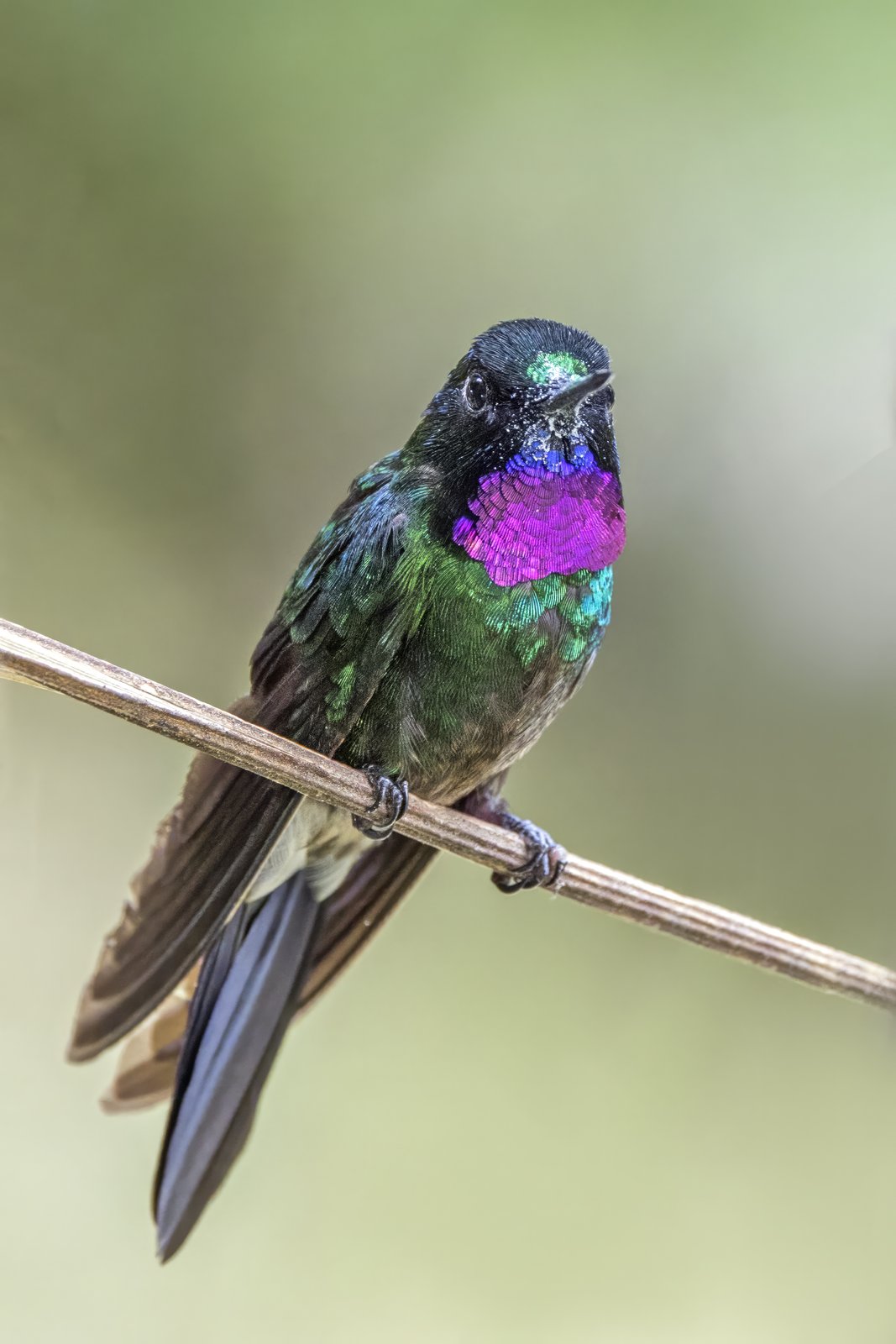
The Tourmaline Sunangel is a small, dark sunangel of cloud forest and elfin forest in the northern Andes. The male has a glittering pink gorget, the female a white, speckled throat; in both the white undertail coverts stand out. It is strongly territorial and chases other hummingbirds from its flowers.
Voice
The song is a repeated series of single notes: a few high, upslurred notes followed by a slightly lower, downslurred note. The call is a short, dry, gravelly trill given at intervals; it also gives a continuous dry chatter.
Recording: Hernán Arias — CC BY-NC-SA 3.0 · xeno-canto
Identification
10–11 cm, with a straight, medium-length, blackish bill and a slightly forked, blackish tail with bronze central feathers. The upperparts are dark glossy green; the underparts are grey with round green spots, and the undertail coverts are white. The male has a small glittering green frontlet, a dark purplish blue chin and a glittering rose-pink gorget, bordered below by emerald green. The female lacks the frontlet; her chin is blackish and her throat whitish with green to dusky grey speckles, sometimes with a few pink feathers. Young males resemble the female but have a white chin.
Confusion species
Gorgeted Sunangel Heliangelus strophianus has a white breast band below the pink throat and lives lower on the western slope. Flame-throated Sunangel Heliangelus micraster is very similar, but the male has an orange to reddish-orange throat; the females differ almost only in range. Amethyst-throated Sunangel Heliangelus amethysticollis has a pale breast band and a buff belly. Glowing Puffleg Eriocnemis vestita has white leg puffs and glittering green underparts.
Habitat
The interior and edges of humid montane forest, especially cloud forest and elfin forest, also shrubby clearings and rough pastures, mostly between about 2300 and 3400 m, sometimes down to 1500 m. It fiercely defends a feeding territory at low-growing flowering plants, both in semi-open country and in forest, and usually clings to the flower instead of hovering. It takes insects from a perch and from foliage. The female incubates two white eggs alone.
Where the bird is most at home, classified by the vegetation units of the Andes and the west coast.


Range and movements
In Colombia in all three cordilleras of the Andes. In Ecuador along the eastern slope of the Andes south to Morona-Santiago. Absent from Peru, Bolivia and the Galápagos. Not found outside the guide area. Almost entirely resident; in Colombia occasionally lower, in the tropical zone.
- Resident
- dark = core range, pale = thinly spread
How and when to look
At feeders and flowering shrubs in cloud forest on the eastern slope of northern Ecuador, for example around Papallacta and Guango, and in the highlands of the Central Cordillera in Colombia. Watch for the white undertail coverts when the bird clings to a flower.
Conservation status
Least Concern. The species has a fairly large range and tolerates forest edges and shrubby terrain.
Scientific name
Heliangelus exortis | (Fraser, 1840)
Fraser described the species in 1840 as Trochilus exortis; because it was later moved to another genus, the author and year stand in brackets. The genus Heliangelus was introduced in 1848 by Gould. The genus name combines Greek hēlios, 'sun', with angelos, 'angel'. The species name comes from Latin exortus, 'dawn, east', from exoriri, 'to rise up'; this matches the genus name 'sun angel'. The specimen the first description was based on came from Guaduas, Cundinamarca, Colombia.