All species › Swifts › Hummingbirds › Flame-throated Sunangel
Flame-throated Sunangel | Heliangelus micraster
Kleine zonnekolibrie | Solángel chico | Anjo-do-sol-de-garganta-flamejante
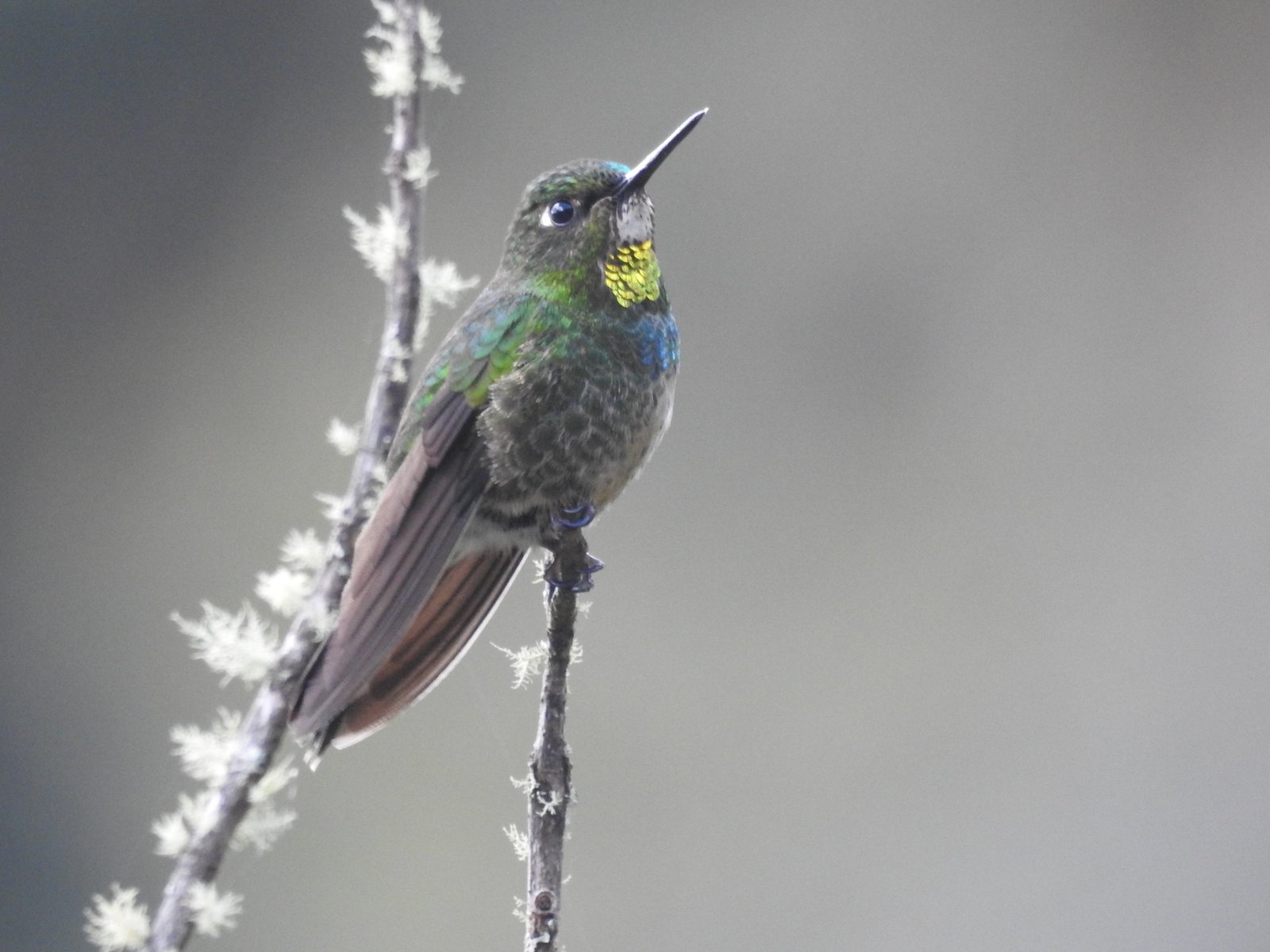
The Flame-throated Sunangel is a small, dark sunangel of mossy montane forest on the eastern slope of the Andes in southern Ecuador and northern Peru. The male has a glittering yellow-orange to reddish-orange gorget, which gives the species its name. It closely resembles the Tourmaline Sunangel, which lives further north.
Voice
A repeated dry djit or a more gravelly drrt.
Recording: Niels Krabbe — CC BY-NC-SA 3.0 · xeno-canto
Identification
9–10 cm, with a short, straight, blackish bill and a dark steel-blue, slightly forked tail. Both sexes are dark glossy green above and on the lower breast, with a greyish belly and an almost white vent. The male has a small glittering blue-green frontlet, a dark purplish blue chin and a glittering yellow-orange gorget with an emerald-green border; in the form cutervensis of Cajamarca the throat is reddish orange. The female lacks the frontlet; her chin is blackish and her throat white with green to dusky grey speckles, sometimes with a few reddish-orange feathers.
Confusion species
Tourmaline Sunangel Heliangelus exortis has a pink throat and lives further north, south to Morona-Santiago; the females differ almost only in range. Purple-throated Sunangel Heliangelus viola is larger, with a deep violet throat, and lives mainly in drier, open country on the western slope. Amethyst-throated Sunangel Heliangelus amethysticollis has a rosy purple throat and a pale breast band. Orange-throated Sunangel Heliangelus mavors, with an orange throat and orange-brown underparts, lives in Colombia and Venezuela.
Habitat
The interior and edges of dense, mossy montane forest and elfin forest, mostly between about 2300 and 3400 m, sometimes down to 1500 m. It defends a feeding territory, usually takes nectar while clinging to flowers at low to middle heights, and catches insects from a perch and from foliage. Females forage more often in shrubby pastures. After the breeding season it makes small altitudinal movements. In Ecuador it breeds from January to May; the female incubates two white eggs alone.
Where the bird is most at home, classified by the vegetation units of the Andes and the west coast.


Range and movements
In Ecuador on the eastern slope of the Andes in the south-east, from Morona-Santiago to Zamora-Chinchipe. In Peru in the north, including Cajamarca (the form cutervensis). Absent from Colombia, Bolivia and the Galápagos. Not found outside the guide area.
- Resident
- dark = core range, pale = thinly spread
How and when to look
Search the upper cloud forest and elfin forest of Zamora-Chinchipe in southern Ecuador, at flowering shrubs along forest edges and clearings. The male often sits on a fixed lookout near its flowers.
Conservation status
Least Concern. The range is fairly small; deforestation and fires in the highlands affect its habitat locally.
Scientific name
Heliangelus micraster | Gould, 1872
Gould described the species in 1872 and placed it straight away in the genus where it still stands. The genus Heliangelus was introduced in 1848 by Gould. The genus name combines Greek hēlios, 'sun', with angelos, 'angel'. The species name combines Greek mikros, 'small', with astēr, 'star'. The specimen the first description was based on came from San Lucas, Loja, Ecuador.