All species › Swifts › Hummingbirds › Purple-throated Sunangel
Purple-throated Sunangel | Heliangelus viola
Violetkeelzonnekolibrie | Solángel gorgipúrpura | Anjo-do-sol-de-garganta-roxa
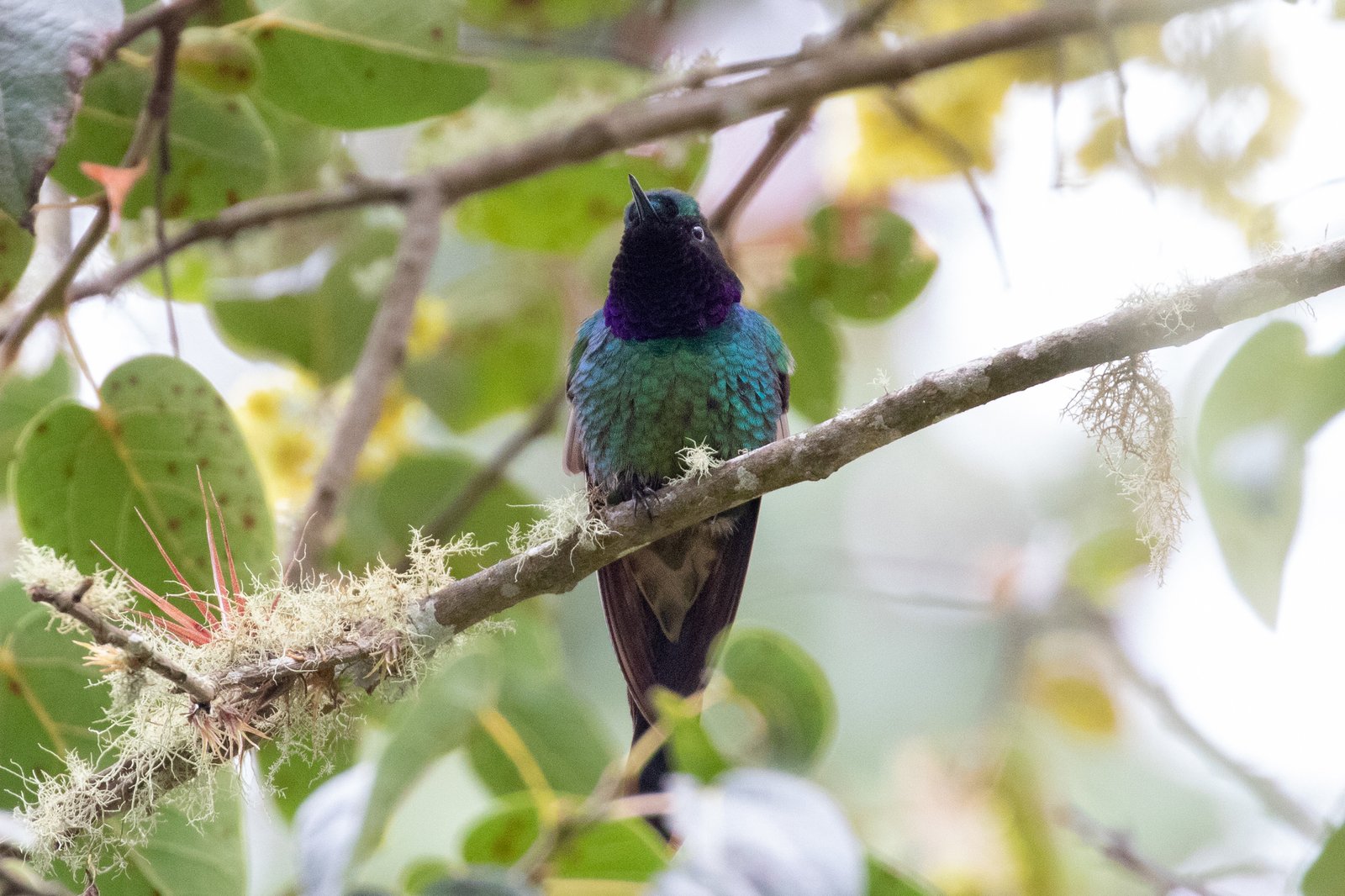
The Purple-throated Sunangel is a relatively large, green sunangel of southern Ecuador and northern Peru, with a deep violet throat and a long, forked tail. It lives at forest edges, in alder groves and in shrubby terrain, and also enters gardens and eucalyptus plantations. Locally it depends heavily on the flowers of introduced eucalyptus.
Voice
A loose series of short, dry trills and a repeated, drawn-out, buzzy call.
Recording: Leonardo Ordóñez-Delgado — CC BY-NC-SA 4.0 · xeno-canto
Identification
11–12 cm, with a short, straight, blackish bill and a fairly long, forked tail with glossy green central and blackish outer feathers. The male is glossy green above and on the belly, with a small glittering blue-green frontlet, a deep violet, glittering gorget and a blue-green breast band below it. The female has the same green colour and tail, but lacks the frontlet and the violet throat; her throat is tawny to off-white with bronzy green speckles. Juveniles resemble the female.
Confusion species
Amethyst-throated Sunangel Heliangelus amethysticollis is smaller, with a rosy purple throat above a cinnamon or whitish band and a buff belly, and lives in wetter forest on the eastern slope. Flame-throated Sunangel Heliangelus micraster is smaller, with an orange throat. Gorgeted Sunangel Heliangelus strophianus has a white breast band and lives further north. Sparkling Violetear Colibri coruscans is larger, with a violet ear patch and a dark tail band.
Habitat
The interior and edges of cloud forest and secondary forest, alder woodland (Alnus), shrubby slopes, hedgerows and gardens, between about 2150 and 3000 m. It feeds on nectar and insects, which it takes from a perch and from foliage. In parts of Ecuador it depends heavily on the introduced Eucalyptus globulus, and its distribution there follows the altitudinal limits of that tree. It breeds from October to January; the female incubates two white eggs alone.
Where the bird is most at home, classified by the vegetation units of the Andes and the west coast.


Range and movements
In Ecuador in the Andes of the south of the country, from about Azuay to Loja. In Peru in the north, south to Cajamarca and Amazonas. Absent from Colombia, Bolivia and the Galápagos. Not found outside the guide area.
- Resident
- dark = core range, pale = thinly spread
How and when to look
Around Cuenca and Loja in southern Ecuador, in gardens, hedgerows and eucalyptus groves, and at flowering shrubs along forest edges. A male often holds a fixed perch above a flowering shrub.
Conservation status
Least Concern. The species tolerates man-made landscapes and locally benefits from eucalyptus plantations.
Scientific name
Heliangelus viola | (Gould, 1853)
Gould described the species in 1853 as Heliotrypha viola; because it was later moved to another genus, the author and year stand in brackets. The genus Heliangelus was introduced in 1848 by Gould. The genus name combines Greek hēlios, 'sun', with angelos, 'angel'. The species name is Latin viola, 'violet', referring to the purple throat. The specimen the first description was based on came from Río Marañón.