All species › Swifts › Hummingbirds › Royal Sunangel
Royal Sunangel | Heliangelus regalis
Peruaanse zonnekolibrie | Solángel real | Anjo-do-sol-real
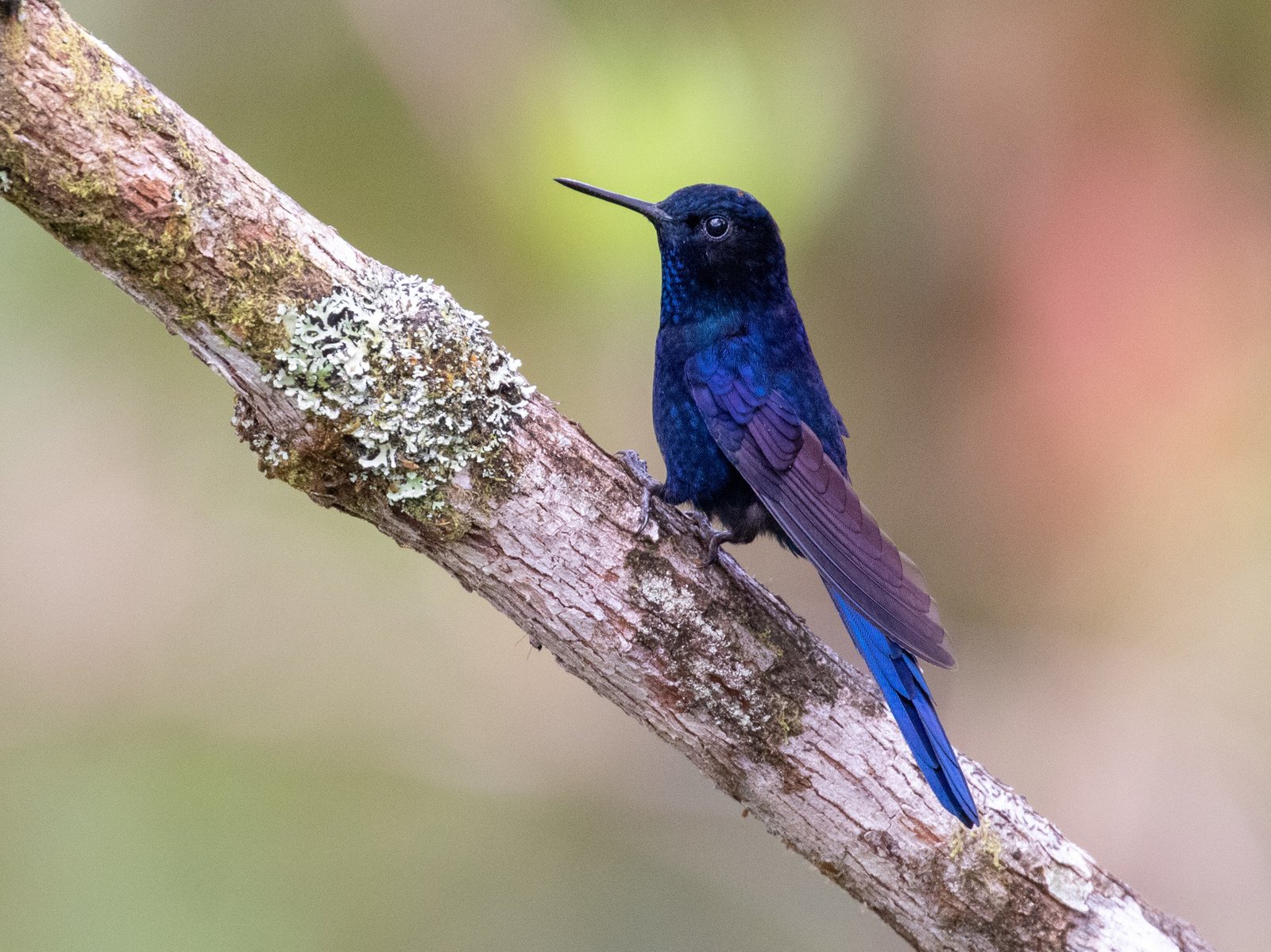
The Royal Sunangel is the only sunangel in which the male is entirely dark blue. The species was described only in 1979 and lives in elfin scrub on sandstone ridges along the eastern slope of the Andes in northern Peru and adjacent southern Ecuador. Its range is small and highly fragmented.
Voice
In display flight the male gives a series of emphatic tseep notes. While feeding a repeated short, dry tsik or tsawk; a thin, high tziíp has been described from a female.
Recording: Juan Freile — CC BY-NC-SA 4.0 · xeno-canto
Identification
10–12 cm, with a short, straight, black bill and a deeply forked tail. The male is entirely dark blue, with a violet-purple to indigo, metallic tail; the gloss is strongest on the forecrown, and in the form johnsoni of the Cordillera Azul over the whole body. The female is dark green above and cinnamon below with bronzy green spots, with a buff band between throat and breast; her tail is less deeply forked and blue-black.
Confusion species
Among the hummingbirds of the guide area the male is recognisable by its entirely dark blue plumage and deeply forked tail. The female resembles the female Amethyst-throated Sunangel Heliangelus amethysticollis, which has a rufous, black-flecked throat and a glittering green lower breast. Tyrian Metaltail Metallura tyrianthina has a shorter, less forked, coppery red tail. Flame-throated Sunangel Heliangelus micraster lives higher, in mossy montane forest.
Habitat
Elfin scrub and open terrain with mossy, stunted forest and small shrubs on sandstone ridges, also steep wooded ravines and forest at middle elevations, mainly between about 1500 and 2200 m, locally from 1250 m. It visits the flowers of various shrubs and small trees and catches insects from a perch and from foliage. Little is known about its breeding.
Where the bird is most at home, classified by the vegetation units of the Andes and the west coast.


Range and movements
In Peru in the north: the Cordillera del Cóndor in Cajamarca and Amazonas, the eastern slope in San Martín and Loreto, and the Cordillera Azul (the form johnsoni). In Ecuador known since 2008 from Zamora-Chinchipe, on the sandstone ridges of the Cordillera del Cóndor. Absent from Colombia, Bolivia and the Galápagos. Not found outside the guide area; known from fewer than ten sites.
- Resident
- dark = core range, pale = thinly spread
How and when to look
Search low, open scrub on sandstone ridges in northern Peru, including the area around Abra Patricia in Amazonas and San Martín. The male often perches in the open on top of a shrub.
Conservation status
Near Threatened. The range is small and highly fragmented; farming and deforestation affect its specialised habitat.
Scientific name
Heliangelus regalis | Fitzpatrick, Willard & Terborgh, 1979
Fitzpatrick, Willard & Terborgh described the species in 1979 and placed it straight away in the genus where it still stands. The genus Heliangelus was introduced in 1848 by Gould. The genus name combines Greek hēlios, 'sun', with angelos, 'angel'. The species name is Latin regalis, 'royal'. The specimen the first description was based on came from Cordillera del Cóndor above San José de Lourdes, Cajamarca, Peru.