All species › Swifts › Hummingbirds › Speckled Hummingbird
Speckled Hummingbird | Adelomyia melanogenys
Zwartoorkolibrie | Colibrí jaspeado | Beija-flor-salpicado
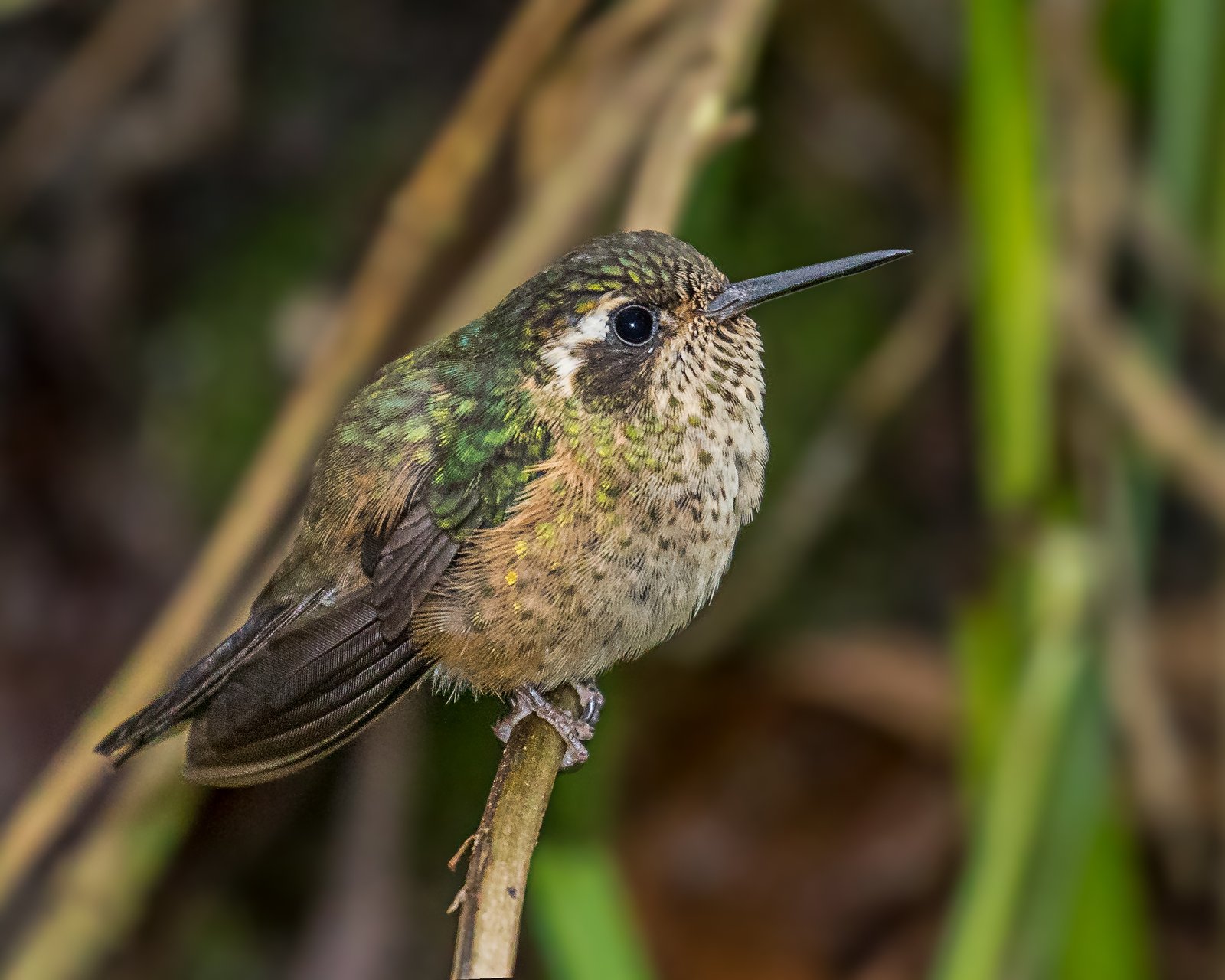
The Speckled Hummingbird is a small, dull-coloured hummingbird of the lower levels of humid montane forest, with a dark ear patch and pale, speckled underparts. It is one of the most widespread hummingbirds of middle elevations in the Andes. It follows a regular route along scattered flowers close to the ground.
Voice
Short, dry tsik notes, often repeated while feeding, and a high, thin twitter.
Recording: Mauricio Cuellar Ramirez (@Birding.travel) — CC BY-NC-SA 4.0 · xeno-canto
Identification
8–9 cm, with a short, straight, black bill. The upperparts are dull bronzy green. A broad, blackish ear patch is bordered above by a whitish stripe behind the eye. The underparts are buff to cinnamon, with dark speckles on the throat and breast. The tail is rounded, bronzy green with a dark band and buff tips to the outer feathers. The sexes are alike.
Confusion species
White-throated Daggerbill Schistes albogularis and Geoffroy's Daggerbill Schistes geoffroyi have a pointed, wedge-shaped bill, a white stripe along the sides of the breast and a glittering green or purple throat. Buff-thighed Puffleg Haplophaedia assimilis and Greenish Puffleg Haplophaedia aureliae are larger and greener, with white or buff leg puffs. Ecuadorian Piedtail Phlogophilus hemileucurus has white underparts and a black-and-white tail. Female woodstars (Chaetocercus) are smaller, with rufous flanks and a dark breast band.
Habitat
The lower and middle levels of humid montane forest and cloud forest, forest edges, older secondary growth and shrubby ravines, mostly between about 1000 and 2500 m, locally up to 3000 m. It visits small flowers of shrubs and epiphytes low down and takes many small insects and spiders. It sometimes comes to feeders. The nest is a cup of moss, often attached to a hanging root under an overhanging bank or rock.
Where the bird is most at home, classified by the vegetation units of the Andes and the west coast.


Range and movements
In Colombia in all three cordilleras and in the Sierra de Perijá and the Sierra Nevada de Santa Marta. In Ecuador on both slopes of the Andes. In Peru along the eastern slope of the Andes over almost the entire length of the country and locally on the western slope in the north. In Bolivia on the eastern slope of the Andes. Absent from the Galápagos. Outside the guide area in Venezuela and north-western Argentina.
- Resident
- dark = core range, pale = thinly spread
How and when to look
Along forest trails in cloud forest at middle elevations, such as at Mindo in Ecuador or along the Manu road in Peru. Watch for a small, brownish hummingbird moving low along the trail from flower to flower.
Conservation status
Least Concern. The species has a very large range and tolerates secondary forest; deforestation affects its habitat locally.
Scientific name
Adelomyia melanogenys | (Fraser, 1840)
Fraser described the species in 1840 as Trochilus melanogenys; because it was later moved to another genus, the author and year stand in brackets. The genus Adelomyia was introduced in 1854 by Bonaparte. The genus name comes from Greek adēlos, 'obscure, unseen', and muia, 'fly', a common element in hummingbird names. The species name comes from Greek melas, 'black', and genus, 'cheek', after the dark cheek patch. The specimen the first description was based on came from Bogotá, Colombia.