All species › Woodpeckers and allies › Woodpeckers › Campo Flicker
Campo Flicker | Colaptes campestris
Campogrondspecht | Carpintero campestre | Pica-pau-do-campo
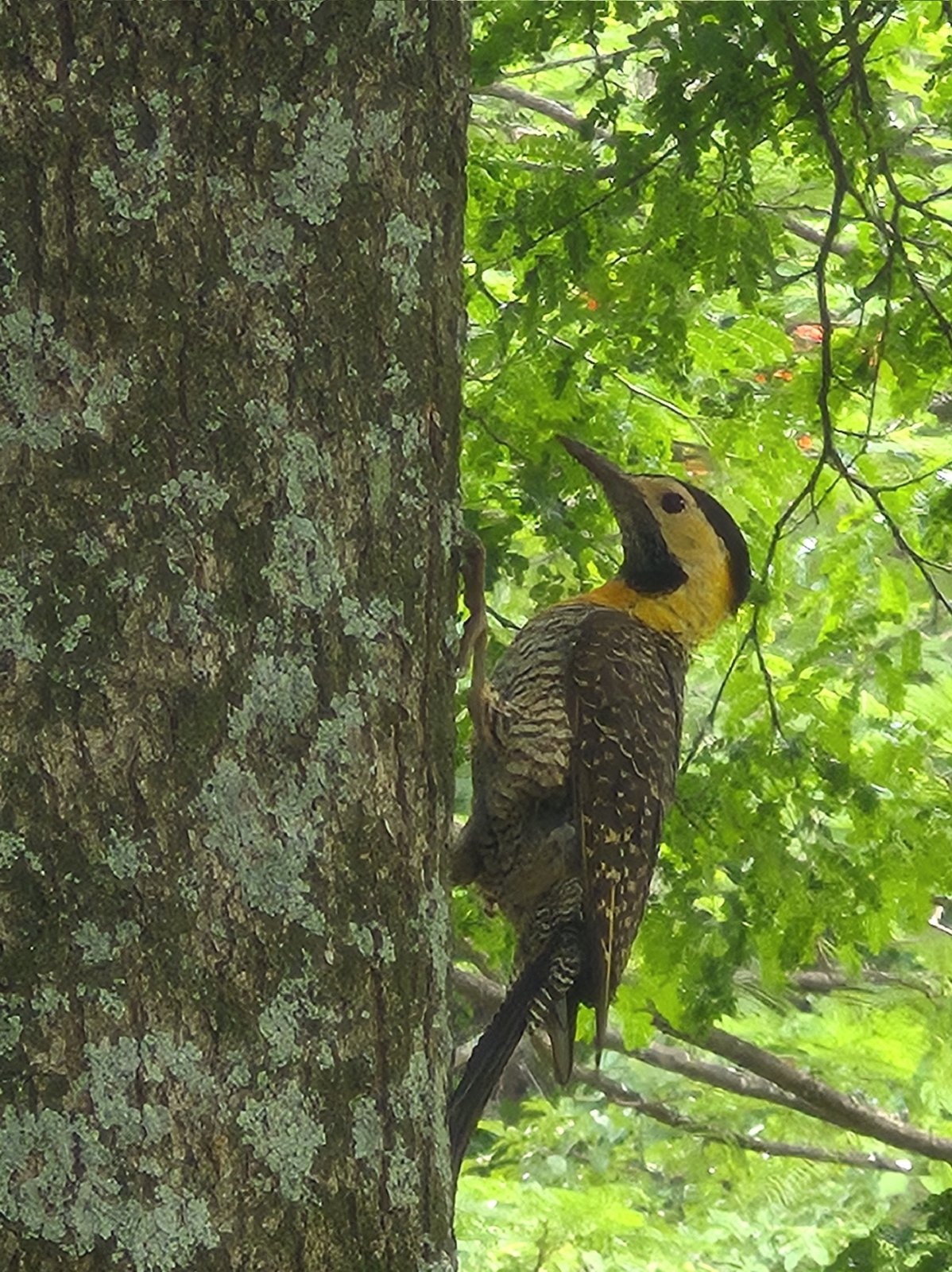
The Campo Flicker is a large ground-feeding woodpecker of open savannas and pastures in eastern South America, which within the guide area reaches only the lowlands of Bolivia and the far south-east of Peru. It takes much of its food on the ground, mainly ants and termites, and often lives in pairs or small, loose groups.
Voice
A loud, rapid series kwik-kwik-kwik-kwik, often in duet, and a piercing, two-syllabled kee-ah. It drums little.
Recording: Fabrício Grigolin — CC BY-NC-SA 4.0 · xeno-canto
Identification
28–31 cm, with a long, slightly decurved, dark bill. The head, neck and breast are golden yellow, with a black crown. In birds in Bolivia the throat is black. The back and wings are barred black and pale buff, the rump is whitish with dark barring and the tail is black. The belly is whitish with narrow black barring. The male has a red-and-black malar stripe, the female a black or buffy one.
Confusion species
Green-barred Woodpecker Colaptes melanochloros has a white cheek, a red nape and a greenish barred back, and feeds mainly in trees. Andean Flicker Colaptes rupicola is similar in shape and behaviour, but has a grey crown and a buff breast and lives only high in the Andes, not in the lowlands. Lineated Woodpecker Dryocopus lineatus is black with a red crest and does not come to the ground.
Habitat
Open and semi-open savanna, cerrado, wet grassland with termite mounds and scattered trees, pastures and the edges of dry forest, in the guide area mainly below 500 m. It searches the ground and termite mounds for ants, termites and their larvae. It nests in a cavity in a tree, a palm trunk, a termite mound or an earth bank.
Where the bird is most at home, classified by the vegetation units of the Andes and the west coast.


Range and movements
In Bolivia in the savannas of the north and east (Beni, Santa Cruz and adjacent areas). In Peru only locally in the savannas of the far south-east, near the Bolivian border. Absent from Colombia, Ecuador and the Galápagos. Outside the guide area in Brazil, Paraguay, Uruguay and north-eastern Argentina, with an isolated population in Suriname.
- Resident
- dark = core range, pale = thinly spread
How and when to look
In the Beni savannas and along roads through open ranchland, look for birds walking on the ground or perched on termite mounds, palms and fence posts. When disturbed they fly to a tree or post and show the pale rump.
Conservation status
Not Evaluated in its current taxonomic treatment. In the older, broader treatment the species was listed as Least Concern. It has a very large range and locally benefits from the clearing of forest for pasture.
Scientific name
Colaptes campestris | (Vieillot, 1818)
Vieillot described the species in 1818 as Picus campestris; because it was later moved to another genus, the author and year stand in brackets. The genus Colaptes was introduced in 1825 by Vigors. The genus name comes from Greek kolaptēs, 'chiseller', from kolaptō, 'to peck, to chisel'. The species name comes from Latin campestris, 'of the open fields', for the open grasslands (campos) it inhabits. The specimen the first description was based on came from Paraguay.