All species › Woodpeckers and allies › Woodpeckers › Andean Flicker
Andean Flicker | Colaptes rupicola
Andesgrondspecht | Carpintero andino | Pica-pau-andino
The Andean Flicker is a large, almost entirely terrestrial woodpecker of the high plateaus and open slopes of the Andes. It lives in small groups that move noisily over grassland and among rocks. It nests in holes dug into earth banks or adobe walls.
Voice
Loud, piercing calls kee-ar and peek, and a long, laughing series kwee-kwee-kwee, often given in chorus by a group.
Recording: Jerome Fischer — CC BY-NC-SA 4.0 · xeno-canto
Identification
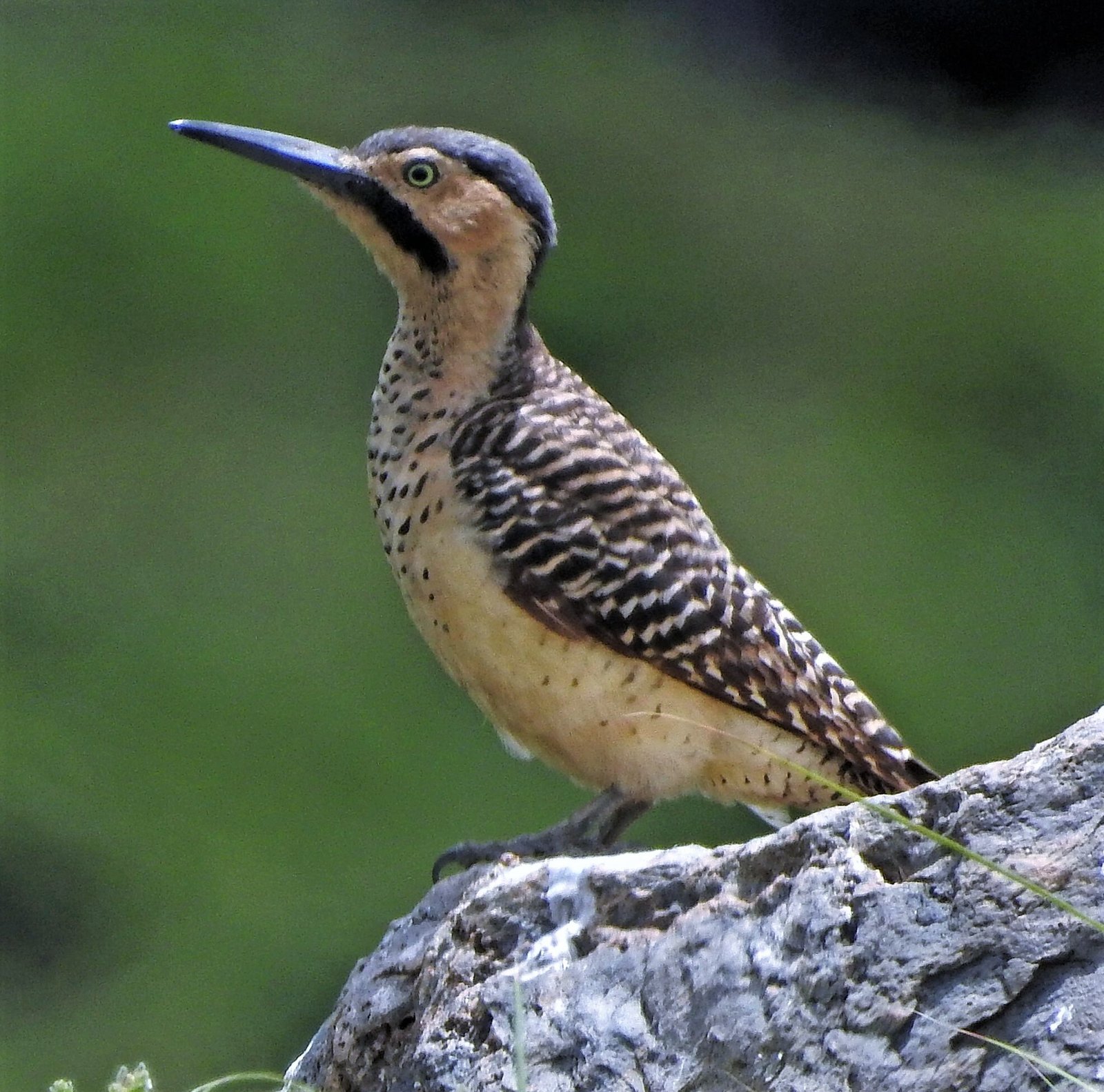
30–33 cm, with a long, slightly decurved bill. The crown is slate-grey, the face and neck buff. The male has a moustachial stripe with red, the female a grey or blackish one. The back is buff with black bars; the rump is yellowish white and conspicuous in flight. The underparts are plain buff to cinnamon, with black spots on the breast. The iris is yellow. In northern Peru the crown is greyer and the breast less spotted.
Confusion species
Green-barred Woodpecker Colaptes melanochloros is smaller, with a black crown and a green, barred back, and lives in woodland and the dry valleys of Bolivia. Black-necked Woodpecker Colaptes atricollis is much smaller, with a black throat, and lives lower in dry scrub. In the field its silhouette is closer to that of a large thrush than to a tree woodpecker.
Habitat
Puna grassland, open rocky slopes, gully edges, fields and villages in the high Andes; roughly between 2500 and 5000 m, mostly above 3000 m. It forages mainly on the ground, digging in soil and dung for ant larvae, beetles and other insects. It nests in a self-dug burrow in an earth bank or in adobe walls, often in loose colonies.
Where the bird is most at home, classified by the vegetation units of the Andes and the west coast.


Range and movements
In Peru along the Andes from the north to the south, on the puna and the higher slopes. In Bolivia on the altiplano and in the higher parts of the Andes. In Ecuador at most a very rare bird in the far south. Absent from Colombia and the Galápagos. Outside the guide area in northern Chile and north-western Argentina.
- Resident
- dark = core range, pale = thinly spread
How and when to look
Search the puna around Lake Titicaca, along roads in the higher parts of Cusco and Arequipa and on rocky slopes near villages; groups often sit on boulders and walls and call loudly.
Conservation status
Not Evaluated in the current circumscription of the species. As a whole widespread and locally common; the species tolerates small-scale farming in the high Andes.
Scientific name
Colaptes rupicola | d'Orbigny, ACVMD, 1840
D'Orbigny, ACVMD described the species in 1840 and placed it straight away in the genus where it still stands. The genus Colaptes was introduced in 1825 by Vigors. The genus name comes from Greek kolaptēs, 'chiseller', from kolaptō, 'to peck, to chisel'. The species name comes from Latin rupes, 'rock', and -cola, 'dweller', for the rocky highlands it inhabits. The specimen the first description was based on came from Sica Sica, La Paz, Bolivia.