All species › Woodpeckers and allies › Woodpeckers › Green-barred Woodpecker
Green-barred Woodpecker | Colaptes melanochloros
Groenbandgrondspecht | Carpintero real | Pica-pau-verde-barrado
The Green-barred Woodpecker is a large flicker of dry forest and semi-open terrain in central and eastern South America. In the guide area it occurs only in Bolivia, both in the lowlands of the Chaco and Chiquitania and in the dry Andean valleys. It feeds a lot on the ground, mainly on ants.
Voice
A loud, fast series kweek-kweek-kweek, a high peeuw and, when excited, a repeated wicka. Drums briefly.
Recording: JAYRSON ARAUJO DE OLIVEIRA — CC BY-NC-SA 4.0 · xeno-canto
Identification
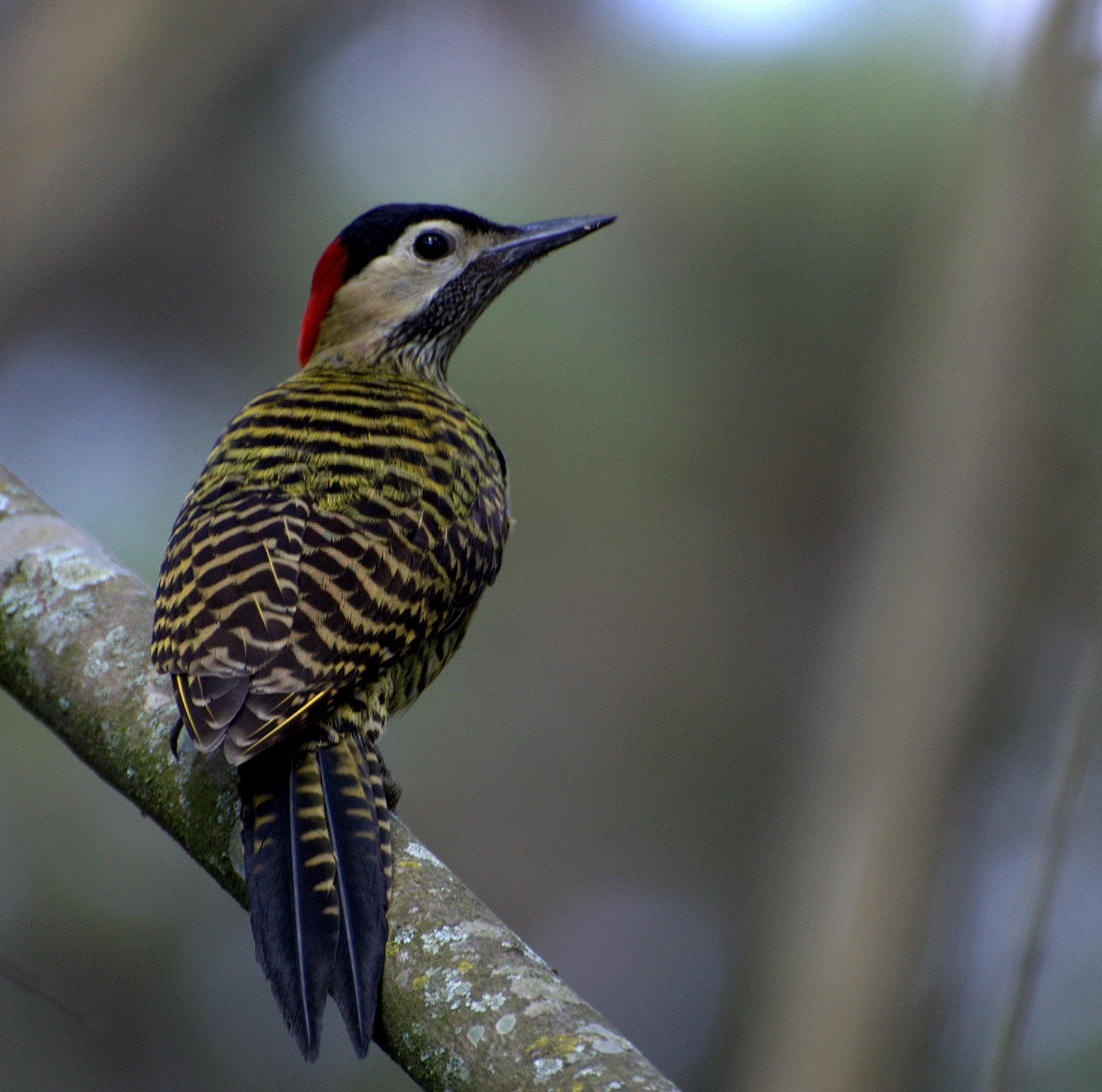
26–28 cm. The crown is black and the nape red. The face is white; the male has a red moustachial stripe, the female a black one. The back is olive-green with dense black bars, and the rump yellowish. The underparts are yellowish white with black heart-shaped or round spots; in the form of the Andean valleys the breast is golden yellow. The underwing and the shafts of the flight feathers are yellow.
Confusion species
Campo Flicker Colaptes campestris has a yellow neck and breast and a black throat or crown, and lives in open grassland. Spot-breasted Woodpecker Colaptes punctigula is smaller, with a streaked throat, and lives in the Amazonian lowlands. Andean Flicker Colaptes rupicola is larger, with a grey crown and a buff breast, and lives on the puna above the treeline.
Habitat
Dry forest and Chaco, savanna with trees, open woodland, the dry valleys of the Andes, fields with trees, parks and villages; from the lowlands to roughly 3000 m in the Andean valleys. It forages on trunks and branches but also feeds a lot on the ground, mainly on ants and their larvae, and sometimes eats fruit. It nests in a self-excavated cavity in a tree, post or cactus.
Where the bird is most at home, classified by the vegetation units of the Andes and the west coast.


Range and movements
In Bolivia in the lowlands of the centre and east, the Chaco and the dry Andean valleys of Cochabamba, Chuquisaca, Santa Cruz and Tarija. Absent from Colombia, Ecuador, Peru and the Galápagos. Outside the guide area in Brazil, Paraguay, Uruguay and Argentina.
- Resident
- dark = core range, pale = thinly spread
How and when to look
Search the dry valleys around Cochabamba and Samaipata and the Chaco forest of Santa Cruz, along forest edges and in yards with trees; birds often forage on the ground.
Conservation status
Not Evaluated in the current circumscription of the species. As a whole widespread and common; the species tolerates open and human-altered terrain.
Scientific name
Colaptes melanochloros | (Gmelin, 1788)
Gmelin described the species in 1788 as Picus melanochloros; because it was later moved to another genus, the author and year stand in brackets. The genus Colaptes was introduced in 1825 by Vigors. The genus name comes from Greek kolaptēs, 'chiseller', from kolaptō, 'to peck, to chisel'. The species name comes from Greek melas, 'black', and khlōros, 'green', for the black and green barring. The specimen the first description was based on came from Rio de Janeiro, Brazil.