All species › Woodpeckers and allies › Woodpeckers › Spot-breasted Woodpecker
Spot-breasted Woodpecker | Colaptes punctigula
Vlekborstgrondspecht | Carpintero pechipunteado | Pica-pau-de-peito-pontilhado
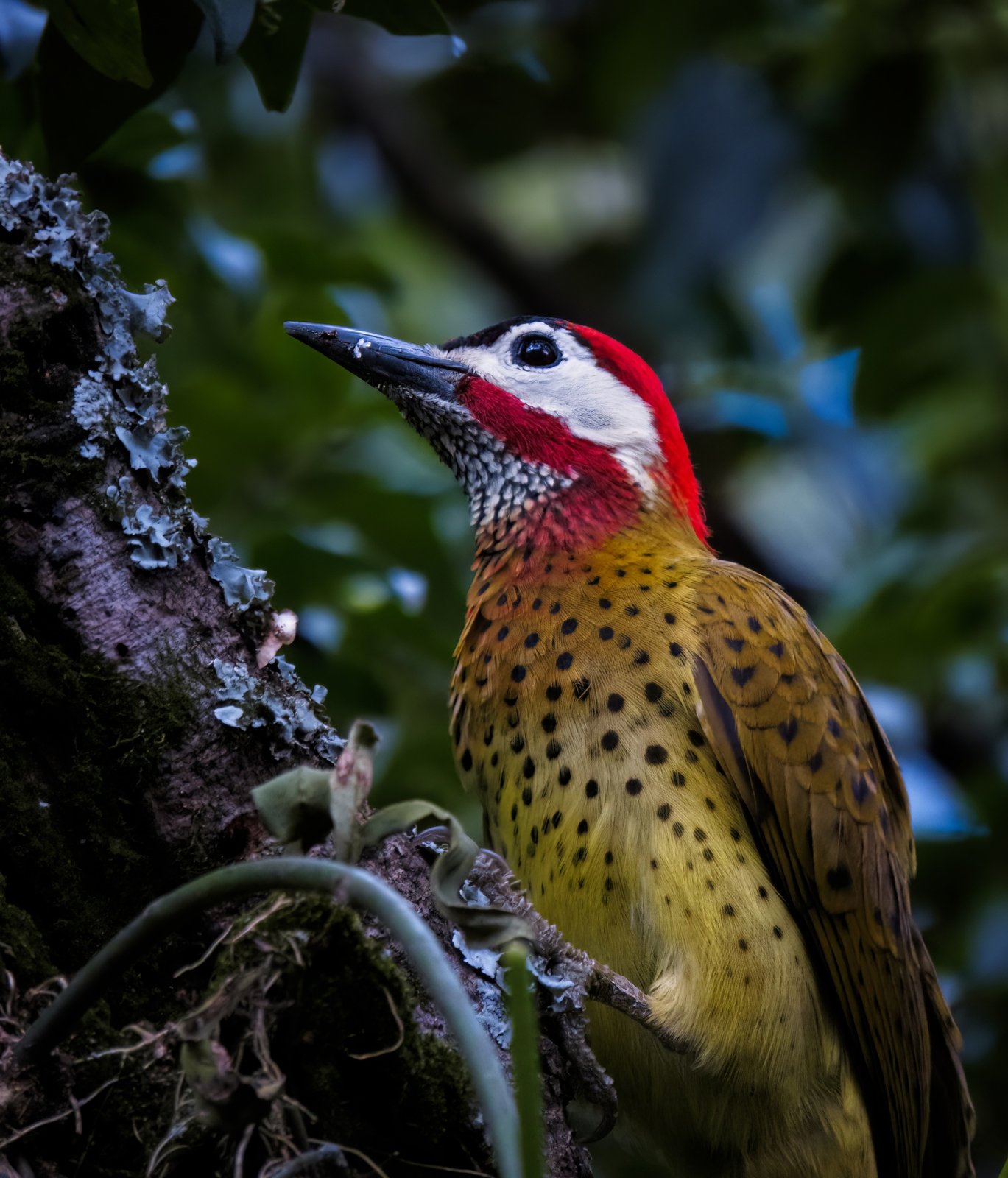
The Spot-breasted Woodpecker is a small flicker of semi-open lowland terrain, from Panama to Amazonia. It combines a white face with a yellow, black-spotted breast. Unlike many other lowland woodpeckers it lives mainly in open country with scattered trees and along rivers.
Voice
A loud series wik-wik-wik, a fast, high rattle and, when excited, a repeated wicka-wicka. Drums infrequently.
Recording: Mauricio Cuéllar-Ramírez — CC BY-NC-SA 4.0 · xeno-canto
Identification
20–22 cm. The crown is black, with red on the hindcrown and nape; the male also has a red moustachial stripe, which is black in the female. The face is white. The throat is streaked black and white. The back is olive-yellow with black bars. The breast and belly are yellowish, the breast with round black spots that become smaller on the belly. The rump is yellowish.
Confusion species
Golden-olive Woodpecker Colaptes rubiginosus has a grey crown and barred rather than spotted underparts, and lives mainly in forest. Golden-green Woodpecker Piculus chrysochloros is plain green above with a yellow cheek stripe and lives in the forest canopy. Lineated Woodpecker Dryocopus lineatus is much larger, black with a red crest.
Habitat
Semi-open country with scattered trees, river islands and riparian woodland, várzea, forest edge, open woodland, savanna with groves, pastures and plantations; mostly below 1000 m, in Colombia locally higher. It forages on trunks and branches and also on the ground, mainly on ants and termites. It nests in a self-excavated cavity in a tree or post.
Where the bird is most at home, classified by the vegetation units of the Andes and the west coast.


Range and movements
In Colombia in the northern lowlands, the llanos and Amazonia. In Ecuador and Peru in the Amazonian lowlands, especially along rivers. In Bolivia in the north. Absent west of the Andes in Ecuador and Peru and from the Galápagos. Outside the guide area in Panama, Venezuela, the Guianas and western and northern Brazil.
- Resident
- dark = core range, pale = thinly spread
How and when to look
Search river islands and riverbanks in the Amazonian lowlands, and in the llanos around groves near pastures; the species often perches in the open on dead branches.
Conservation status
Least Concern. The species tolerates open and human-altered terrain well and locally benefits from deforestation.
Scientific name
Colaptes punctigula | (Boddaert, 1783)
Boddaert described the species in 1783 as Picus punctigula; because it was later moved to another genus, the author and year stand in brackets. The genus Colaptes was introduced in 1825 by Vigors. The genus name comes from Greek kolaptēs, 'chiseller', from kolaptō, 'to peck, to chisel'. The species name comes from Latin punctum, 'spot', and gula, 'throat', for the spotted throat and breast. The specimen the first description was based on came from Cayenne, French Guiana.