All species › Woodpeckers and allies › Woodpeckers › Black-necked Woodpecker
Black-necked Woodpecker | Colaptes atricollis
Zwartnekgrondspecht | Carpintero peruano | Pica-pau-de-pescoço-preto
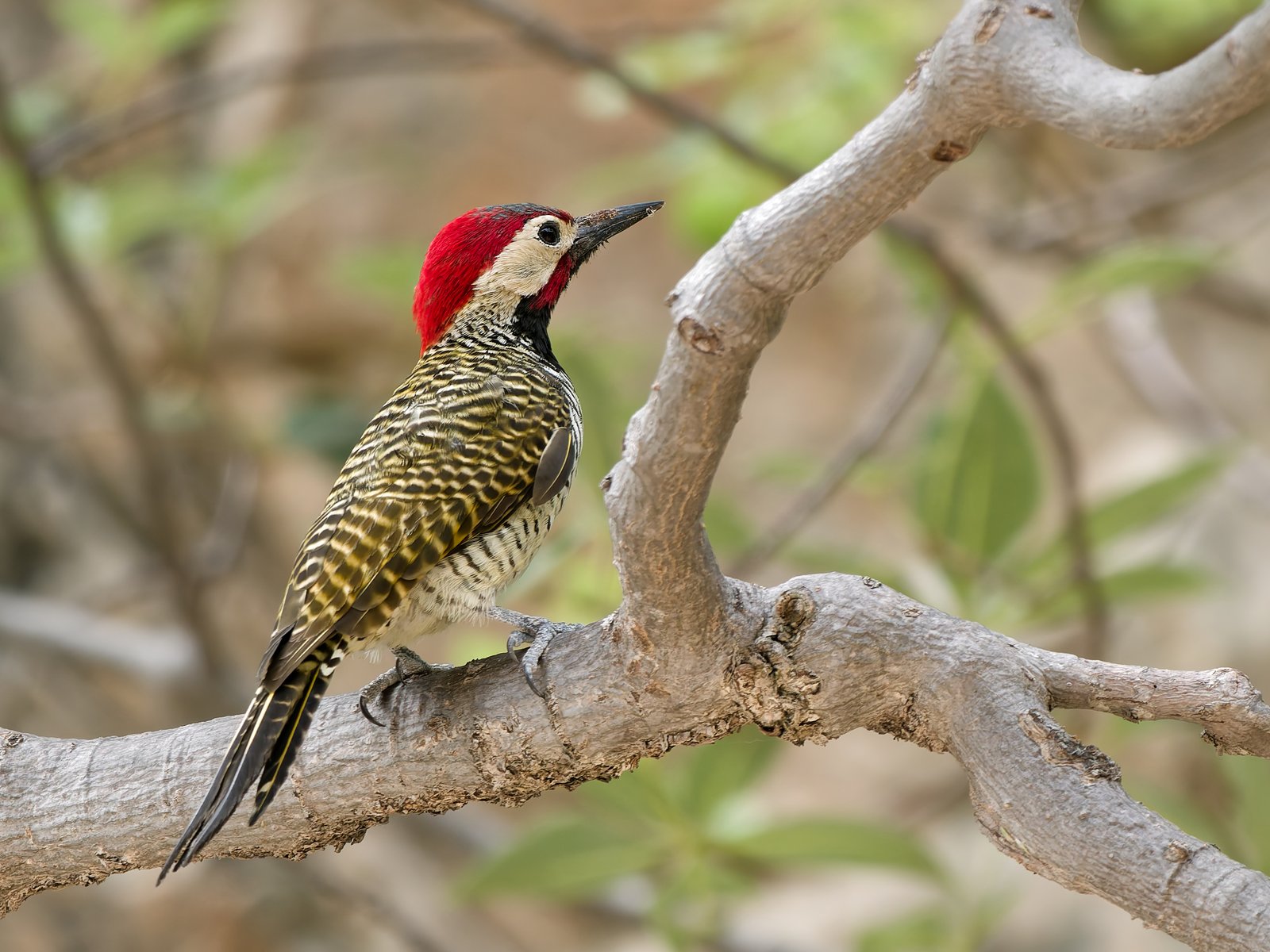
The Black-necked Woodpecker is found only in Peru, on the dry western slope of the Andes and in dry valleys between the ranges. It is the only woodpecker in much of this bare landscape of cacti and shrubs. Its black throat and neck distinguish it from related species.
Voice
A loud series kee-kee-kee and single shrill peeuw calls; drums briefly.
Recording: Dan Lane — CC BY-NC-SA 4.0 · xeno-canto
Identification
25–27 cm. The crown is grey; the male has a red hindcrown and nape and a red moustachial stripe, the female red only on the nape. The face is whitish. The throat and foreneck are black, which gives the species its name. The back is olive-brown with black bars, and the rump yellowish. The underparts are pale yellow with dense black bars. The underwing and shafts of the flight feathers are yellow.
Confusion species
Andean Flicker Colaptes rupicola is much larger, with a buff face and neck lacking a black throat, and lives higher on the puna. Golden-olive Woodpecker Colaptes rubiginosus has a green back and lives in humid forest. Striped Woodpecker Veniliornis lignarius and other small Veniliornis woodpeckers are much smaller and lack a black throat.
Habitat
Dry scrub with cacti, arid slopes with scattered trees, riparian growth and fields with lines of trees, also eucalyptus plantings; roughly between 500 and 4000 m, mostly between 1500 and 3000 m. It forages on trunks, cacti and on the ground. It eats ants and other insects. It nests in a cavity in a tree or columnar cactus.
Where the bird is most at home, classified by the vegetation units of the Andes and the west coast.


Range and movements
Only in Peru: on the western slope of the Andes from the north to the far south, and in the dry Marañón valley. Absent from Colombia, Ecuador, Bolivia and the Galápagos. Endemic to the guide area.
- Resident
- dark = core range, pale = thinly spread
How and when to look
Search the dry valleys on the western slope, for example above Lima along the roads to Santa Eulalia and Huaral, in cactus scrub and around fields with trees.
Conservation status
Least Concern. The species tolerates farmland with trees and is locally common.
Scientific name
Colaptes atricollis | (Malherbe, 1850)
Malherbe described the species in 1850 as Chrysopicos atricollis; because it was later moved to another genus, the author and year stand in brackets. The genus Colaptes was introduced in 1825 by Vigors. The genus name comes from Greek kolaptēs, 'chiseller', from kolaptō, 'to peck, to chisel'. The species name comes from Latin ater, 'black', and collum, 'neck', for the black neck. The specimen the first description was based on came from Peru.