All species › Woodpeckers and allies › Woodpeckers › Crimson-mantled Woodpecker
Crimson-mantled Woodpecker | Colaptes rivolii
Roodmantelspecht | Carpintero dorsicarmesí | Pica-pau-de-manto-carmesim
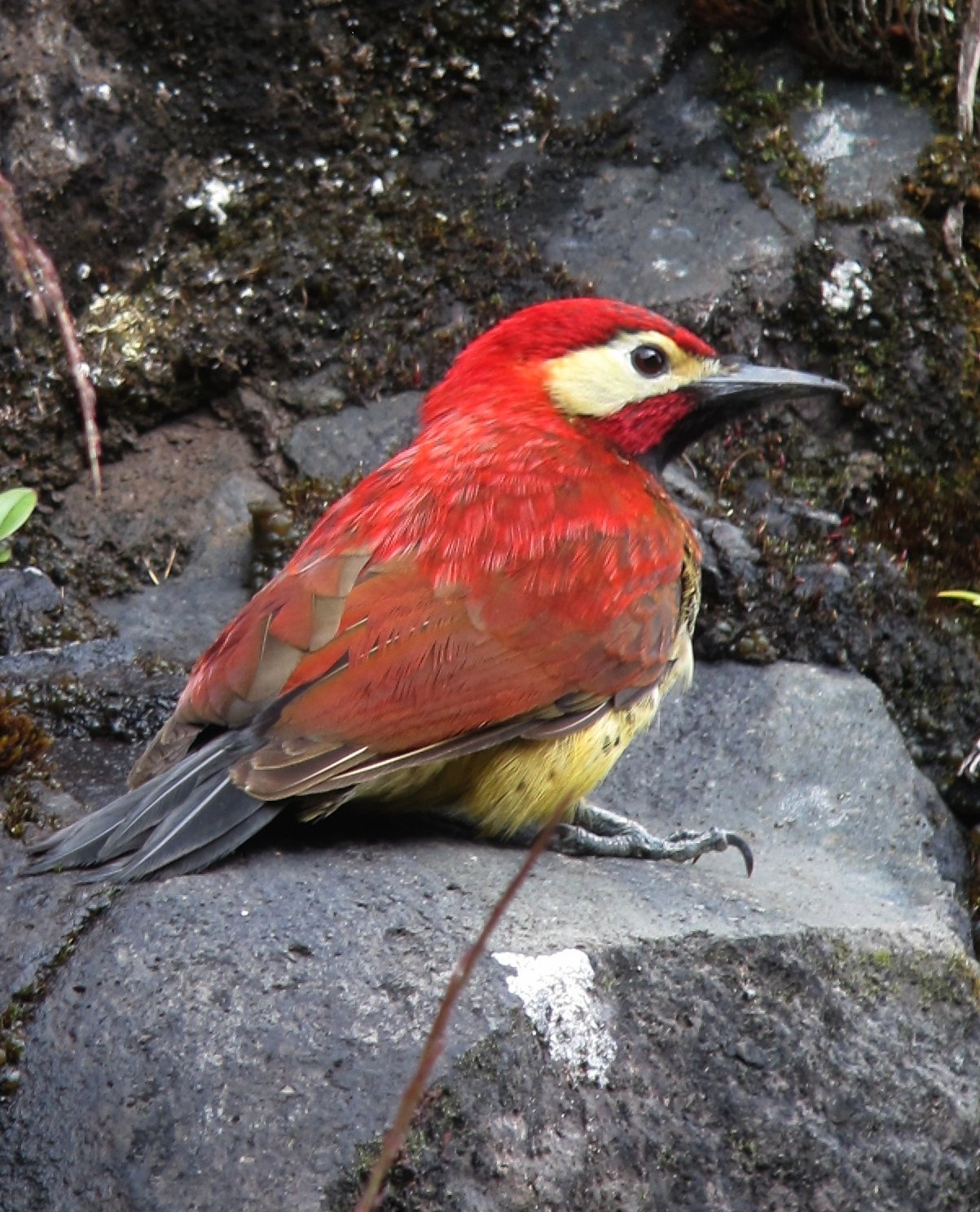
The Crimson-mantled Woodpecker is a woodpecker of upper montane forest in the Andes, from Venezuela to Bolivia. It combines a crimson back with a yellow belly and a whitish face. It lives higher than most other woodpeckers in the guide area, up to the treeline.
Voice
A loud, sharp single call kee or kirr and a fast, rising rattle; drums briefly.
Recording: Fabrice Schmitt — CC BY-NC-SA 4.0 · xeno-canto
Identification
25–28 cm. The back, mantle and wing coverts are crimson, the flight feathers and tail blackish. The face is yellowish white and the throat black. The breast is black with pale scaling or, in the south, an almost plain black breast band; the belly is golden yellow. The male has a red crown and moustachial stripe, the female a black crown and no red in the moustache. The eyes are dark.
Confusion species
Golden-olive Woodpecker Colaptes rubiginosus has an olive-green back, a grey crown and barred underparts, and lives lower. Andean Flicker Colaptes rupicola is larger, mainly brown and buff with a grey crown, and lives in open, treeless terrain. Woodpeckers of the genus Campephilus with red on the head have a black back and a red crest.
Habitat
Cloud forest, upper montane forest, elfin forest near the treeline, Polylepis woodland and forest edge, locally also shrubs and trees in the páramo; roughly between 1800 and 3800 m. It forages on trunks, branches and mossy tree trunks, sometimes also on the ground. It eats ants, beetle larvae and other insects, and some fruit. It nests in a self-excavated cavity.
Where the bird is most at home, classified by the vegetation units of the Andes and the west coast.


Range and movements
In Colombia in all three Andean ranges and the Santa Marta mountains. In Ecuador on both Andean slopes and in the higher valleys. In Peru along the eastern slope and the higher parts of the western slope in the north. In Bolivia in the Yungas of La Paz and Cochabamba. Absent from the lowlands and the Galápagos. Outside the guide area in western Venezuela.
- Resident
- dark = core range, pale = thinly spread
How and when to look
Search the upper zone of cloud forest and forest edges near the treeline, often in high-elevation mixed flocks. Pairs often perch in the open on dead trunks.
Conservation status
Not Evaluated in the current circumscription of the species. As a whole widespread and locally common; the species tolerates forest edge, but depends on trees at high elevation.
Scientific name
Colaptes rivolii | (Boissonneau, 1840)
Boissonneau described the species in 1840 as Picus Rivolii; because it was later moved to another genus, the author and year stand in brackets. The genus Colaptes was introduced in 1825 by Vigors. The genus name comes from Greek kolaptēs, 'chiseller', from kolaptō, 'to peck, to chisel'. The species name honours François Victor Masséna, 3rd Duke of Rivoli (1799–1863), French bird collector and amateur ornithologist. The specimen the first description was based on came from Chipaque, Cundinamarca, Colombia.