All species › Woodpeckers and allies › Woodpeckers › Golden-olive Woodpecker
Golden-olive Woodpecker | Colaptes rubiginosus
Olijfrugspecht | Carpintero olivo | Pica-pau-oliváceo
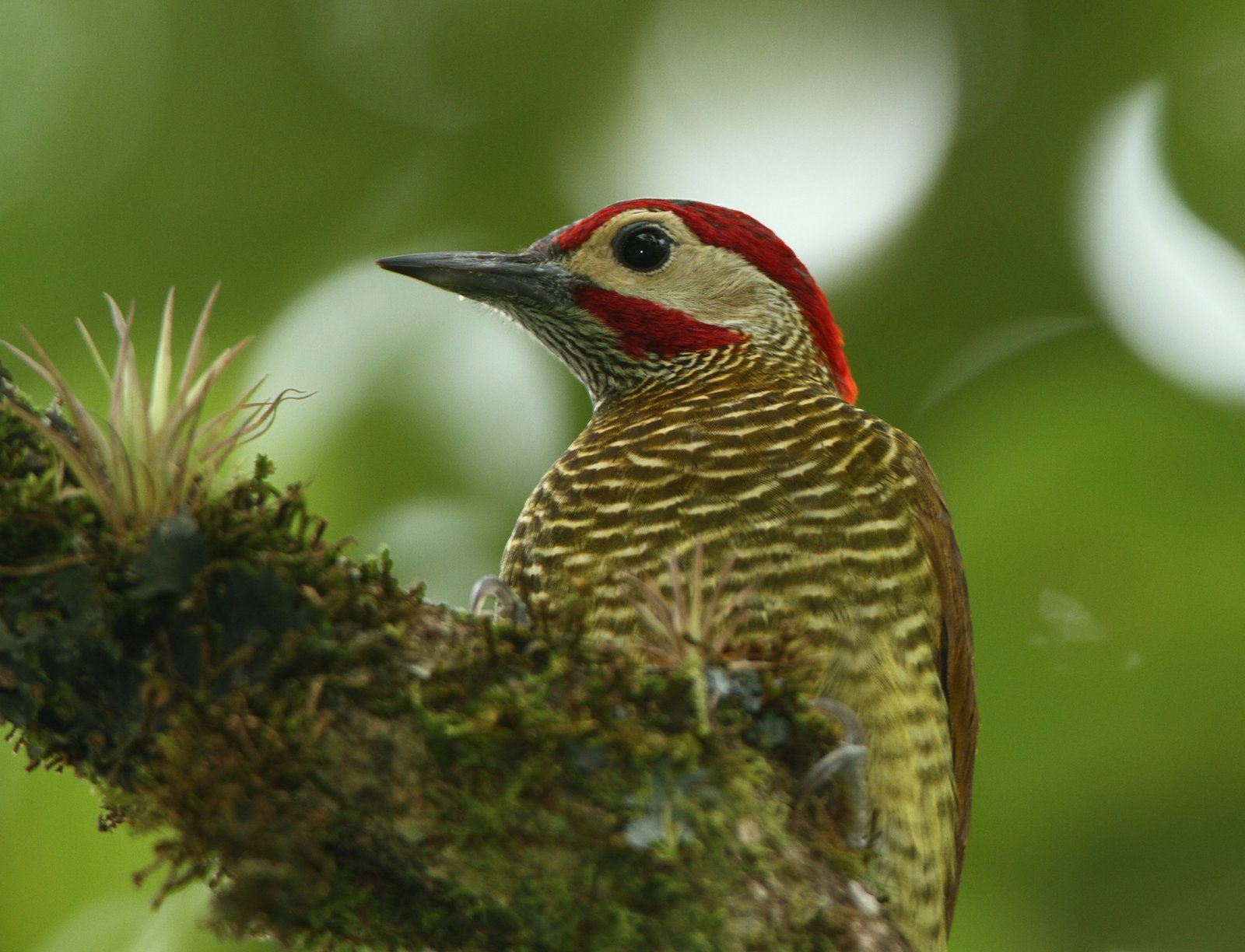
The Golden-olive Woodpecker is a medium-sized woodpecker with a golden-green back and a grey crown, widespread from Mexico to Argentina. In the guide area it is mainly a bird of montane forest and forest edge on the Andean slopes, but in the west it descends into the lowlands. It is one of the most widespread woodpeckers at middle elevations.
Voice
A long, fast, rolling trill on one pitch; also a sharp, descending djeerr. Drums in short, rapid bursts.
Recording: Paul Molina Abril — CC BY-NC-SA 4.0 · xeno-canto
Identification
20–23 cm. The back and wings are golden olive-green. The crown is slate-grey, bordered with red that in the male continues onto the nape; the cheek is whitish. The male has a red moustachial stripe, which in the female is absent or dark; the female has red only on the nape. The throat is dark-streaked. The underparts are yellowish with dense olive bars. The tail is dark.
Confusion species
Golden-green Woodpecker Piculus chrysochloros has a yellow stripe below a dark cheek patch and no grey crown, and lives in the Amazonian lowlands. Crimson-mantled Woodpecker Colaptes rivolii has a crimson back and lives higher. Spot-breasted Woodpecker Colaptes punctigula has a black crown and spotted rather than barred underparts. White-throated Woodpecker Piculus leucolaemus has a white throat and a yellow stripe across the cheek.
Habitat
Humid montane forest, cloud forest, forest edge, secondary forest, coffee plantations and semi-open country with trees, roughly from sea level to 2500 m, locally higher; in the west also in humid and dry lowland forest. It forages on trunks and branches in the middle strata, often in mixed flocks. It eats ants, beetles and their larvae, sometimes fruit. It nests in a self-excavated cavity.
Where the bird is most at home, classified by the vegetation units of the Andes and the west coast.


Range and movements
In Colombia widespread in the Andes, the Santa Marta mountains and the northern lowlands. In Ecuador on both Andean slopes and in the western lowlands. In Peru on the eastern slope of the Andes and in the north-west. In Bolivia in the Yungas and the montane forests of the eastern slope. Absent from the Galápagos. Outside the guide area from Mexico through Central America and Venezuela to north-western Argentina.
- Resident
- dark = core range, pale = thinly spread
How and when to look
In montane forest, follow mixed flocks along roads and forest edges; the rolling trill often gives the species away before it is seen. In western Ecuador also in gardens and plantations with tall trees.
Conservation status
Not Evaluated in the current circumscription of the species. As a whole widespread and common; the species tolerates forest edge, secondary forest and plantations.
Scientific name
Colaptes rubiginosus | (Swainson, 1820)
Swainson described the species in 1820 as Picus rubiginosus; because it was later moved to another genus, the author and year stand in brackets. The genus Colaptes was introduced in 1825 by Vigors. The genus name comes from Greek kolaptēs, 'chiseller', from kolaptō, 'to peck, to chisel'. The species name comes from Latin rubiginosus, 'rusty', from robigo, 'rust'. The specimen the first description was based on came from Caracas, Venezuela.